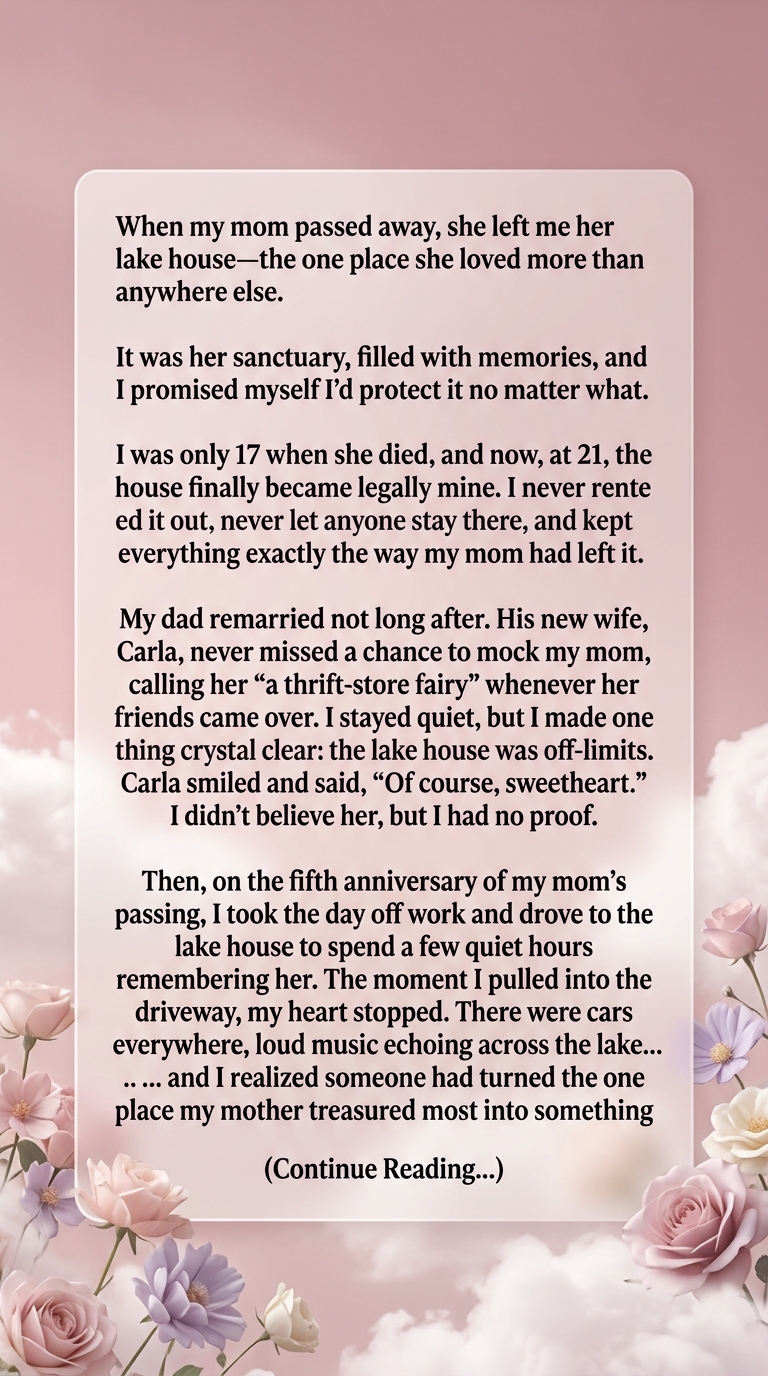
When my mom passed away, she left me her lake house—the one place she loved more than anywhere else.
It was her sanctuary, filled with memories, and I promised myself I’d protect it no matter what.
I was only 17 when she died, and now, at 21, the house finally became legally mine. I never rented it out, never let anyone stay there, and kept everything exactly the way my mom had left it.
My dad remarried not long after. His new wife, Carla, never missed a chance to mock my mom, calling her “a thrift-store fairy” whenever her friends came over.
I stayed quiet, but I made one thing crystal clear: the lake house was off-limits.
Carla smiled and said, “Of course, sweetheart.”
I didn’t believe her, but I had no proof.
Then, on the fifth anniversary of my mom’s passing, I took the day off work and drove to the lake house to spend a few quiet hours remembering her.
The moment I pulled into the driveway, my heart stopped.
There were cars everywhere.
Loud music echoed across the lake. People were laughing on the deck. Someone had dragged my mother’s antique chairs outside, and strangers were swimming off the dock.
A huge white tent stood beside the house.
For a few seconds, I couldn’t move.
Then I saw a banner hanging above the porch.
CARLA’S 40TH BIRTHDAY WEEKEND
My hands started shaking.
I walked toward the front door.
It was unlocked.
Inside, my mother’s carefully preserved living room had been completely transformed. Her photographs were stacked in a corner. Her handmade curtains were gone. Someone had moved her piano to make room for a bar.
And sitting at the kitchen table was Carla, wearing a champagne-colored dress and laughing with her friends.
She looked up.
Her smile disappeared.
“Oh,” she said. “You’re here.”
I stared at her.
“What is this?”
She rolled her eyes.
“It’s a party. Don’t be dramatic.”
“My house?”
Carla laughed nervously.
“Your dad said it was fine.”
My father appeared behind her, holding a drink.
I looked at him.
“Did you give her permission to use my property?”
He sighed.
“She’s family.”
“That wasn’t my question.”
He avoided my eyes.
Carla crossed her arms.
“Your mother isn’t here anymore. It’s just a house.”
That sentence hit me harder than anything else.
I looked around at the place where my mother had spent countless summers with me.
The little scratches on the kitchen table.
The faded blanket she’d always kept on the couch.
The framed photograph of us beside the lake.
This wasn’t just a house.
It was the last place in the world that still felt like her.
I quietly took out my phone and called the sheriff.
Carla’s face changed instantly.
“Wait. You’re calling the police?”
“I’m calling because strangers are occupying my private property without permission.”
My father stepped forward.
“Don’t do this.”
I looked him straight in the eyes.
“You knew I said no.”
He had nothing to say.
Within twenty minutes, the party began falling apart.
People started grabbing their bags.
The music stopped.
The laughter disappeared.
Carla was furious.
She screamed that I was selfish, ungrateful, and destroying the family.
I didn’t answer.
I simply stood on the porch and watched every single car leave.
When the last one disappeared down the road, the lake became quiet again.
My father stayed behind.
He looked exhausted.
“I thought you’d eventually let the house become a family place.”
I shook my head.
“You didn’t ask because you knew I’d say no.”
He stared at the floor.
Then he said something I never expected.
“Your mother would have hated seeing us fight.”
I swallowed the lump in my throat.
“No. She would have hated seeing you let someone erase her.”
He looked at me for a long moment.
Then he quietly left.
I spent the next three hours cleaning.
I put my mother’s chairs back where they belonged.
I rehung her photographs.
I folded her blanket over the couch.
And when I finally finished, I sat alone on the dock as the sun disappeared behind the lake.
That’s when I noticed something carved into the underside of the wooden railing.
I had never seen it before.
It was my mother’s handwriting.
“If you’re reading this, you’re old enough to understand that some things are worth protecting.”
My eyes filled with tears.
Underneath that sentence was another:
“Never let anyone make you feel guilty for protecting what I left you.”
I sat there crying until the stars appeared.
The next morning, I called a lawyer.
I changed the locks.
I installed cameras.
And I made one final decision.
I wouldn’t sell the lake house.
I wouldn’t rent it.
And I wouldn’t let anyone turn it into a battlefield.
Instead, I turned it into what my mother always dreamed it could be.
A place where people could come home.
Every summer, I invited children from families who couldn’t afford vacations to spend a week at the lake.
No luxury.
No parties.
No strangers taking photographs for social media.
Just fishing, swimming, campfires, books, and quiet mornings.
Years later, I found myself standing on the same dock, watching a little girl laugh as she tried to catch her first fish.
She turned toward me and shouted, “Can we come back next summer?”
I smiled.
“Of course.”
For the first time, I understood why my mother had loved that place so much.
It wasn’t the house.
It wasn’t the lake.
It was the feeling of giving someone a place where they could breathe, feel safe, and make memories.
That night, I sat beneath the old porch light and looked at my mother’s photograph.
“I kept my promise, Mom,” I whispered.
And somehow, with the lake water moving gently against the shore, I felt like she already knew.