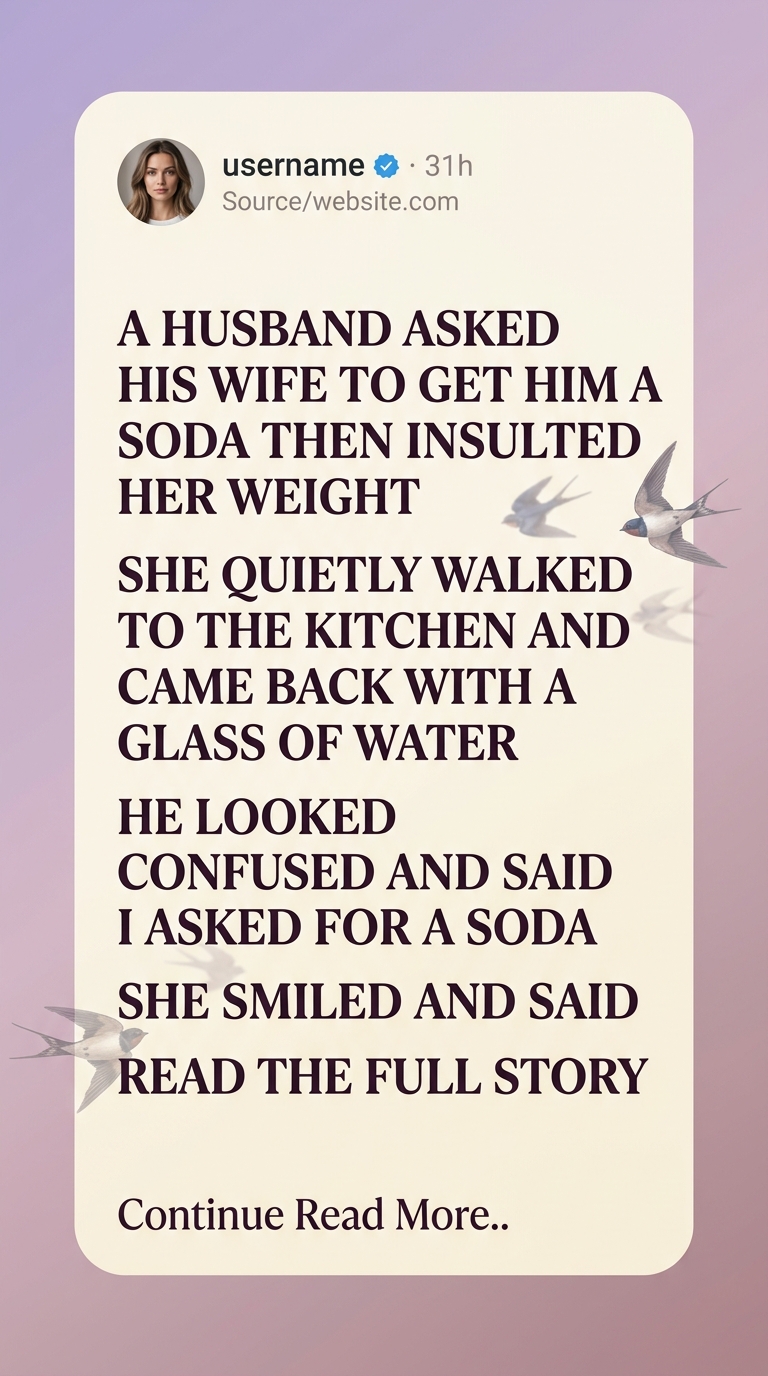
My husband asked me to get him a soda.
“Bring me a soda,” he called from the couch.
I was standing in the kitchen cleaning up after dinner.
“Sure,” I answered.
Then he added, without even looking up from his phone:
“And don’t take forever. You know how you get after eating all that food.”
I stopped.
I turned around.
He finally looked at me and laughed.
“What?”
“Nothing,” I said.
He smirked.
“You know I’m joking.”
I nodded.
“Of course.”
I walked into the kitchen.
I opened the refrigerator.
There were several cans of soda inside.
I reached toward one.
Then I stopped.
Instead, I grabbed a glass.
I filled it with cold water.
Then I walked back into the living room.
I handed it to him.
He stared at the glass.
“I asked for a soda.”
“I know.”
“Then why did you bring me water?”
I smiled.
“Because I realized something.”
He frowned.
“What?”
I sat down across from him.
“For years, you’ve been asking me for things.”
Coffee.
Dinner.
Clean shirts.
Favors.
Help with your work.
Rides.
Money.
And every time I gave you what you wanted, you found a way to make me feel like I wasn’t enough.”
He looked annoyed.
“Where is this coming from?”
I continued.
“You asked for a soda tonight and insulted my weight in the same sentence.”
He rolled his eyes.
“Oh, come on. It was a joke.”
“No.”
I shook my head.
“It wasn’t.”
He put the glass down.
“So what? You’re going to make a big deal over one comment?”
I looked at him.
“One comment doesn’t hurt.”
He stared at me.
“A pattern does.”
The room became quiet.
For years, I had accepted little insults.
At first, they were jokes.
Then they became habits.
“You look tired.”
“That dress makes you look bigger.”
“You should probably skip dessert.”
“Are you really going to eat that?”
He always laughed afterward.
And I always pretended I wasn’t hurt.
But something had changed inside me.
I wasn’t angry anymore.
I was tired.
I looked at him and said:
“You know what I realized while I was standing in that kitchen?”
He didn’t answer.
“I’ve spent years trying to become the woman you wouldn’t criticize.”
He looked away.
“I lost weight because you said I should.”
“I stopped buying clothes I liked because you said they made me look heavy.”
“I started apologizing for eating in front of you.”
“And every time I changed something, you found something else to criticize.”
He looked uncomfortable.
“That isn’t fair.”
I nodded.
“You’re right.”
He looked surprised.
“Because it wasn’t your job to decide whether I was enough.”
He was silent.
I pointed toward the glass.
“You know why I brought you water?”
He shook his head.
“Because tonight, I stopped serving the version of myself you kept demanding.”
His expression changed.
“What does that mean?”
“It means I’m done.”
He stared at me.
“Done with what?”
“Trying to earn kindness from you.”
He stood up.
“Are you seriously threatening to leave me over a soda?”
I shook my head.
“No.”
I looked him directly in the eyes.
“I’m leaving because of fifteen years of feeling small.”
He didn’t speak.
I continued.
“I’ve spent fifteen years making excuses for you because I loved you.”
I took a breath.
“But loving someone doesn’t mean you have to accept being diminished by them.”
He sat down slowly.
For the first time, he didn’t have a sarcastic answer.
Then he said something I never expected.
“I didn’t realize I made you feel that way.”
I looked at him.
“I told you.”
“When?”
“Not with words.”
I pointed toward the kitchen.
“Every time I stopped eating when you walked into the room.”
“Every time I changed clothes because you made a comment.”
“Every time I laughed at your jokes even though they hurt.”
“You just didn’t want to notice.”
He looked down.
The next morning, I packed a suitcase.
Not because I hated him.
Not because I wanted revenge.
Because I needed to hear my own thoughts without his voice in the background.
I stayed with my sister for several weeks.
During that time, something unexpected happened.
I started eating breakfast again.
I bought a dress I loved.
I went for walks because I enjoyed them, not because I was afraid of gaining weight.
I laughed more.
I slept better.
And slowly, I remembered the woman I had been before I started measuring myself through someone else’s eyes.
Three weeks later, my husband asked to meet.
We sat at a quiet café.
He looked different.
Not physically.
Something in his expression had changed.
“I’ve been thinking,” he said.
I waited.
“I thought teasing you was harmless.”
I didn’t respond.
“I was wrong.”
He looked at his hands.
“I’ve been cruel.”
That word mattered.
Because he finally said it himself.
He didn’t blame me.
He didn’t say I was too sensitive.
He didn’t call it a joke.
He called it what it was.
“I want you to come home,” he said.
I took a slow breath.
“I might.”
He looked up.
“But not because you promise to stop.”
“What then?”
“Because you understand why you need to change.”
He nodded.
“I do.”
“And if I come back, my body is not going to be a topic of conversation.”
He nodded again.
“You don’t get to make jokes about what I eat.”
Another nod.
“You don’t get to decide what I wear.”
“Yes.”
“And if you ever make me feel small again, I’m leaving.”
He looked at me.
“I understand.”
I didn’t immediately go home.
Trust wasn’t rebuilt in one conversation.
It took time.
But he started changing.
Not with grand gestures.
With small things.
He stopped commenting on my food.
He complimented me without adding criticism.
He listened when I spoke.
And most importantly, he learned that an apology wasn’t proven by words.
It was proven by behavior.
Months later, we were sitting at home watching television.
He looked at me.
“Do you want a soda?”
I laughed.
“No, thank you.”
He smiled.
“Water?”
I nodded.
He stood up.
“I’ll get it.”
I watched him walk toward the kitchen.
And I smiled.
Because the night I brought him a glass of water, I thought I was simply making a point.
I didn’t realize I was beginning to choose myself.
The soda was never the problem.
My weight was never the problem.
The problem was that I had spent years believing love required me to become smaller.
That night, I finally understood something.
The right person won’t ask you to shrink so they can feel bigger.
And sometimes, the most powerful thing you can say isn’t an argument.
It’s simply walking away from the version of yourself that accepted less than you deserved.