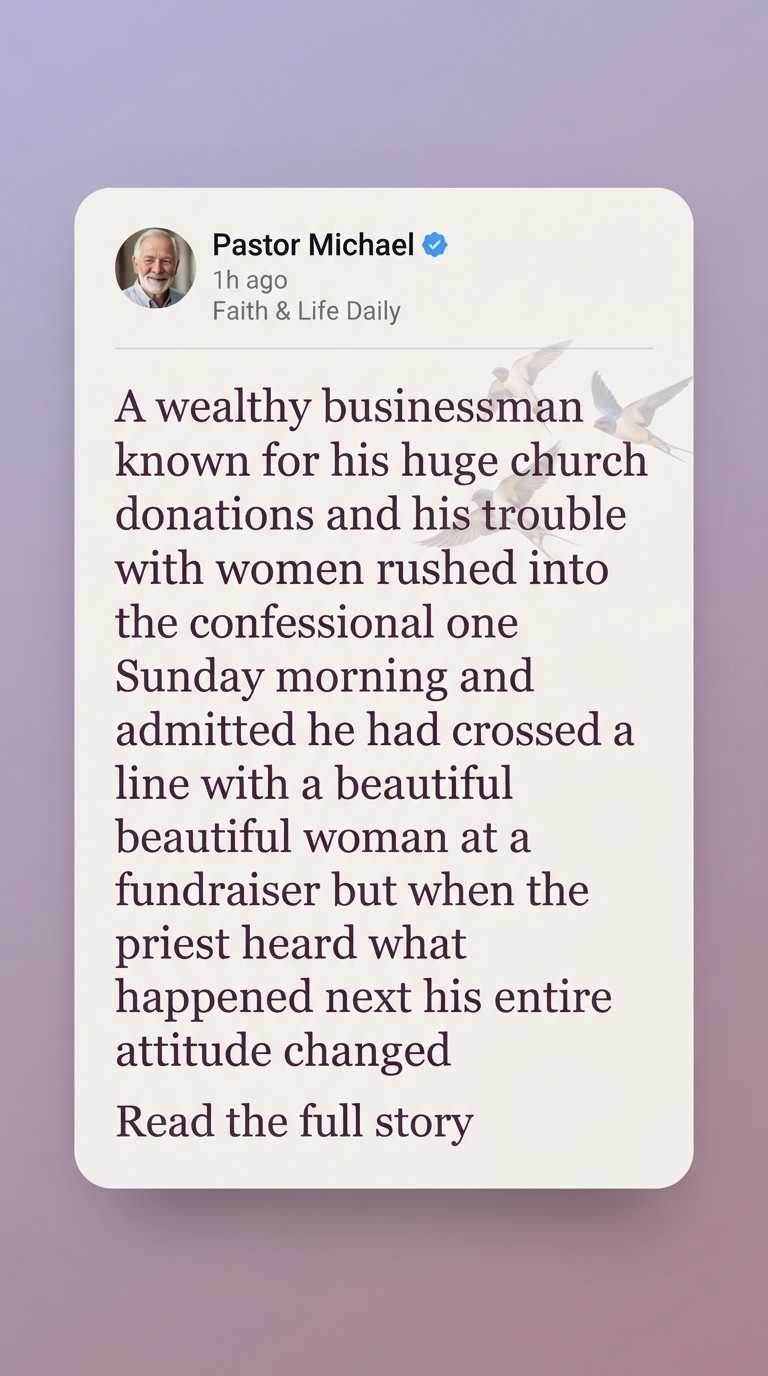
DID YOU KNOW?
Daniel Mercer was known throughout town as a wealthy businessman.
He donated generously to the church.
He sponsored charity events.
He paid for school supplies, helped families with medical bills, and quietly supported the local food pantry.
But there was another side of Daniel that people rarely discussed.
He had a reputation for being careless with women.
He had been married twice.
Both marriages had ended badly.
And despite his public generosity, some people wondered whether he was using charity to hide the parts of himself he didn’t want anyone to see.
One Sunday morning, Daniel walked into the church before the first service.
He didn’t greet anyone.
He didn’t stop to talk.
He went straight to the confessional.
Father Thomas was already inside.
“Forgive me, Father,” Daniel whispered.
Father Thomas recognized his voice.
“Tell me what is troubling you.”
Daniel took a long breath.
“I crossed a line.”
The priest waited.
“At a charity fundraiser last night, I met a woman.”
“What happened?”
“I was attracted to her.”
Father Thomas remained quiet.
Daniel continued.
“I said things I shouldn’t have said.”
“Did you touch her?”
Daniel hesitated.
“Yes.”
The priest’s voice became firm.
“Did she want you to?”
Daniel lowered his head.
“No.”
Father Thomas paused.
“Then you need to understand that what happened was not simply a mistake. You made another person’s boundaries secondary to your own desires.”
Daniel swallowed.
“I know.”
But then he continued.
“And that’s not the worst part.”
Father Thomas looked toward him.
“What happened next?”
Daniel’s voice began to shake.
“She recognized me.”
The priest frowned.
“Who was she?”
Daniel whispered her name.
Father Thomas suddenly went completely still.
For the first time, his calm expression changed.
“You’re certain?”
“Yes.”
“Tell me exactly what happened after she recognized you.”
Daniel closed his eyes.
“She told me something.”
“What?”
“She said she had spent years trying to forgive me.”
The priest leaned forward.
Daniel explained that the woman at the fundraiser wasn’t a stranger.
She was the daughter of one of the women Daniel had hurt years earlier.
Daniel had once been involved with her mother while he was married.
The affair had destroyed the woman’s family.
Her daughter had watched her mother struggle for years afterward.
Daniel had never known how deeply his actions had affected them.
Until that night.
“She looked at me and said, ‘You don’t remember me, do you?’”
Daniel’s voice cracked.
“She told me who she was.”
Father Thomas was silent.
Daniel continued.
“She said she came to the fundraiser because the charity was helping her family.”
He stopped.
“I realized I’d been giving money to organizations without ever asking who was actually receiving help.”
Father Thomas finally spoke.
“And what did you do?”
“I apologized.”
“Did she accept your apology?”
“No.”
Daniel nodded slowly.
“She told me I didn’t get to decide when she forgave me.”
The priest’s expression softened.
Daniel continued.
“She walked away.”
“And that’s why you came here?”
Daniel shook his head.
“No.”
He pulled something from his pocket.
It was a photograph.
He handed it to the priest.
The photograph showed Daniel many years earlier, standing beside his first wife and their young daughter.
Father Thomas looked at it.
“What is this?”
Daniel whispered,
“I found it last night.”
Behind the photograph was a handwritten note.
Father Thomas read it.
The note had been written by Daniel’s first wife shortly before she died.
It said:
I hope someday Daniel understands that money can repair a roof, but it can’t repair trust. I don’t want my daughter to grow up believing that generosity excuses betrayal.
Father Thomas looked up.
Daniel was crying.
“I never knew she wrote that.”
“When did you find it?”
“Last night.”
The priest looked at him carefully.
“And now you understand?”
Daniel nodded.
“For years, I thought giving money made me a good man.”
He wiped his eyes.
“But I wasn’t becoming a better man. I was just becoming a richer man who could afford to hide his mistakes.”
Father Thomas remained silent.
Daniel continued.
“I thought people respected me because of what I gave.”
He looked down.
“But maybe they respected what I gave, not who I was.”
The priest’s entire attitude changed.
Until that moment, he had been speaking to Daniel as a man who had committed another serious mistake.
Now he saw someone confronting a much deeper truth.
“Daniel,” Father Thomas said quietly, “charity is not payment for forgiveness.”
“I know.”
“And confession is not a way to make guilt disappear.”
“I know.”
“Then what are you prepared to do?”
Daniel looked up.
“Change.”
“That’s a beginning. What will you change?”
Daniel thought for a moment.
“Everything I can.”
He sold several luxury properties.
He created a scholarship fund in his late wife’s name.
But this time, he didn’t put his name on it.
He also stepped away from several public charity events.
People were confused.
Some assumed he had lost money.
Others thought he was angry.
He didn’t explain.
Instead, he began doing something completely different.
He started meeting privately with people he had hurt.
Not to ask them for forgiveness.
Not to defend himself.
Simply to listen.
Some refused to see him.
Some told him exactly what they thought.
Some accepted his apology.
Others didn’t.
And Daniel learned to accept that too.
Months later, he returned to the church.
Father Thomas saw him sitting quietly in the back.
After the service, Daniel approached him.
“I wanted to thank you.”
“For what?”
“For not making me feel better.”
The priest smiled.
“You didn’t need to feel better.”
“I needed to become better.”
Father Thomas nodded.
“That is the difference.”
Daniel looked toward the church doors.
“I used to think my greatest responsibility was giving away what I had.”
“And now?”
“Using what I have without expecting it to erase who I am.”
Years passed.
Daniel never became perfect.
But people noticed something different.
He stopped seeking attention.
He stopped using generosity to build his reputation.
He became more careful with people’s boundaries.
And when someone thanked him for a donation, he would often say:
“Thank the people who needed it. I just happened to have the resources.”
One Sunday, Father Thomas watched Daniel quietly carry boxes of food into the church basement.
No cameras.
No reporters.
No applause.
Just work.
The priest smiled.
Because the man who once entered the confessional wanting forgiveness had finally understood something deeper.
True change wasn’t about saying the right words.
It was about living differently when nobody was watching.
And sometimes the most important confession isn’t the one spoken behind a curtain.
It’s the one a person finally makes to himself.