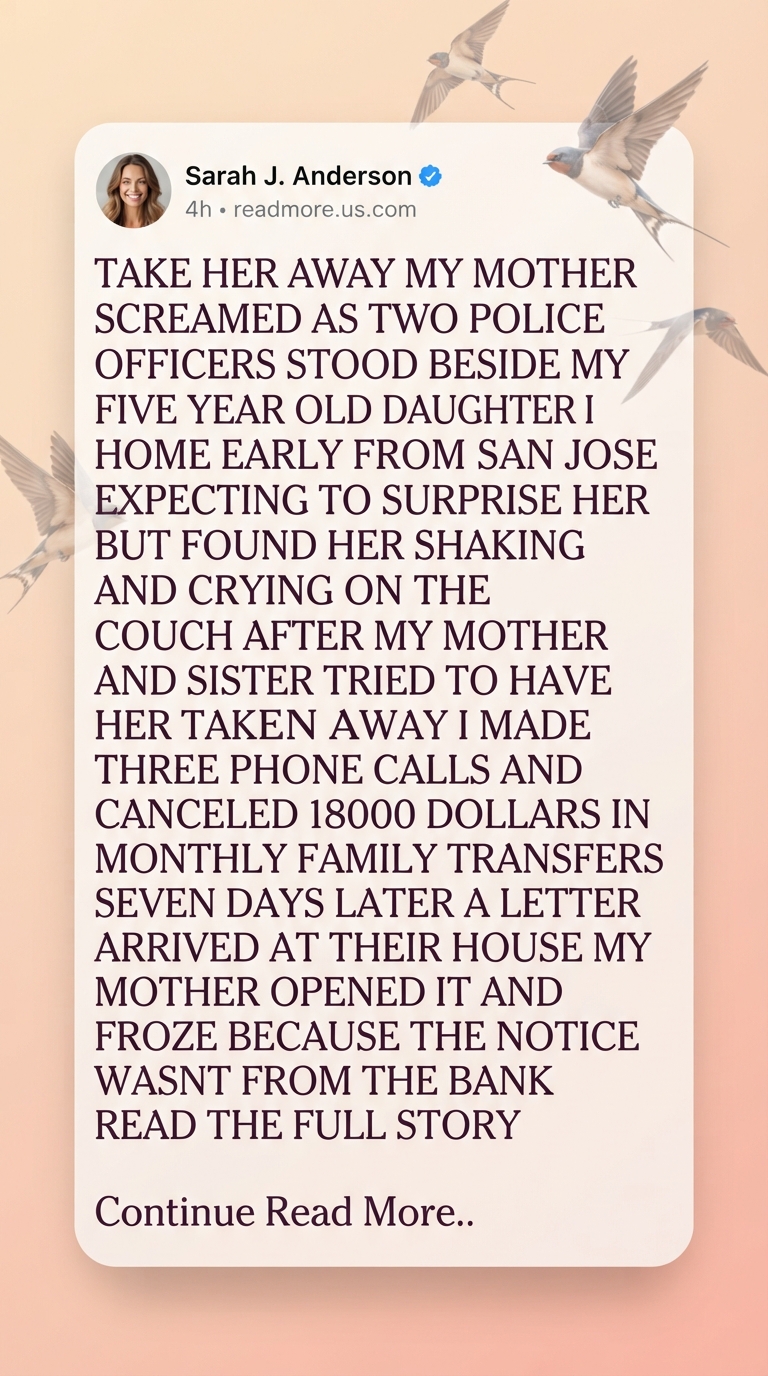
“TAKE HER AWAY!” my mother screamed as two police officers stood beside my five-year-old daughter.
I had come home early from San Jose expecting to surprise everyone.
Instead, I found my little girl shaking and crying on the couch.
My mother stood across the room with her arms folded.
My sister was holding a folder filled with papers.
And two police officers were asking my daughter simple questions.
“Where is your mother?”
She pointed at the door.
“She’s coming home.”
I dropped my suitcase.
“What is happening?”
My mother turned toward me.
“You need to stay out of this.”
I stared at her.
“Out of what?”
My sister stepped forward.
“We were trying to protect her.”
“From what?”
Neither answered.
I rushed to my daughter and knelt beside her.
She grabbed my neck and held on tightly.
“Mommy, Grandma said you weren’t coming back.”
My heart sank.
I looked at my mother.
“Why would you tell her that?”
My mother raised her voice.
“Because someone has to think about this child’s future!”
One of the officers quietly asked me to step into the hallway so we could talk.
That’s when I learned what my mother and sister had been trying to do.
They had contacted authorities and claimed I was rarely home, that my daughter was being left in an unstable environment, and that they believed she should be placed with family temporarily.
My daughter was five.
I had been traveling for work.
But I had never abandoned her.
She lived with me.
Her school was five minutes from our house.
Her doctor, dentist, teachers, and daycare all knew me.
I had never been arrested.
There had never been a complaint against me.
And most importantly, my daughter was safe.
The officers explained that they were there because a report had been made.
After speaking with me, checking the situation, and talking to my daughter appropriately, they made it clear there was no reason to remove her from my care that night.
When they finally left, my daughter wouldn’t let go of my hand.
I looked at my mother.
“You tried to take my daughter away from me.”
She shook her head.
“We were doing what was best.”
“No,” I said quietly. “You were doing what you wanted.”
My sister interrupted.
“You’re never here. You’re always working. Mom has practically raised her.”
That sentence made something click inside me.
For years, I had been sending money to my family.
Not a little.
Every month, I transferred thousands of dollars.
I paid my mother’s mortgage.
My sister’s rent.
Utilities.
Groceries.
Insurance.
School expenses.
Medical bills.
Family vacations.
Even repairs I had never been asked about.
I had convinced myself that helping them was what family did.
But standing there while my daughter trembled beside me, I suddenly realized something.
They hadn’t just accepted my help.
They had built their lives around it.
And now they believed my money gave them a right to control my daughter.
That night, after putting my little girl to bed, I opened my laptop.
I looked at the automatic transfers.
$4,500.
$3,200.
$2,700.
$1,900.
The total came to nearly $18,000 every month.
I stared at the number for a long time.
Then I made three phone calls.
The first canceled the automatic transfer to my mother.
The second canceled the transfer supporting my sister.
The third removed several recurring payments I had been making for family expenses.
I didn’t send an angry message.
I didn’t threaten anyone.
I simply stopped financing a life where I was treated like an outsider.
Seven days later, a letter arrived at my mother’s house.
She opened it at the kitchen table.
Then she froze.
Because the notice wasn’t from the bank.
It was from the attorney who had handled my family’s financial arrangements.
My mother called me immediately.
“What did you do?”
“I didn’t do anything to you.”
“You canceled everything!”
“I stopped paying for everything.”
There was silence.
Then she said something I will never forget.
“You can’t just abandon your family.”
I closed my eyes.
“I didn’t abandon my family, Mom. I stopped being responsible for everyone else’s choices.”
She started crying.
Then she told me what the letter said.
Years earlier, when my father died, there had been a small family trust.
I had been named the primary beneficiary.
My mother had received permission to live in the family home as long as certain expenses were maintained.
But the attorney’s letter explained something my mother had never told me.
The house was not entirely hers.
A portion of it belonged to me.
And because I had been paying the mortgage, taxes, insurance, and major repairs for years, the attorney had been keeping records.
The letter wasn’t demanding that my mother leave.
It was notifying her that the financial arrangement had to be formally reviewed.
My mother was terrified.
But I wasn’t interested in taking the house.
I told her that.
“I don’t want your home.”
“Then what do you want?”
I looked over at my daughter, who was coloring at the kitchen table.
“I want you to understand that being her grandmother doesn’t make you her parent.”
My mother was silent.
“And being my sister doesn’t give you the right to decide whether my child belongs with me.”
Another silence.
Then she whispered, “We thought you were choosing work over your daughter.”
“I work so she has a good life.”
“But you’re gone so much.”
“I travel because I provide for her. And I always come home.”
My mother began crying.
Then she finally admitted the truth.
My sister had convinced her that if they could get temporary custody of my daughter, I would have no choice but to move back home permanently.
My mother had believed it was the only way to keep the family together.
But they had never asked me.
They had made a plan without me.
And they had used my daughter to force my hand.
That was the part I couldn’t forgive easily.
Weeks passed.
I changed every financial arrangement.
I hired a family attorney.
I made sure my daughter’s school and medical records were updated.
And I created boundaries that should have existed years earlier.
My mother didn’t see my daughter alone for a while.
My sister didn’t see her at all.
Eventually, my mother asked if she could come over.
I almost said no.
But my daughter heard the conversation.
She looked at me and asked, “Is Grandma coming?”
I asked her how she felt.
She thought for a moment.
“I miss her.”
So I agreed.
My mother arrived carrying a small box.
She sat across from me and opened it.
Inside was a photograph of my father holding me when I was five.
On the back, he had written:
“Make sure she always knows she is loved.”
My mother wiped her eyes.
“I forgot what that meant,” she whispered.
“You didn’t forget,” I said. “You just started believing that loving someone meant controlling them.”
She nodded.
“I was wrong.”
It took time.
There were still difficult conversations.
There were apologies that had to be followed by changed behavior.
But slowly, my mother began rebuilding trust.
She never asked me for money again.
My sister eventually apologized too.
Not because she wanted the transfers back.
But because she finally understood what she had done to my daughter.
Months later, my little girl was sitting on the porch with my mother, showing her a drawing.
My mother looked at me.
“I thought I was protecting her.”
I answered honestly.
“Next time, protect her by listening to her.”
My daughter ran over and hugged my waist.
Then she looked at my mother.
“Grandma can come tomorrow too.”
My mother smiled through her tears.
“I’d like that.”
I watched them walk back inside together.
I had spent years believing that being a good daughter meant paying every bill, solving every problem, and keeping everyone comfortable.
That day taught me something different.
Sometimes loving your family means helping them.
And sometimes loving your child means finally saying no.
I didn’t take my mother’s home.
I didn’t take revenge.
I simply took back my responsibility for the one person who had always needed me most.
My daughter.
And for the first time in years, my family understood that my love was never measured by how much money I sent.
It was measured by the fact that I came home.