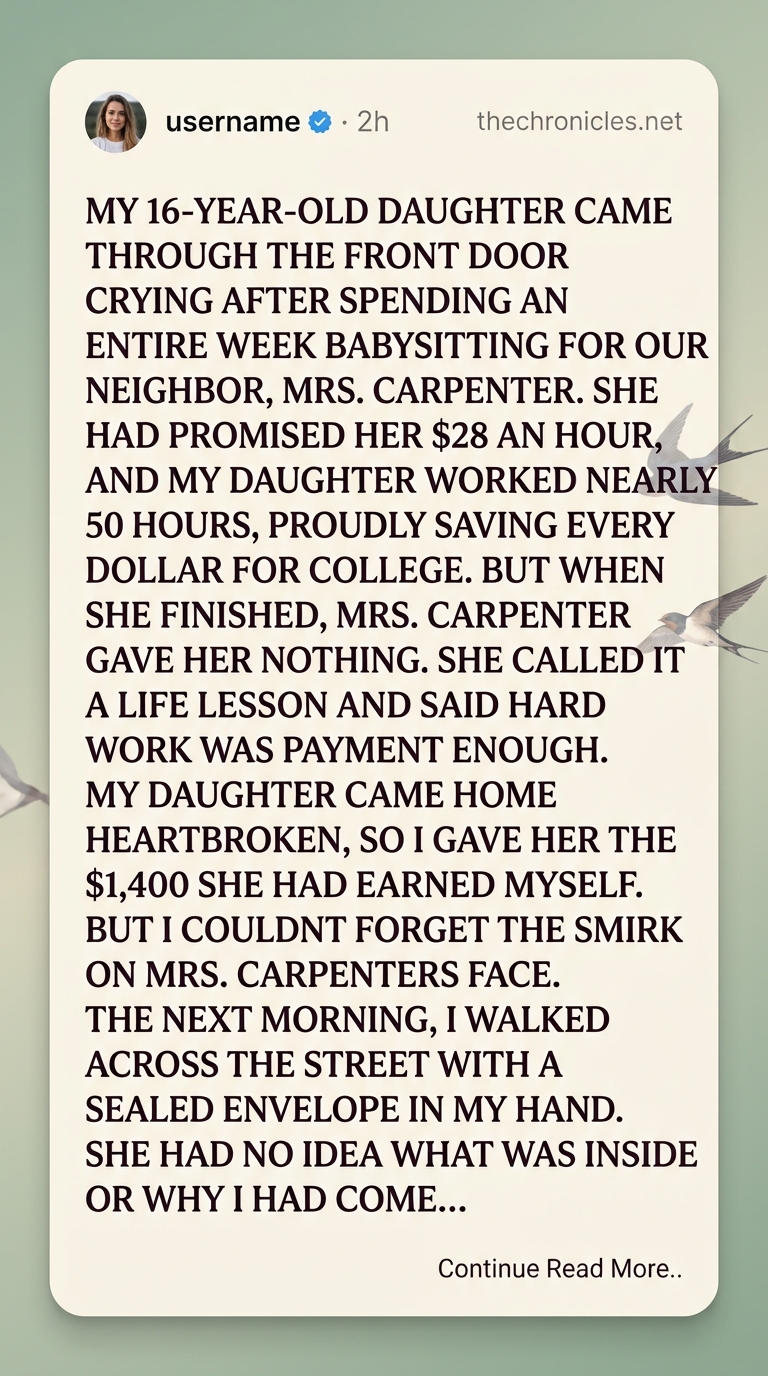
My sixteen-year-old daughter came through the front door crying.
I had never seen her so upset about money.
She wasn’t the kind of teenager who expected things to be handed to her.
She had been working hard all week.
Our neighbor, Mrs. Carpenter, had asked her to babysit while she attended a series of appointments and errands.
Before my daughter started, Mrs. Carpenter had promised her $28 an hour.
My daughter was thrilled.
She calculated everything carefully.
Nearly fifty hours.
Almost $1,400.
She told me she was going to put every dollar into her college savings.
For an entire week, she came home exhausted but proud.
“I made it through another day,” she would say.
Then Friday afternoon arrived.
She came home carrying her backpack.
But there was no smile.
I immediately knew something was wrong.
“What happened?”
She wiped her eyes.
“Mrs. Carpenter didn’t pay me.”
I thought I’d misunderstood.
“What?”
“She said she was teaching me a lesson.”
My daughter explained.
Mrs. Carpenter had told her that hard work was its own reward.
“She said if I only worked for money, then I didn’t understand responsibility.”
I stared at my daughter.
“But she promised you $28 an hour.”
“I know.”
“Did she change the agreement?”
“No.”
My daughter pulled out her phone.
There were messages between them confirming the rate and the hours.
She had worked almost fifty hours.
She had done everything she was asked to do.
And Mrs. Carpenter had given her nothing.
Then my daughter said something that broke my heart.
“Maybe I was stupid for believing her.”
“No,” I said immediately.
“You weren’t stupid.”
I sat beside her.
“You kept your word. She didn’t.”
My daughter started crying again.
I told her to calculate exactly what she had earned.
$1,400.
Then I transferred the money to her savings account.
She stared at her phone.
“Mom, you don’t have to do that.”
“Yes, I do.”
“But it’s a lot.”
“It was your money.”
She hugged me.
But I couldn’t stop thinking about Mrs. Carpenter.
Especially the smirk my daughter described.
The next morning, I walked across the street carrying a sealed envelope.
Mrs. Carpenter opened the door.
She smiled.
“Good morning.”
“Good morning.”
Her eyes went to the envelope.
“What’s that?”
“I think you know.”
She sighed.
“If this is about your daughter—”
“It is.”
She crossed her arms.
“I was trying to teach her responsibility.”
I held out the envelope.
“No.”
She looked surprised.
“No?”
“You were trying to teach her that someone’s promise doesn’t have to mean anything.”
Her expression hardened.
“I don’t owe a teenager $1,400.”
I looked at her.
“You absolutely do.”
She laughed.
“Your daughter agreed to help me.”
“She agreed to work for $28 an hour.”
“I changed my mind.”
“After she completed the work.”
Mrs. Carpenter shrugged.
“That’s life.”
I nodded.
“You’re right.”
Then I handed her the envelope.
She looked at it suspiciously.
“What is this?”
“Something you should have seen before you made your decision.”
She opened it.
Inside was a copy of the written agreement between her and my daughter.
At the bottom was another document.
A letter from the local community center.
My daughter had volunteered there for years.
The center was preparing a scholarship recommendation for her.
The letter described her reliability, responsibility, and commitment.
Mrs. Carpenter read it silently.
Then she looked at me.
“What does this have to do with me?”
“Everything.”
I explained that my daughter hadn’t needed a lesson about hard work.
She needed adults to keep their promises.
Mrs. Carpenter became defensive.
“I was trying to help her grow up.”
“Then you should have taught her something useful.”
“What?”
“That when you make an agreement, you honor it.”
She looked down at the papers.
I continued.
“I paid my daughter what you promised because I wasn’t going to let her believe her work had no value.”
Mrs. Carpenter was quiet.
Then she asked,
“Why bring this to me?”
“Because I don’t want my daughter to learn the wrong lesson from this.”
She looked confused.
“I want her to learn that people can make mistakes. But I also want her to learn that she doesn’t have to accept unfair treatment just because an adult tells her to.”
I turned to leave.
Then she stopped me.
“Wait.”
I looked back.
She disappeared into the house.
A few minutes later, she returned holding an envelope.
She handed it to me.
Inside was a check for $1,400.
“I was wrong,” she said quietly.
I didn’t smile.
I simply nodded.
“Thank you.”
Then she added something I didn’t expect.
“I owe your daughter an apology.”
That afternoon, she came to our house.
She apologized directly to my daughter.
Not because I forced her.
Because she finally understood.
My daughter accepted the apology.
But she didn’t go back to babysitting for her.
And I was proud of that too.
A few months later, my daughter received a small scholarship from the community center.
She put the $1,400 into her college account.
When I asked her what she learned from the experience, she smiled.
“I learned that hard work matters.”
I nodded.
“And?”
She thought for a moment.
“That my work has value. And I should expect people to keep their promises.”
I smiled.
That was the real lesson.
Not that adults are always right.
Not that money is everything.
But that being young doesn’t mean your time is worthless.
And sometimes, standing up for someone isn’t about fighting their battles for them.
It’s about making sure they know they deserve to be treated fairly.