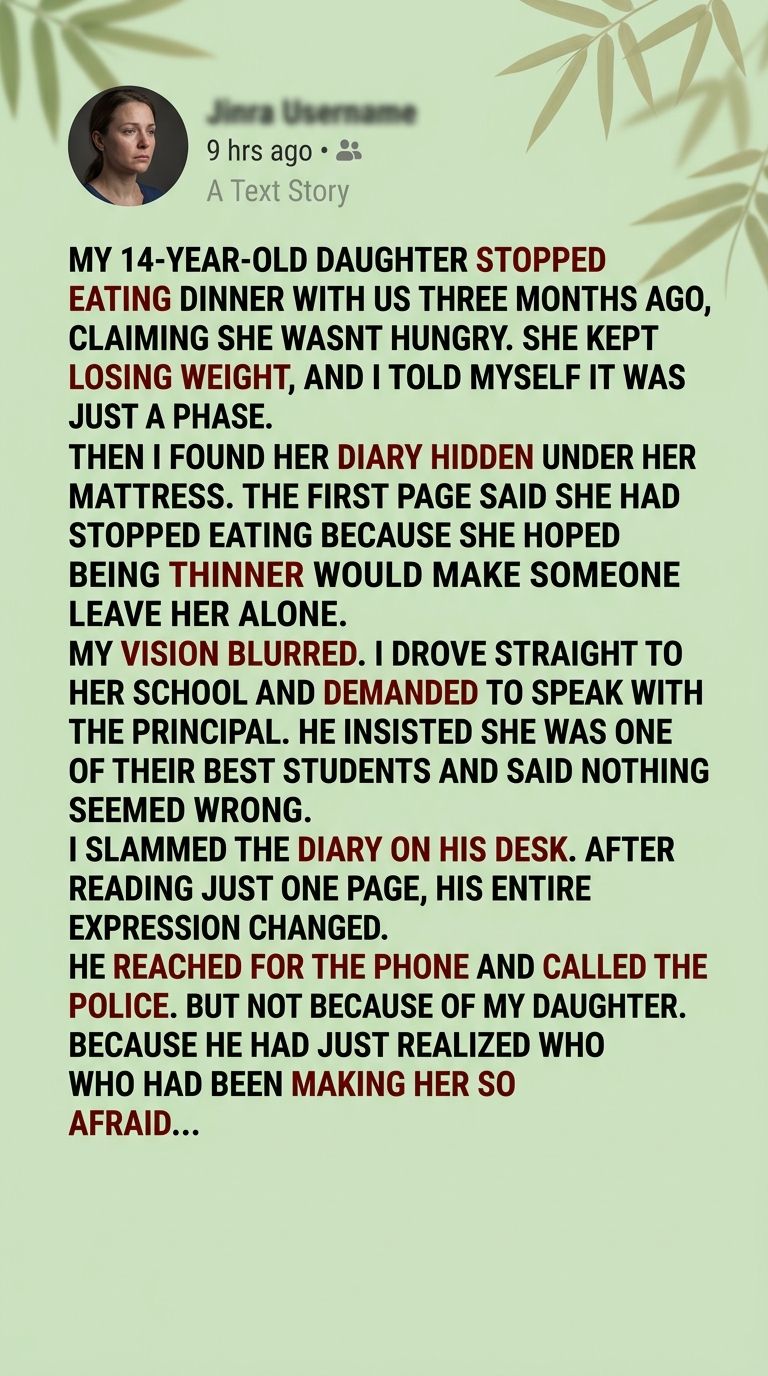
Three months ago, my 14-year-old daughter, Emma, stopped eating dinner with us.
At first, she said she wasn’t hungry.
I believed her.
Teenagers go through phases, I told myself.
Maybe she was eating more at school.
Maybe she was simply stressed.
But then I noticed her clothes becoming loose.
She looked tired all the time.
I asked her if something was wrong.
“I’m fine, Mom.”
She always gave me the same answer.
I’m fine.
Then one evening, while changing her sheets, I found her diary hidden beneath the mattress.
I knew I shouldn’t read it.
But the first page was addressed to no one.
And one sentence made my hands shake.
“I stopped eating because I thought being thinner might finally make him leave me alone.”
I sat on the edge of her bed.
My vision blurred.
Who was “he”?
And what had he been doing?
I turned another page.
Emma wrote that someone had been making comments about her at school.
Then she wrote that the person had started waiting for her after class.
She had become afraid to walk home alone.
She hadn’t told me because she believed it would make things worse.
The final sentence on the page said:
“Nobody will believe me because everyone thinks he’s such a good person.”
I grabbed my keys.
I drove straight to the school.
I demanded to speak with the principal.
When he walked into the office, I placed the diary on his desk.
“My daughter is afraid of someone at this school.”
He looked concerned.
“Who?”
“I don’t know yet.”
He picked up the diary.
“I can assure you Emma is one of our best students. Her teachers haven’t reported any problems.”
I pushed the diary toward him.
“Then read this.”
He read the first page.
His expression changed immediately.
He turned another page.
Then another.
Suddenly, he reached for the phone.
“I need to contact the police.”
My heart stopped.
“Why?”
He looked at me.
“Because I recognize the person she’s describing.”
“Who?”
He hesitated.
Then he said a name.
It was a school employee.
Someone I had seen many times.
Someone parents trusted.
Someone who had been working at the school for years.
I couldn’t believe it.
The principal explained that another student had recently reported uncomfortable behavior involving the same person.
The school had started reviewing security footage and records.
But there hadn’t been enough evidence to understand what was happening.
Until Emma’s diary.
Her writing gave investigators information that connected several incidents.
The police arrived at the school.
They spoke with Emma privately and carefully.
Most importantly, they made sure she understood that she wasn’t in trouble.
When I finally saw my daughter, she ran into my arms.
“I’m sorry, Mom.”
I held her tightly.
“You have nothing to apologize for.”
“I should have told you.”
“You were scared.”
She nodded against my shoulder.
“I thought you would be angry with me.”
I pulled back and looked into her eyes.
“I could never be angry with you for being afraid.”
The investigation continued.
Other students were interviewed, and additional evidence was reviewed.
The employee was removed from contact with students while the authorities investigated the allegations.
The school also brought in counselors to support the students affected.
But there was another problem.
Emma had spent months believing that changing herself was the only way to make someone stop bothering her.
We immediately got professional help for her.
Her doctor explained that her health had already been affected and that she needed proper care and support.
There were no quick fixes.
Some days were difficult.
Some days she didn’t want to talk.
But slowly, she began to understand something important.
The problem had never been her appearance.
It had never been her fault.
She didn’t need to change herself to deserve safety.
Months later, Emma returned to school.
Her life wasn’t magically perfect.
But she was speaking again.
Laughing again.
Eating meals with us again.
One evening, she sat at the dinner table and looked at me.
“I thought if I disappeared a little, he would stop noticing me.”
I reached across the table and held her hand.
“You never needed to disappear.”
She smiled sadly.
“I know that now.”
Then she added,
“Next time something scares me, I’ll tell you.”
I smiled.
“And I’ll listen.”
That was the promise we made to each other.
Because sometimes children don’t stay silent because they don’t trust their parents.
Sometimes they stay silent because they are terrified that speaking up will make everything worse.
And sometimes the most important thing a parent can say is very simple:
“You don’t have to face this alone.”