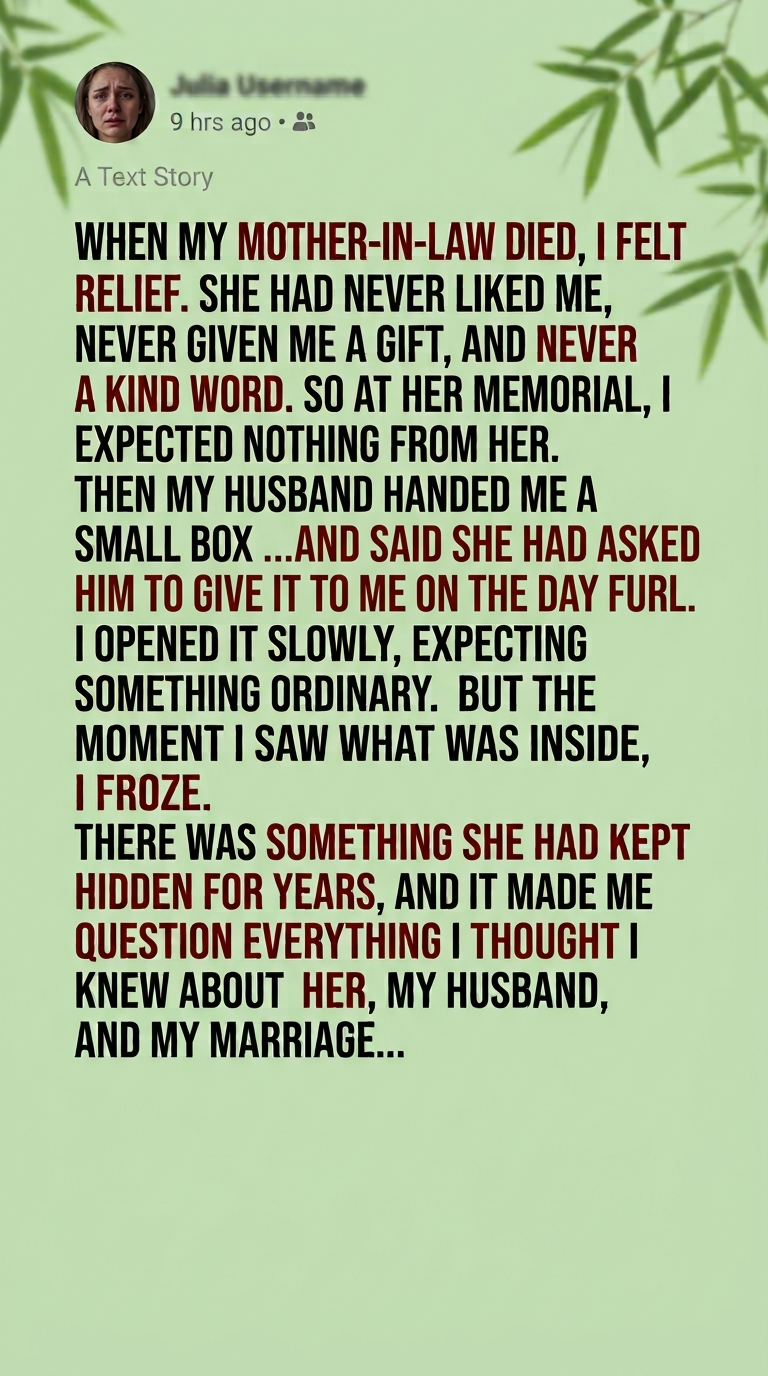
When my mother-in-law died, I felt relief.
She had never liked me.
Not once had she given me a gift.
Not once had she said a kind word about me.
For years, I tried to win her approval.
I cooked for her.
I remembered her birthday.
I visited when she was sick.
But nothing ever changed.
So when she died, I was sad for my husband, but a small part of me felt relieved.
At her memorial, I expected nothing from her.
Then, after the service, my husband quietly approached me.
He was holding a small wooden box.
“She asked me to give you this on the day of her funeral,” he said.
I stared at him.
“Me?”
He nodded.
My hands trembled as I opened the box.
Inside was an old photograph.
It showed my husband as a little boy, standing beside a woman I had never seen before.
Underneath the photograph was a handwritten letter.
I unfolded it slowly.
The first sentence made my heart stop.
“You deserve to know why I treated you the way I did.”
I looked at my husband.
He looked just as confused as I was.
I kept reading.
She explained that years before I met my husband, she had discovered something about his childhood that she had kept secret from everyone.
The woman in the photograph was his biological mother.
My mother-in-law wasn’t his biological mother at all.
She had raised him after his biological mother disappeared from his life when he was very young.
But there was more.
The letter revealed that his biological mother had never abandoned him.
She had spent years trying to find him.
My mother-in-law had prevented them from reconnecting.
She had been afraid that if the truth came out, her son would leave her.
Then came the part that made me question everything.
She had known who I was long before my husband introduced me.
She had investigated my family.
She knew that my grandmother had once been close friends with his biological mother.
She believed I had married her son because I knew about his past.
That was why she had treated me so coldly.
She thought I was hiding something.
But she admitted she had been wrong.
The final pages were different.
Her handwriting became shaky.
She wrote:
“I spent so many years protecting my secret that I forgot I was hurting the people I loved.”
Then she explained that she had recently contacted the woman from the photograph.
She was alive.
And she wanted to meet her son.
My husband read the letter beside me.
Neither of us spoke for several minutes.
Then he whispered,
“She knew this whole time?”
I nodded.
But the letter wasn’t finished.
At the very end was a second envelope.
Inside was a photograph of a woman standing outside a small house.
On the back was an address.
My husband stared at it for a long time.
Then he started crying.
Not because his mother had died.
But because, for the first time in his life, he knew where his real mother was.
A few weeks later, we went together to that address.
An elderly woman opened the door.
The moment she saw my husband, she covered her mouth.
They stared at each other.
Neither knew what to say.
Then she whispered his childhood nickname.
He immediately broke down.
They hugged like two people trying to recover decades they had lost.
I stood a few steps away, crying too.
For years, I had believed my mother-in-law hated me.
But the truth was more complicated.
She had been afraid.
Afraid of losing her son.
Afraid of being exposed.
Afraid that the family she had built would disappear.
Her actions had caused years of pain, and I couldn’t pretend they hadn’t.
But the small box she left behind gave us something she had never been able to give while alive.
The truth.
And because of that truth, my husband finally found the mother he had spent his entire life unknowingly missing.
That day, I realized something.
Sometimes people hide painful secrets because they believe they’re protecting the people they love.
But secrets don’t disappear.
They simply wait for someone brave enough to open the box.