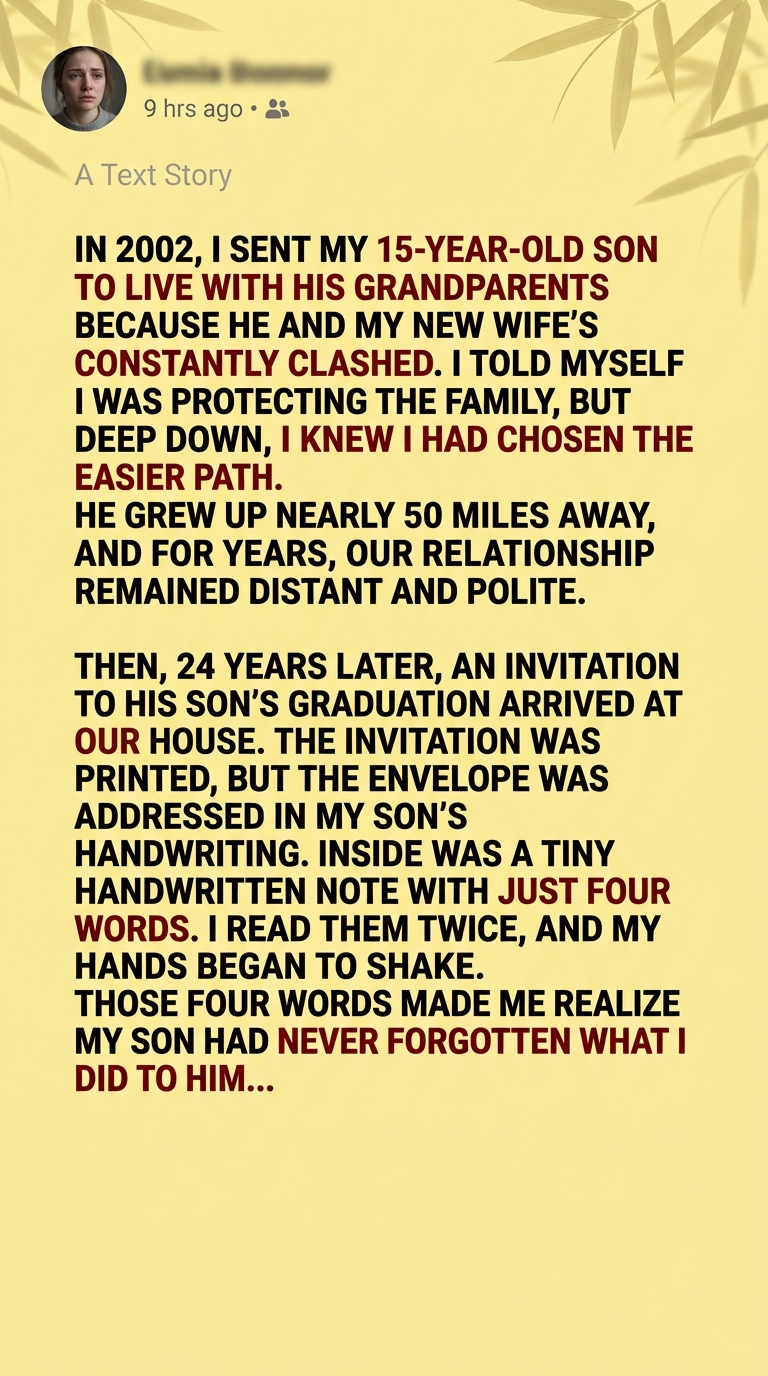
In 2002, I sent my 15-year-old son to live with his grandparents.
He and my new wife constantly clashed.
Every dinner ended in an argument.
Every weekend felt like a battle.
My wife said he was disrespectful.
My son said she wanted me to choose between them.
And eventually, I did.
I told myself I was protecting the family.
I told myself that sending him to his grandparents was temporary.
I promised him I would visit every weekend.
But deep down, I knew the truth.
I had chosen the easier path.
He moved nearly 50 miles away.
At first, I called often.
Then the calls became less frequent.
Eventually, our conversations became short and polite.
“Are you doing okay?”
“Yeah, Dad.”
“How’s school?”
“Fine.”
Years passed.
He graduated.
Got married.
Built a life of his own.
I attended important moments when I was invited, but there was always a distance between us that neither of us talked about.
I kept telling myself that he had moved on.
Then, 24 years later, an invitation arrived at our house.
My son’s son was graduating.
The invitation was beautifully printed.
But the envelope was addressed in my son’s handwriting.
I stared at it for several seconds before opening it.
Inside was the formal graduation invitation.
And beneath it was a tiny handwritten note.
Only four words.
I read them once.
Then again.
My hands began to shake.
The note said:
“I remember, Dad. Always.”
I sat down.
For 24 years, I had convinced myself that my son had forgiven me.
Maybe he had.
But forgiveness wasn’t the same as forgetting.
And suddenly, I remembered everything.
The night he packed his suitcase.
The way he stood at the front door waiting for me to change my mind.
The way he asked,
“Dad, are you really sending me away?”
And the terrible thing was that I had answered yes.
I had chosen peace in my marriage over being there for my child.
I had spent years telling myself he had needed to leave.
But he had needed his father.
I couldn’t attend the graduation without facing what I had done.
So I wrote him a letter.
I didn’t make excuses.
I didn’t blame my wife.
I didn’t say I had been doing what I thought was best.
I simply wrote:
“I was your father, and you needed me. I chose the easier path. I’m sorry.”
I put the letter in the envelope and drove to his house.
When he opened the door, we stood there silently.
He looked older than the boy I remembered.
But his eyes were the same.
“I got your note,” I said.
He nodded.
“I didn’t write it to punish you.”
“I know.”
“I just wanted you to understand that I never forgot.”
My voice broke.
“I know.”
He looked down for a moment.
Then he said something I’ll never forget.
“I didn’t need you to be perfect, Dad. I just needed you to choose me once.”
I couldn’t hold back my tears.
“I should have.”
He stepped forward.
For the first time in decades, he hugged me.
It wasn’t a magical moment that erased 24 years.
It didn’t erase the pain.
It didn’t undo the nights he spent wondering why his father had sent him away.
But it was a beginning.
At his son’s graduation, I sat quietly in the audience.
When his grandson’s name was called, my son looked back at me.
Our eyes met.
He smiled.
And I realized something I should have understood in 2002:
Children may eventually forgive the choices their parents made.
But that doesn’t mean those choices stop mattering.
Sometimes four simple words can force you to face an entire lifetime.
“I remember, Dad. Always.”