“IT’S MINE.”
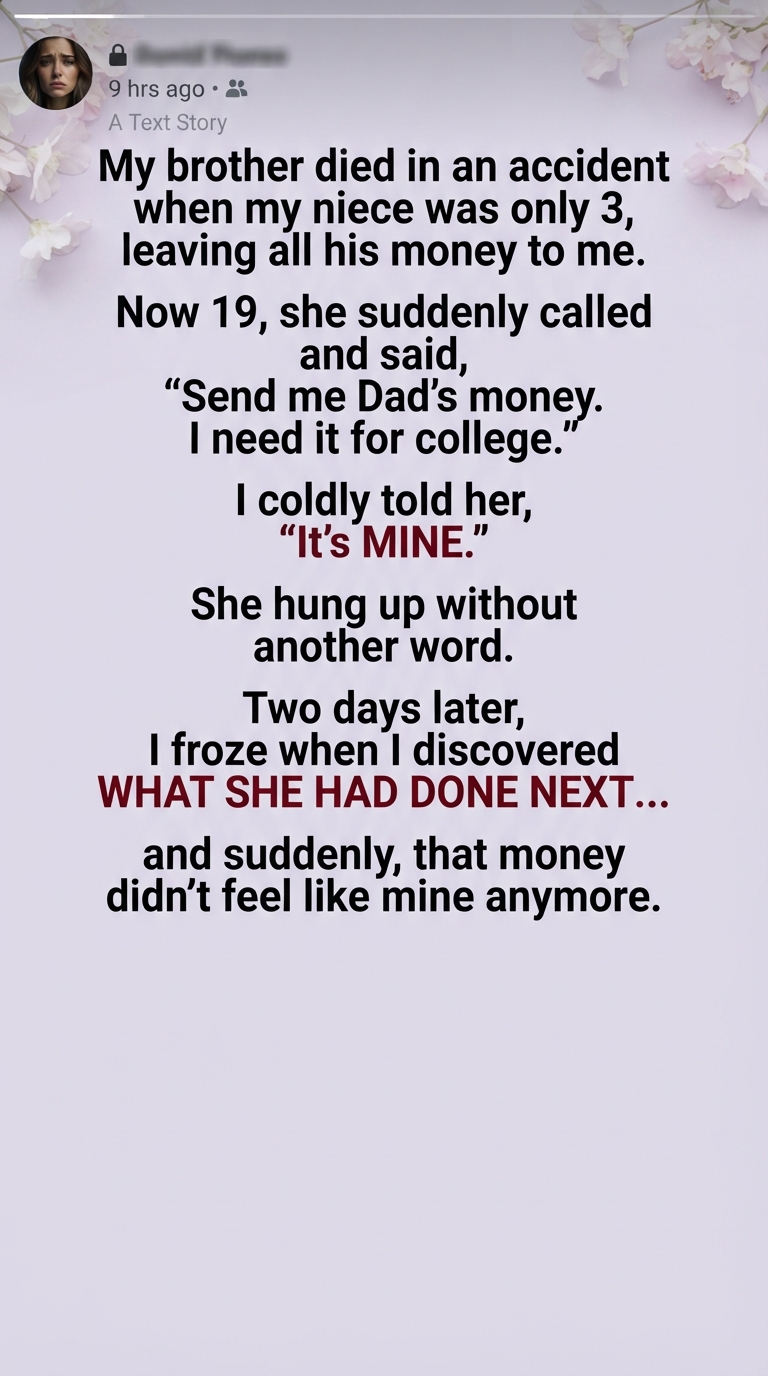
My brother died in an accident when my niece was only three years old.
Her name was Lily.
I was twenty-seven at the time.
My brother, Daniel, was thirty.
He left behind a three-year-old daughter, a small house, several investments, and more money than anyone in our family expected.
There was one sentence in his will that changed everything:
“I leave my estate to my sister, Claire.”
Not to Lily.
To me.
The lawyer explained why.
Daniel had written that he trusted me to protect Lily until she was old enough to understand what her father had left behind.
At the time, I thought I understood what he meant.
I promised him I would take care of her.
And I did.
For sixteen years, I paid for Lily’s clothes, school supplies, medical bills, vacations, and everything else she needed.
I never told her exactly how much money her father had left.
I wanted her to grow up believing that she was loved—not that she was wealthy.
Then, on her nineteenth birthday, she called me.
“Can we talk?”
“Of course.”
There was a long pause.
Then she said:
“I need Dad’s money.”
My stomach tightened.
“What money?”
“You know what money.”
I didn’t answer.
She continued.
“I’ve been accepted into a good college. Tuition is expensive. Dad left money for me.”
I leaned back in my chair.
“Lily, your father’s will left the estate to me.”
“I know.”
“Then you know it’s mine.”
Silence.
“I thought you were keeping it for me.”
I felt irritated.
“Your father trusted me with it.”
“He trusted you to take care of me.”
“I did.”
“I know.”
Her voice sounded strangely calm.
“Then please send me what I need for college.”
I looked at the bank statement on my desk.
The account had grown considerably over the years.
I could have paid her tuition without even noticing the difference.
But something inside me hardened.
“You’re an adult now.”
“I know.”
“So maybe it’s time you learn something about money.”
“What?”
“Nothing is automatically yours just because you think it should be.”
There was silence.
Then Lily whispered:
“Is that really what you believe?”
“Yes.”
Her voice became smaller.
“Okay.”
I expected her to argue.
She didn’t.
She simply said:
“Goodbye, Aunt Claire.”
The call ended.
Two days later, I received an email.
The subject line was:
I KEPT MY PROMISE TO DAD.
I opened it.
There was a single attachment.
A scanned copy of my brother’s original will.
I had seen it before.
But underneath it was another document.
A handwritten letter.
My brother’s handwriting.
I recognized it immediately.
The letter was addressed to Lily.
“My little girl,
If you’re reading this, you’re old enough to understand something.
The money I leave behind isn’t meant to make you rich. It’s meant to give you choices.
Your aunt Claire will control everything until you’re old enough to manage it yourself.
But I need her to remember one thing.
The money isn’t really hers.
It’s yours.
I am trusting her because I believe she will protect you, not because I want her to own what belongs to you.
If one day you need it for your education, your future, or a chance I can no longer give you, I hope she remembers why I chose her.
I didn’t choose my sister because she needed the money.
I chose her because my daughter needed someone she could trust.”
I stopped reading.
My hands were shaking.
Then I noticed something else.
The letter was dated three weeks before Daniel died.
And beneath his signature was a sentence I had never seen.
“Claire, please don’t make Lily ask twice.”
I closed my eyes.
Suddenly, I remembered that night sixteen years ago.
The lawyer had read the will.
Everyone had been crying.
I had barely listened.
I remembered him saying:
“Daniel has appointed Claire as trustee of the assets.”
Trustee.
Not owner.
I had spent sixteen years telling myself that the money was mine.
Maybe because the bank account was in my name.
Maybe because I had paid the bills.
Maybe because somewhere along the way, I had confused being responsible for something with owning it.
But there was something else in Lily’s email.
A second attachment.
It was a college acceptance letter.
She had been accepted into the exact university her father had attended.
And at the bottom was a handwritten note from Lily:
“I didn’t ask you because I wanted Dad’s money.”
“I asked because I wanted to finish what he started.”
Then came the sentence that broke me.
“But after you said it was yours, I decided I didn’t want anything from you.”
I immediately called her.
No answer.
I called again.
Nothing.
I drove to her apartment.
She wasn’t there.
Her roommate told me she had left that morning.
“Where did she go?”
“I don’t know.”
My heart sank.
Then the roommate handed me an envelope.
“For you.”
Inside was a key.
And a note.
“Storage unit 214.”
I drove there.
The storage unit contained boxes of my brother’s belongings.
Old photographs.
A baseball glove.
His university jacket.
A broken watch.
And one small wooden box.
Inside was a video camera.
I found an old television in the storage room and somehow managed to play the recording.
My brother appeared on the screen.
He looked younger than I remembered.
He smiled.
Then he said:
“Claire, if you’re watching this, something has probably gone wrong.”
I laughed through my tears.
“That sounds like you.”
He continued.
“I know you’re going to think I’m giving you a fortune.”
He paused.
“I’m not.”
He explained that the money had been placed into a trust for Lily.
He had chosen me as trustee because he believed I would protect her from people who might try to take advantage of her.
Then he said:
“But there’s something else.”
He leaned closer to the camera.
“If Lily ever asks you for the money, don’t make her prove she deserves it.”
My throat tightened.
“She’s my daughter.”
He smiled.
“And if she’s brave enough to ask you for help, that’s probably because she’s already learned to stand on her own.”
The video ended.
I sat in that storage unit for a long time.
Then I cried.
Not because I had lost the money.
Because I realized I had nearly lost Lily.
I called the lawyer the next morning.
“I need to know the truth about Daniel’s estate.”
He was quiet.
Then he said:
“Claire, I’ve been waiting for you to ask.”
He explained everything.
The estate had never legally belonged to me.
I was the trustee.
The money belonged to Lily.
I had been responsible for managing it until she reached the age specified in the trust.
And now she was nineteen.
She had every right to request it for her education.
I asked him how much was left.
He told me.
It was more than enough to pay for four years of college.
I asked him where Lily was.
“She came to see me yesterday.”
My heart jumped.
“What did she say?”
“She asked for copies of the trust documents.”
“Why?”
“She wanted to make sure you couldn’t be blamed for anything.”
I stared at the floor.
“What?”
“She told me she didn’t want to destroy you.”
I couldn’t speak.
“She said you raised her.”
The lawyer paused.
“She said, ‘My aunt made mistakes, but she’s still my family.’”
That was when I completely broke down.
I found Lily three days later.
She was sitting on a bench outside the university campus.
I walked toward her.
She saw me.
Neither of us spoke.
Finally, I sat beside her.
“I was wrong.”
She looked down.
“I know.”
“I should have told you everything years ago.”
“Yes.”
“I thought I was protecting you.”
“I know.”
“I became so focused on being responsible for your father’s money that I forgot why he trusted me with it.”
She looked at me.
“Why?”
I swallowed.
“Because he wanted you to have a future.”
She didn’t say anything.
I handed her a folder.
Inside were the trust documents.
The financial statements.
And a letter.
“I transferred control to you.”
She stared at me.
“You did?”
“Yes.”
“But what about you?”
I smiled through tears.
“I don’t need your father’s money.”
She looked confused.
“Then why did you say it was yours?”
I took a long breath.
“Because somewhere along the way, I became afraid that if I stopped being needed, I wouldn’t know who I was.”
Her eyes filled with tears.
Then she hugged me.
I held her tightly.
For the first time in years, she felt like the three-year-old girl I had once carried through a crowded funeral.
But she wasn’t that little girl anymore.
She was nineteen.
She was grown.
And she didn’t need me to own her future.
She only needed me to help protect it.
Months later, Lily started college.
She used the money for tuition, books, and housing.
She also created a scholarship in her father’s name.
The first recipient was a student whose family couldn’t afford university.
When I asked her why she had done it, she smiled.
“Dad gave me a future.”
She looked at the scholarship paperwork.
“I thought I should give someone else one too.”
I cried that day.
Not because of the money.
Because I finally understood what my brother had meant.
He never left me a fortune.
He left me a responsibility.
And Lily wasn’t the child who needed protecting anymore.
She was the person I had been protecting all along.
The money had never been mine.
Neither was the future it bought.
It belonged to the little girl my brother had trusted me to love.
And I realized something painful but beautiful:
Sometimes the greatest test of love isn’t whether you’re willing to give someone everything.
It’s whether you’re willing to admit that it was never yours to keep.