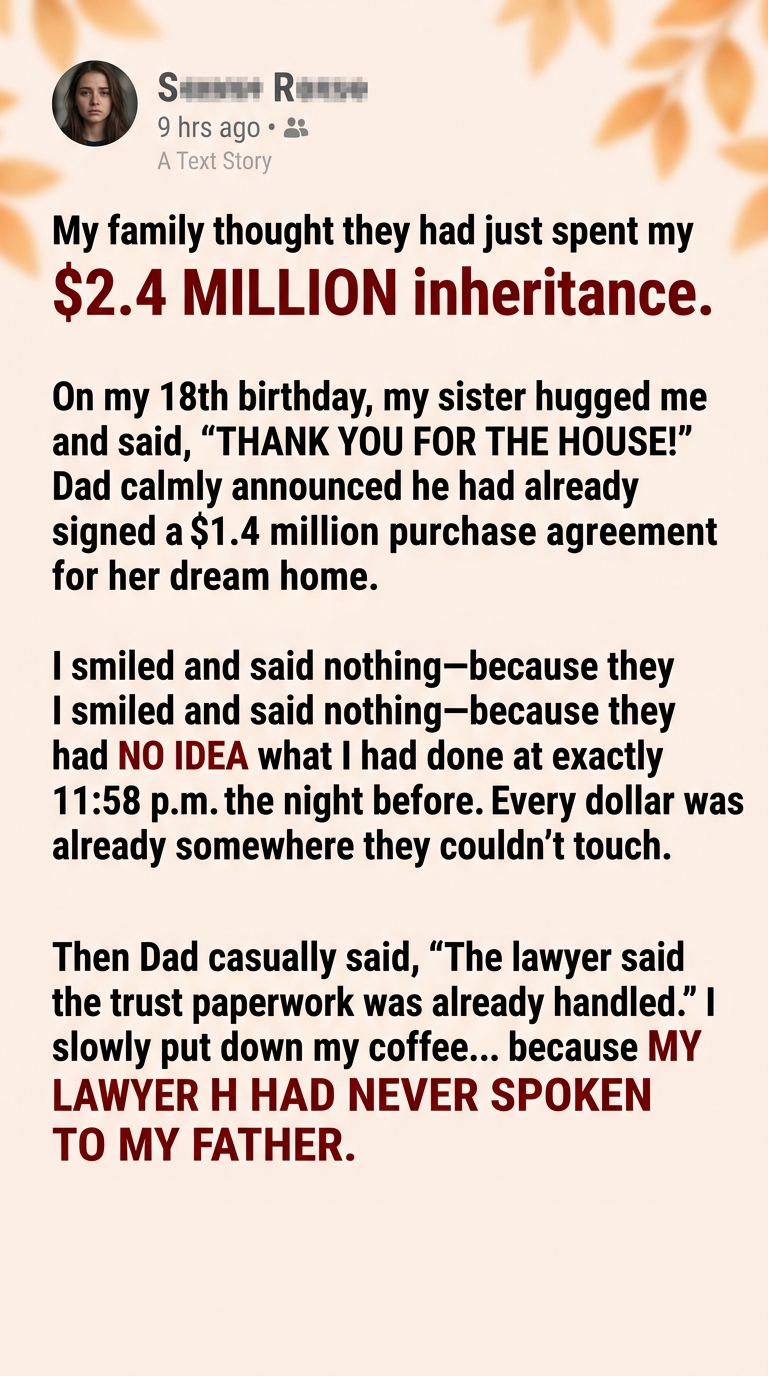
My family thought they had just spent my $2.4 million inheritance.
They were wrong.
It started on my eighteenth birthday.
My sister, Madison, wrapped her arms around me before I had even finished opening my presents.
“Thank you for the house!” she whispered excitedly.
I blinked.
“What house?”
She pulled away and laughed.
“Dad told me not to say anything until breakfast.”
Across the table, my father smiled like everything was perfectly normal.
Then he calmly slid a folder toward Madison.
“The purchase agreement is already signed,” he said. “The $1.4 million house should close next month.”
I stared at him.
My inheritance.
My $2.4 million inheritance.
The money my grandmother had left specifically for me.
The money my family had spent years telling me would “eventually help everyone.”
I slowly put down my fork.
Nobody noticed that I wasn’t surprised.
Because at exactly 11:58 p.m. the night before, I had already made my move.
Every dollar was somewhere they couldn’t touch.
Dad continued talking.
“Your sister has always dreamed of that neighborhood. Your grandmother would have wanted the family to enjoy the money.”
I almost laughed.
Grandmother had spent her final year warning me about exactly this.
She had once squeezed my hand and said, “When people tell you something belongs to the family, ask whose name is actually on the paper.”
I hadn’t understood then.
I understood now.
My father reached for his coffee.
“The lawyer said the trust paperwork was already handled.”
I froze.
My lawyer had never spoken to my father.
Not once.
I looked directly at him.
“Which lawyer?”
Dad hesitated.
“Your grandmother’s attorney.”
“No,” I said quietly. “He isn’t my attorney.”
The room became silent.
Madison looked from Dad to me.
“What does that mean?”
I opened my phone.
“I think we should all call him.”
Dad’s expression changed.
“There’s no need.”
“Yes,” I said. “There is.”
I pressed the number.
A few minutes later, my grandmother’s estate attorney answered.
I put the phone on speaker.
“Mr. Harris,” I said, “my father says you authorized the trust paperwork and the purchase of a $1.4 million house.”
There was a long pause.
Then he said:
“I authorized no such thing.”
Madison’s smile disappeared.
Dad stood up.
“You’re misunderstanding—”
Mr. Harris interrupted.
“Your father has no authority over that trust.”
I watched my father’s face go pale.
The attorney continued.
“The inheritance was transferred into a protected trust controlled by you when you turned eighteen. No family member can withdraw from it, borrow against it, or purchase property with it without your written authorization.”
Madison stared at Dad.
“But the house…”
Mr. Harris sighed.
“I don’t know anything about a house.”
That was when everything fell apart.
Dad had apparently assumed that because I was young, I wouldn’t understand the documents.
He had spent months telling relatives that the inheritance was “family money.”
He had even negotiated with the seller of Madison’s dream house.
But there was one problem.
He had negotiated using money that wasn’t his.
The next morning, the seller’s attorney called him.
The purchase agreement was canceled.
Madison was furious.
Not at Dad.
At me.
“You could have helped us!”
I looked at her.
“You mean I could have bought you a $1.4 million house?”
“You’re my sister!”
“And that’s exactly why I didn’t.”
She stared at me.
I continued.
“Because being family doesn’t mean I owe you everything I own.”
For the first time, nobody had an answer.
Dad eventually admitted what he had done.
He had assumed I would follow whatever plan he made.
He had already calculated how the inheritance could be divided between family expenses, Madison’s house, and a business investment.
He had even created a spreadsheet.
My name was listed at the top.
But under “beneficiary,” he had written:
FAMILY.
I took a photograph of it.
Then I handed it to my attorney.
There were consequences.
The false paperwork was investigated.
The purchase agreement was formally withdrawn.
Dad had to explain to several people why he had represented himself as having authority over money he didn’t control.
Madison eventually apologized.
Not immediately.
It took months.
But one evening, she showed up at my apartment without Dad.
“I was angry because I thought you took something away from me,” she said.
I waited.
She looked down.
“Then I realized you never took anything from me.”
She was right.
I had simply refused to let someone else take something from me.
I kept my inheritance.
But I didn’t spend it recklessly.
I hired an independent financial adviser.
I bought a modest home of my own.
I invested most of the money.
And I created a separate account for emergencies and future plans.
Months later, I received a letter from my grandmother’s attorney.
Inside was a handwritten note my grandmother had left for me years earlier.
It said:
“Money doesn’t reveal people’s character. It reveals what they were willing to hide when they thought you couldn’t protect yourself.”
I read that sentence twice.
Then I smiled.
Because my family had spent my eighteenth birthday planning what they were going to do with my future.
They never realized that at 11:58 p.m. the night before…
I had already taken control of it.
And this time, nobody else was going to decide where my life went.