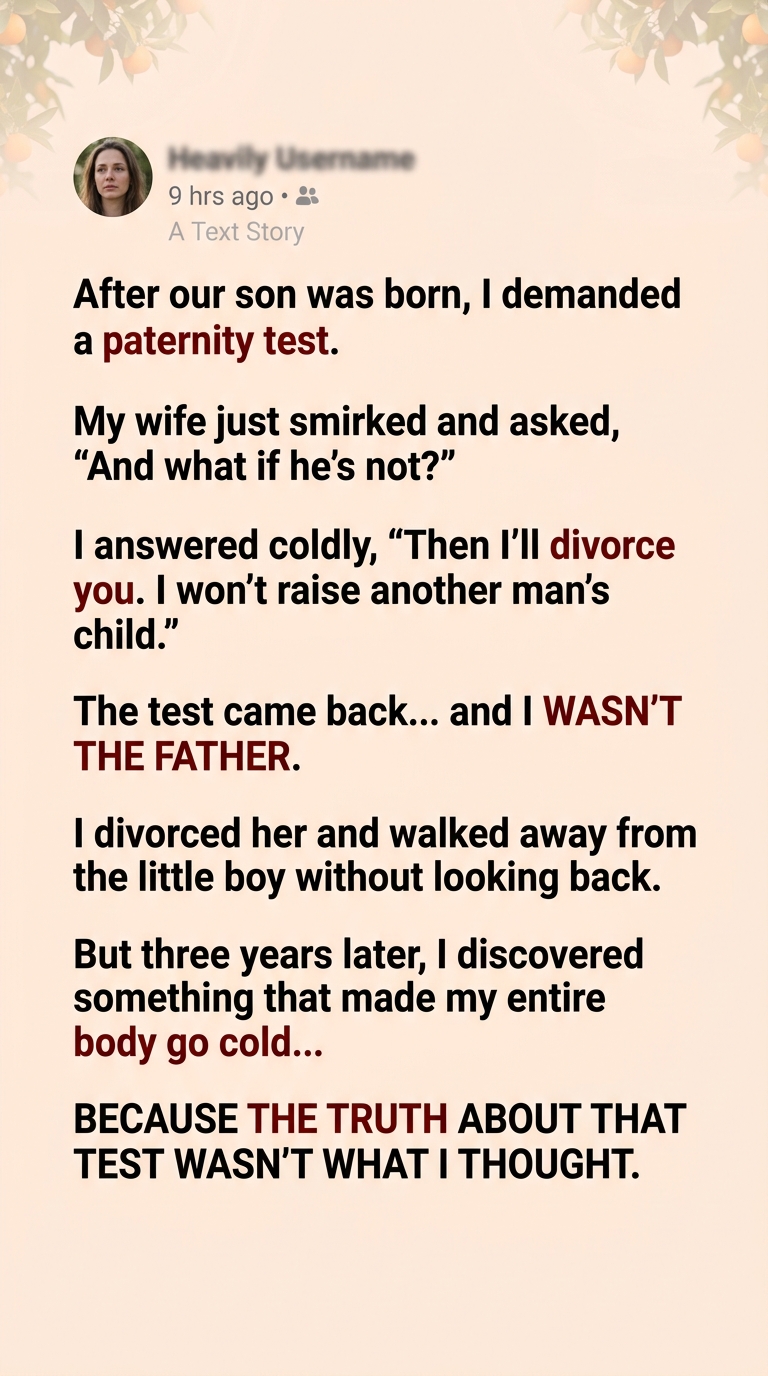
After our son was born, I demanded a paternity test.
I thought I was prepared for any answer.
I wasn’t.
My wife, Laura, sat across from me at the kitchen table.
She looked strangely calm.
“And what if he’s not?” she asked.
I stared at her.
“Then I’ll divorce you.”
I paused.
“I won’t raise another man’s child.”
She looked at me for several seconds.
Then she smiled sadly.
“Okay.”
Three weeks later, the results arrived.
I opened the envelope alone.
I read the first line.
Probability of paternity: 0%.
My hands went cold.
I looked at Laura.
She didn’t cry.
She didn’t argue.
She simply said:
“I told you.”
I filed for divorce.
Within months, the marriage was over.
And I walked away from the little boy.
His name was Noah.
I never held him again.
I told myself I was protecting my dignity.
I told myself I had been betrayed.
I told myself he wasn’t my responsibility.
Then, three years later, I received a phone call.
It was from the testing laboratory.
“Mr. Carter?”
“Yes?”
“We need to discuss an old paternity report.”
My stomach tightened.
“What about it?”
“There may have been an issue with the sample identification.”
I sat down.
“What issue?”
The woman hesitated.
“The report you received may not have been generated from the sample you believe it was.”
I couldn’t breathe.
“What does that mean?”
“We discovered an administrative error during an internal review.”
My mind immediately went back to that kitchen table.
Laura’s expression.
Her strange calmness.
The words:
“And what if he’s not?”
I asked for the file.
The laboratory couldn’t disclose everything over the phone, but they told me there had been a mix-up involving two samples processed on the same day.
I contacted Laura.
She refused to speak to me at first.
Eventually, she agreed to meet.
We sat across from each other at a café.
She looked older.
Tired.
I didn’t know how to begin.
Finally, I asked:
“Was Noah my son?”
Laura looked at me.
“Yes.”
My entire body went cold.
“You knew?”
She nodded.
“I always knew.”
“Then why did you let me leave?”
Her eyes filled with tears.
“Because you had already decided.”
I shook my head.
“That test said I wasn’t his father.”
“I know.”
“And you didn’t fight it.”
“I tried.”
She looked down.
“You wouldn’t listen.”
I remembered.
The arguments.
The accusations.
My certainty.
I had been so convinced that betrayal was the only explanation that I never considered another possibility.
Laura explained what had happened.
The original sample collected from Noah had been mislabeled during processing.
The laboratory had issued the wrong report.
She had requested a retest.
But by then, I had already filed for divorce.
I had already told everyone I wasn’t the father.
I had already walked away.
And she had been too hurt—and too angry—to keep fighting someone who had already made up his mind.
I asked the question I had been afraid to ask.
“Where is he?”
She gave me an address.
I drove there that evening.
A little boy opened the door.
He was three years old.
He looked at me.
I looked at him.
And something inside me broke.
He had my eyes.
The same crooked smile.
The same little habit of rubbing his thumb against his palm when he was nervous.
I whispered:
“Noah?”
He nodded.
Then he looked at his mother.
“Who is he?”
Laura didn’t answer.
I knelt down.
“My name is Daniel.”
He stared at me.
“Are you my daddy?”
I couldn’t speak.
My eyes filled with tears.
“Yes.”
The word barely came out.
“Yes, I am.”
He smiled.
And then he did something I will never forget.
He held out a toy car.
“Do you want to play?”
I laughed through my tears.
“Yes.”
We sat on the floor.
For the first time in three years, I was exactly where I should have been.
Later that night, Laura and I talked.
There was no magical reconciliation.
No instant forgiveness.
Too much had happened.
But we agreed on one thing.
Noah deserved the truth.
And he deserved a father who would be there.
I couldn’t get back the three years I had lost.
I couldn’t erase the day I walked away.
But I could stop losing tomorrow.
I began visiting every weekend.
Then twice a week.
Then whenever Noah asked.
The first Father’s Day after the truth came out, he handed me a handmade card.
There was a crooked drawing of three people holding hands.
Underneath it, in large uneven letters, he had written:
“MY DAD.”
I stared at it for a long time.
Then I hugged him.
“I missed so much.”
He looked at me.
“You’re here now.”
That sentence stayed with me.
Because he was right.
I couldn’t change the past.
But I could change what happened next.
Years later, Noah asked me why I hadn’t been there when he was little.
I told him the truth.
“I believed something that wasn’t true.”
He thought about it.
Then asked:
“Are you going to leave again?”
I looked him directly in the eyes.
“Never.”
He nodded.
“Okay.”
Then he went back to playing.
I sat there watching him.
For years, I had believed the paternity test proved I wasn’t his father.
The truth was much harder.
The test hadn’t only been wrong.
I had been wrong.
And the biggest lesson of my life wasn’t about DNA.
It was about how quickly anger can make us walk away from someone who never did anything wrong.
I lost three years with my son.
I would spend the rest of my life making sure I never wasted another day.