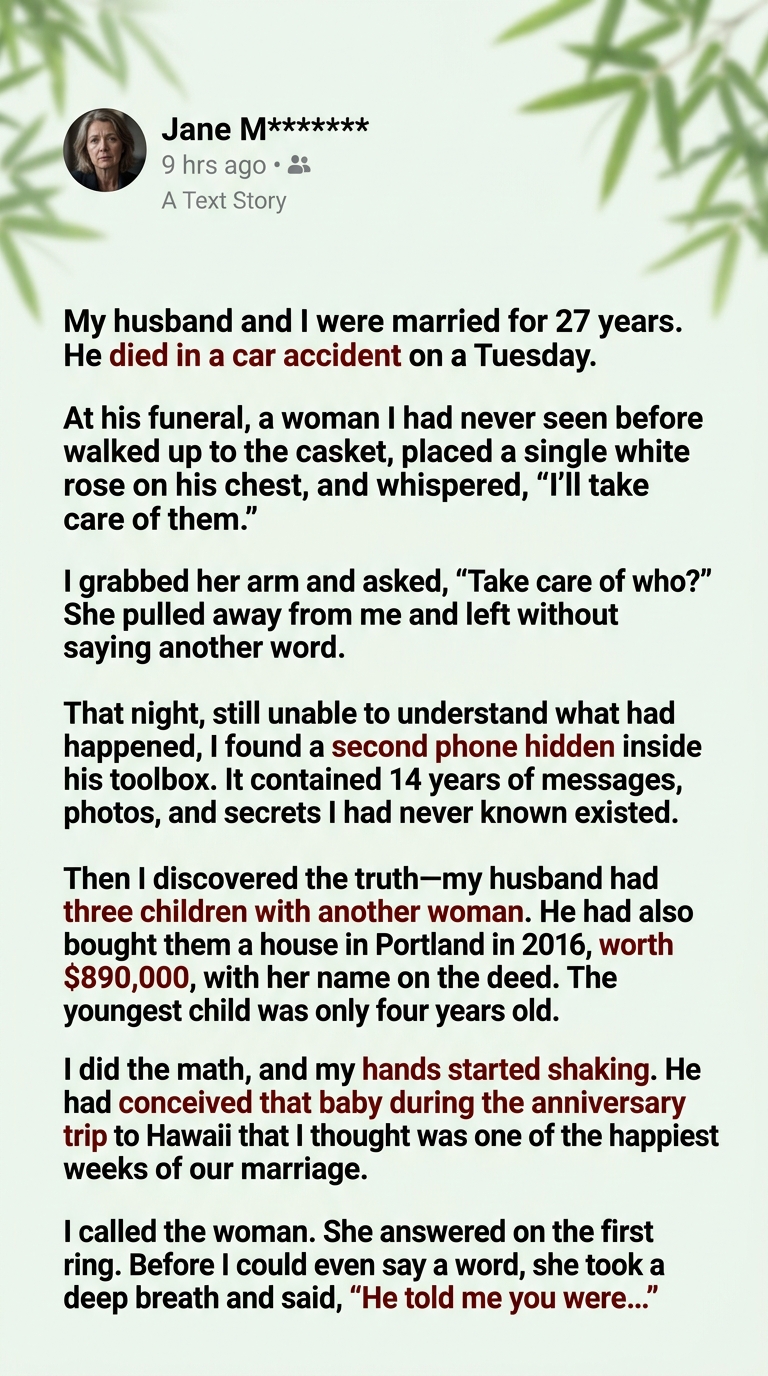
My husband and I were married for 27 years.
Twenty-seven years.
We had raised children.
Bought a house.
Paid mortgages.
Celebrated birthdays.
Taken vacations.
Survived illnesses.
Fought over stupid things.
Made up.
Grown old together.
Or at least, I thought we had.
He died in a car accident on a Tuesday.
Three days later, I stood beside his casket, greeting people I barely remembered.
Everyone kept telling me the same thing.
“He loved you.”
“You were his whole world.”
“You two had such a beautiful marriage.”
I nodded.
I thanked them.
And I tried to believe them.
Then a woman I had never seen before walked into the funeral home.
She was probably in her forties.
Dark hair.
Black coat.
Red eyes.
She walked straight toward my husband’s casket.
Nobody stopped her.
She placed a single white rose on his chest.
Then she leaned close.
And whispered something.
I couldn’t hear it.
She stepped back.
I grabbed her arm.
“Who are you?”
She looked at me.
There was something in her eyes I will never forget.
Not hatred.
Not anger.
Pity.
I tightened my grip.
“Take care of who?”
She pulled her arm away.
Then she said quietly,
“I’m sorry.”
And walked out.
I stood there frozen.
That night, I couldn’t sleep.
I kept replaying those words.
I’ll take care of them.
Who were they?
I searched my husband’s office.
Nothing.
His desk.
Nothing.
His laptop.
Password protected.
Then I remembered his toolbox.
He always kept it locked.
I opened it.
Under a stack of old receipts was a phone.
A second phone.
My hands started shaking.
I turned it on.
There was no password.
The first message I saw was dated fourteen years earlier.
Are you coming tonight? The kids are waiting.
My heart stopped.
I scrolled.
Another message.
She still doesn’t know?
Then:
I promised you I would never abandon you.
Then photographs.
A little boy.
A little girl.
Another child.
My husband standing beside them.
My husband holding a baby.
My husband sitting at a birthday party.
My husband at Christmas.
My husband in a house I had never seen.
I kept scrolling.
Fourteen years of messages.
Fourteen years of lies.
And then I found the woman’s name.
Rachel.
I searched through the messages.
That’s when I discovered the house.
Portland.
Purchased in 2016.
A beautiful three-bedroom home.
Worth nearly $890,000.
The deed had Rachel’s name on it.
My husband’s name was there too.
I sat on the floor.
My back against the toolbox.
I couldn’t breathe.
Then I found the children’s names.
Three of them.
The oldest was thirteen.
The middle child was nine.
The youngest was four.
Four.
I stared at the screen.
Then I did the math.
My husband had been in Hawaii with me four years earlier.
Our anniversary trip.
The trip I’d called one of the happiest weeks of our marriage.
We had watched the sunset together.
Had dinner by the ocean.
He had told me he loved me more than ever.
And apparently, somewhere during that same period, he had been living another life.
I called Rachel.
She answered on the first ring.
Neither of us spoke.
Then she took a deep breath.
“He told me you were…”
Her voice broke.
“…dying.”
I froze.
“What?”
“He told me you had cancer.”
I couldn’t speak.
Rachel continued.
“He said you had been sick for years.”
“I’ve never had cancer.”
Silence.
Then Rachel whispered,
“What?”
“I’ve never had cancer.”
She started crying.
“Oh my God.”
I sat down.
“What did he tell you?”
“He said your marriage was over.”
My hands went numb.
“He told me you knew about us.”
I closed my eyes.
“No.”
“He said you didn’t want children.”
I laughed.
But there was no humor in it.
“We couldn’t have children.”
Rachel went silent.
“He told me you couldn’t have children.”
I whispered,
“We chose not to.”
Another silence.
Then Rachel said something that made everything even worse.
“He told me you wanted him to have a family.”
I covered my mouth.
“He said you encouraged him to see us.”
I couldn’t breathe.
Rachel started sobbing.
“I never wanted to hurt you.”
“You knew about me.”
“Yes.”
“You knew my name?”
“Yes.”
“You knew we were married?”
“Yes.”
My voice became cold.
“How long?”
“Fourteen years.”
I closed my eyes.
Fourteen years.
She had known about me.
And I’d known nothing about her.
Then she said,
“He told me you were cruel.”
I opened my eyes.
“What?”
“He said you hated children.”
My heart cracked.
Because I loved children.
I had spent twenty-seven years teaching elementary school.
I had volunteered at shelters.
I had babysat my nieces.
I had always dreamed of being a mother.
My husband knew that.
He knew everything.
And he had used my greatest heartbreak to justify his second family.
Then Rachel whispered,
“But there’s something else.”
“What?”
“He never told me the truth about the house.”
“What do you mean?”
“He told me he bought it for the children.”
“He did.”
“Yes.”
“But he told me the money came from an inheritance.”
I stared at the phone.
“What inheritance?”
“I don’t know.”
My stomach dropped.
Because I knew exactly what she meant.
My husband had received a large inheritance from his father five years earlier.
He had told me he wanted to put most of it into our retirement.
I had trusted him.
I suddenly understood.
He hadn’t just cheated on me.
He had taken money from the life we built together.
I spent the next two days going through every financial document I could find.
Bank statements.
Investment accounts.
Tax records.
Property records.
And what I found was devastating.
The Portland house wasn’t the only thing.
There were transfers.
Thousands of dollars at a time.
Sometimes tens of thousands.
Tuition payments.
Medical bills.
Car payments.
Vacations.
Furniture.
Everything.
For fourteen years.
Then I found the biggest transfer.
A large amount had been moved from one of our investment accounts shortly before the Portland house was purchased.
I called the bank.
The account was jointly owned.
The money was marital property.
My husband had moved it without telling me.
I sat there staring at the statement.
And suddenly, the grief disappeared.
Not completely.
But underneath it was something stronger.
Clarity.
I called Rachel again.
“We need to meet.”
She hesitated.
“Why?”
“Because your children are innocent.”
Silence.
“And so am I.”
We met at a quiet café.
When I saw her in person, she looked exhausted.
She sat across from me.
“I am sorry.”
“I believe you.”
She looked surprised.
“But you knew about me.”
“Yes.”
“That part will take me longer.”
She nodded.
“I understand.”
Then she placed a folder on the table.
“What is this?”
“Letters.”
“From him?”
She nodded.
“He wrote them for the children.”
I opened the folder.
The first letter was addressed to his oldest son.
Then his daughter.
Then the youngest.
They were not love letters.
They were explanations.
And the more I read, the more I realized something terrifying.
My husband had built two separate realities.
To Rachel, he was a devoted father trapped in a loveless marriage.
To me, he was a faithful husband who had no secrets.
To his children, he was a father who promised he would always protect them.
And somehow, he had convinced himself that all three versions could exist forever.
Until he died.
Then the truth collided.
Rachel wiped her eyes.
“He loved them.”
“I know.”
“And he loved you.”
I looked at her.
“Maybe.”
She lowered her head.
“I don’t know if that makes it better or worse.”
“Worse.”
She nodded.
“I think so too.”
We sat quietly.
Then I said something neither of us expected.
“I don’t want the house.”
She looked at me.
“What?”
“I want the money he took from our marriage to be accounted for.”
“And the house?”
“I don’t want children punished for what their father did.”
Rachel stared at me.
“You’re serious?”
“Yes.”
“But legally—”
“I’ll deal with the legal side.”
I paused.
“But I want those children protected.”
Rachel started crying.
“I don’t understand.”
“Neither do I.”
I looked out the window.
“But they didn’t betray me.”
Months passed.
The estate was settled.
The financial records were examined.
The money my husband had taken from our joint assets was accounted for.
Some of it was recovered.
Some wasn’t.
The Portland house remained with the children and Rachel, subject to the legal arrangements we made.
I never became friends with Rachel.
Not really.
There were too many wounds.
But we stopped being enemies.
And once a month, I received photographs.
The children at school.
The little boy losing his first tooth.
The youngest learning to ride a bicycle.
Sometimes I looked at them and wondered how a man could create so much love while causing so much pain.
Then, nearly a year after the funeral, Rachel called me.
“Can I ask you something?”
“Yes.”
“Would you come to the house?”
I hesitated.
“Why?”
“The youngest keeps asking about the woman in Daddy’s old photographs.”
My heart stopped.
“What photographs?”
“The ones from your wedding.”
I went silent.
Rachel continued.
“He found one of you and your husband on your wedding day.”
I swallowed.
“What does he say?”
“He says, ‘That’s Daddy’s other family.’”
I closed my eyes.
Four years old.
Too young to understand any of this.
“Why do you want me there?”
Rachel took a breath.
“Because I think they deserve to know the truth someday.”
I looked around my empty house.
Then I said,
“I’ll come.”
When I arrived in Portland, the three children were waiting.
The oldest stood awkwardly near the doorway.
The daughter looked nervous.
The youngest ran toward me without hesitation.
He stopped in front of me.
Looked up.
Then asked,
“Are you Grandma?”
I froze.
Rachel looked at me.
I crouched down.
“No, sweetheart.”
He frowned.
“Then who are you?”
I looked at the little boy who had been born from the biggest betrayal of my life.
And I answered honestly.
“I’m someone who loved your dad very much.”
The boy smiled.
“So did I.”
I felt tears fill my eyes.
“I know.”
He reached for my hand.
And I took it.
That was the strangest moment of my life.
Because I had spent months believing those children were proof that my husband had destroyed everything.
But standing there, holding that little boy’s hand, I finally understood.
They weren’t proof of his betrayal.
They were innocent children who had been born into a lie they never asked for.
My husband had left behind a mess of secrets.
But I didn’t have to continue the lie.
I couldn’t change what he had done.
I couldn’t get back fourteen years.
I couldn’t erase the betrayal.
But I could choose what happened next.
And sometimes healing doesn’t mean forgiving the person who hurt you.
Sometimes it means refusing to let their choices determine the kind of person you become.
My husband had spent fourteen years dividing his life into secrets.
I decided I wouldn’t spend the rest of mine divided by them.