My wife got pregnant.
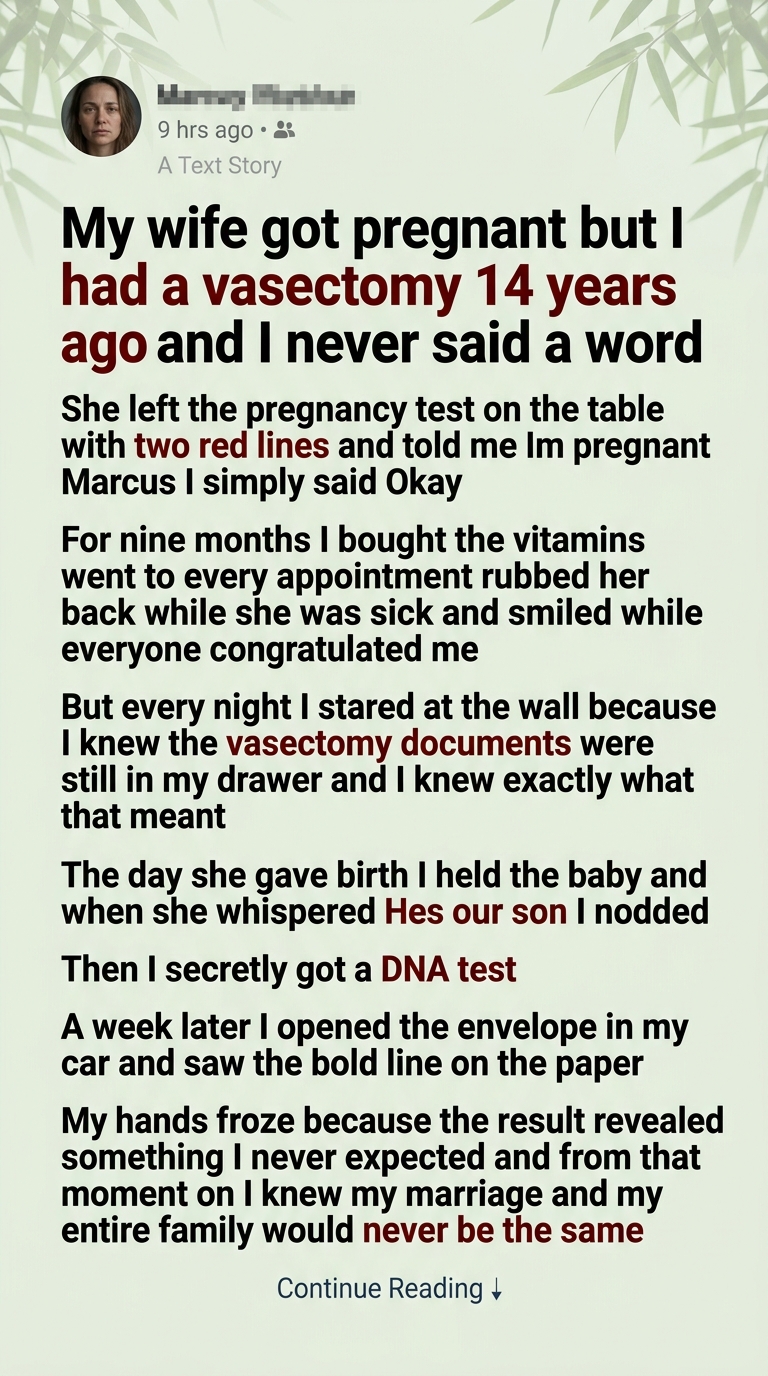
The problem was, I had a vasectomy fourteen years earlier.
I never told her I knew what that meant.
One morning, she left a pregnancy test on the kitchen table.
Two red lines.
She walked into the room smiling.
“I’m pregnant, Marcus.”
I stared at the test.
Then at her.
“Okay,” I said.
That was all.
She hugged me.
I hugged her back.
But inside, my mind was racing.
The documents from my vasectomy were still in the bottom drawer of my desk.
I knew exactly when the procedure had been done.
I knew the doctor.
I knew the date.
And I knew what the follow-up tests had confirmed.
For fourteen years, I had never thought about it.
Until that morning.
Still, I said nothing.
For the next nine months, I played the role everyone expected me to play.
I bought her vitamins.
I drove her to appointments.
I held her hair when she was sick.
I rubbed her back when she couldn’t sleep.
I painted the nursery.
I smiled when our families celebrated.
Everyone congratulated me.
“Marcus, you’re going to be a father again!”
I smiled.
But every night, when my wife was asleep, I stared at the ceiling.
I kept asking myself the same question.
How?
I didn’t want to accuse her without knowing the truth.
Maybe there was something I didn’t understand.
Maybe the procedure had somehow failed.
Maybe the impossible was possible.
So I waited.
The day our son was born, everything changed.
When the nurse placed him in my arms, I looked down at his tiny face.
My heart did something I wasn’t prepared for.
He was beautiful.
My wife was exhausted but smiling.
She reached for my hand.
“He’s our son,” she whispered.
I nodded.
“Our son.”
But there was something I needed to know.
Not because I wanted to reject the baby.
Not because I wanted to destroy my family.
I needed the truth.
So, without telling my wife, I arranged for a DNA test.
A week later, I sat alone in my car with the envelope on my lap.
My hands were shaking.
I opened it.
I read the result.
Then I read it again.
Probability of paternity: 0%.
I closed my eyes.
For several minutes, I couldn’t move.
My first thought was exactly what I had feared.
My wife had been unfaithful.
But then I noticed something strange.
The report contained another reference number.
I called the laboratory.
A woman answered.
I gave her the information.
There was a long pause.
“Mr. Carter,” she said, “there’s something you need to know.”
My heart started pounding.
“What?”
“The sample you submitted was compared against the reference information you provided.”
“Yes.”
“But there appears to be a discrepancy in the medical records.”
“What kind of discrepancy?”
She asked me to come in.
I arrived the next morning.
The laboratory director sat across from me with several documents.
“Your vasectomy records are unusual.”
I stared at him.
“What does that mean?”
“The procedure was performed fourteen years ago. But the follow-up record indicates something else.”
“What?”
He slid a document toward me.
The sample recorded after the procedure wasn’t mine.
I stared at the page.
“What are you saying?”
“Your medical file contains a specimen that appears to have been incorrectly attached to your records.”
I couldn’t believe it.
“So my vasectomy…”
“We can’t confirm from these records that it was successful.”
I sat back.
For fourteen years, I had believed I couldn’t father another child.
But there was more.
The laboratory director pointed to the DNA report.
“The newborn is not biologically related to you.”
I felt my stomach drop.
“Then whose child is he?”
He shook his head.
“We don’t know.”
I left the laboratory more confused than when I entered.
I drove home.
My wife was sitting in the nursery, holding our son.
She looked up.
“You’ve been acting strange.”
I sat across from her.
“I need to ask you something.”
She became nervous.
“What?”
“Do you know who the baby’s biological father is?”
Her face went pale.
She looked down at the baby.
Then she started crying.
“I don’t know.”
I froze.
“What do you mean, you don’t know?”
She took a deep breath.
“Marcus, I never cheated on you.”
“Then explain this.”
I showed her the DNA report.
She stared at it.
Then she whispered something that changed everything.
“I think the hospital made a mistake.”
“What?”
She explained that during the pregnancy, her doctor had told her there was an issue with one of the early records.
There had been another pregnant woman receiving treatment at the same clinic around the same time.
Both women had similar names.
Both were expecting boys.
And on the day of delivery, there had been an emergency involving multiple patients.
My wife had always assumed the paperwork had been corrected.
Apparently, it hadn’t been.
We immediately contacted the hospital.
What they discovered was almost unbelievable.
Our baby had been accidentally switched with another newborn for several hours.
The DNA test hadn’t revealed an affair.
It had revealed something much worse.
We had been raising the wrong child.
The hospital launched an investigation.
The other family was contacted.
And eventually, DNA testing confirmed it.
The little boy in our home was not biologically ours.
Our biological son was living with another family.
My wife collapsed when she heard the news.
I felt like the entire world had disappeared beneath my feet.
For nine months, I had been afraid my wife had betrayed me.
Instead, both of us had become victims of a terrible mistake.
But there was one more problem.
We had to decide what to do next.
The hospital offered lawyers, counselors, and every form of support they could provide.
But no document could answer the question that mattered most.
Who was our son?
The child in my arms was the baby I had held every night.
The baby I had talked to before he was born.
The baby whose mother I had watched struggle through nine months of pregnancy.
He wasn’t biologically mine.
But was biology enough to erase everything we had already become?
We eventually met the other family.
They were devastated too.
The other father had spent nine months believing he was raising his biological son.
None of us had chosen this.
None of the children had chosen it.
So we made a decision.
We would not rush.
We would not tear the children away from the only parents they knew overnight.
With professional help, we slowly introduced the families.
The two boys grew up knowing about their biological families.
They spent holidays together.
They celebrated birthdays together.
And over time, something unexpected happened.
Our families became connected.
My wife and I remained married.
But our marriage changed.
For months, we barely spoke about anything except the children.
Eventually, we learned to talk again.
And I finally told her the truth about my vasectomy.
She stared at me.
“You knew?”
“I knew something didn’t make sense.”
“Why didn’t you tell me?”
“Because I was afraid.”
She looked at me for a long time.
Then she said,
“You should have trusted me enough to tell me.”
She was right.
I had spent months protecting myself from a betrayal that hadn’t happened.
And in doing so, I had nearly created another one.
Years later, I still remember that envelope.
That bold line.
The moment I thought my entire family had been destroyed.
But the DNA test taught me something I never expected.
A DNA result can tell you where a child came from.
It cannot tell you who raised him.
It cannot measure love.
It cannot erase midnight feedings, first steps, scraped knees, bedtime stories, or the thousands of ordinary moments that turn two people into parents.
The little boy who wasn’t biologically mine still calls me Dad.
And I still answer.
Because sometimes, the most important family isn’t the one written on a laboratory report.
It’s the family that chooses each other every day.