My wife got pregnant.
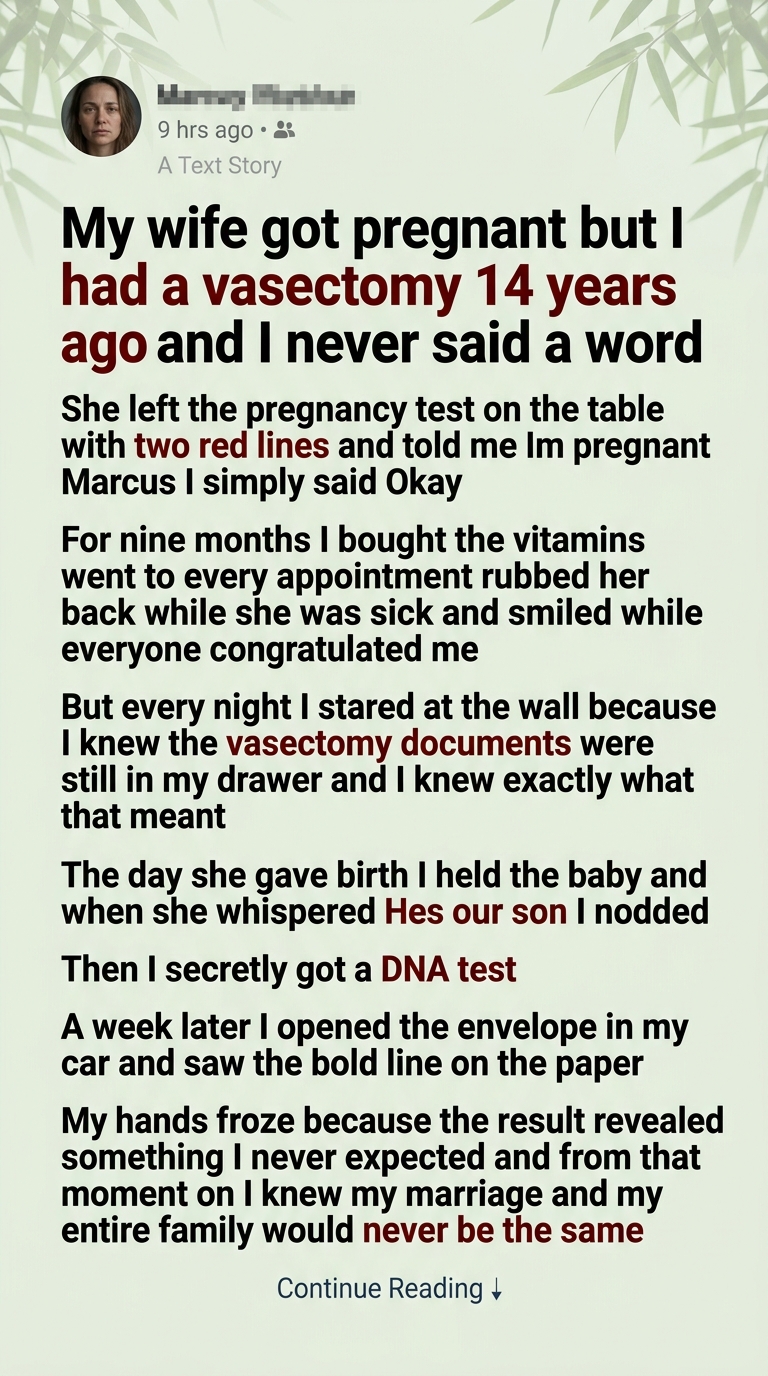
The problem was, I had a vasectomy fourteen years ago.
And I never told her.
One morning, she left a pregnancy test on the kitchen table.
Two red lines.
When I walked into the room, she was smiling.
“I’m pregnant, Marcus.”
I looked at the test.
Then I looked at her.
“Okay,” I said.
She laughed and hugged me.
I hugged her back.
But inside, I was completely frozen.
The paperwork from my vasectomy was still in the bottom drawer of my desk.
I knew exactly when the procedure had happened.
I remembered the follow-up appointment.
I remembered being told the procedure had been successful.
So I knew this pregnancy couldn’t be explained by the story I had believed for fourteen years.
But I didn’t accuse my wife.
I didn’t ask questions.
I simply watched.
For nine months, I went with her to every appointment.
I bought her vitamins.
I drove her to the doctor.
I rubbed her back when she was sick.
I helped prepare the nursery.
Whenever someone congratulated me, I smiled.
“Congratulations, Marcus! You’re going to be a father again!”
I smiled.
But every night, after my wife fell asleep, I stared at the ceiling.
One question kept repeating in my mind.
How is this possible?
The day our son was born, I held him for the first time.
He was tiny.
Perfect.
My wife looked at me with tears in her eyes.
“He’s our son,” she whispered.
I nodded.
“Our son.”
But I knew I couldn’t live with the question forever.
A few days later, I secretly arranged a DNA test.
I told myself I wasn’t trying to destroy my family.
I just needed the truth.
A week later, I sat alone in my car with the envelope on the passenger seat.
I opened it.
I read the result.
Then I read it again.
Probability of paternity: 0%.
My hands went numb.
My first thought was simple.
My wife had been unfaithful.
I stared through the windshield for several minutes.
I wanted to be angry.
I wanted to confront her.
But something stopped me.
The report contained information that didn’t make sense.
So I called the laboratory.
The technician checked the records.
Then she said something that changed the entire situation.
“Mr. Marcus, there’s something unusual about your case.”
“What?”
“The DNA sample doesn’t match the baby.”
“I know.”
“No. I mean something else. There appears to be a discrepancy in the identification records connected to the newborn.”
I sat up.
“What kind of discrepancy?”
She told me to come to the hospital.
The next morning, I met with the hospital’s records department.
They showed me a series of documents.
There had been another baby boy born at the hospital on the same day.
The two mothers had been in neighboring rooms.
During an emergency transfer, identification labels had been temporarily mixed up.
The records were later corrected.
Or so everyone believed.
But something had gone wrong.
The DNA sample used for my test had been connected to the wrong newborn record.
I stared at the paperwork.
“So you’re saying the DNA test is accurate…”
“Yes.”
“But it tested the wrong child?”
The doctor nodded.
My heart started racing.
“Then where is my biological son?”
They didn’t know.
Not yet.
A second round of testing was ordered.
My wife was shocked when I finally told her.
She started crying.
“You thought I cheated on you?”
“I didn’t know what to think.”
She shook her head.
“I never cheated on you.”
For the first time in months, I believed her.
The hospital eventually located the other family.
They had been raising a little boy who wasn’t biologically theirs.
And the baby we had taken home wasn’t biologically ours.
Our entire world turned upside down.
There was no villain.
No secret affair.
No betrayal.
Just a terrible mistake that had gone unnoticed for months.
We met the other family.
They were just as devastated as we were.
The other father kept repeating,
“How could this happen?”
No one had an answer.
The hardest part wasn’t discovering the mistake.
It was deciding what to do next.
The two boys were innocent.
They knew only one set of parents.
They knew one home.
One voice calling them at bedtime.
One family comforting them when they cried.
So the doctors and counselors advised us not to make sudden decisions.
We slowly introduced the families.
We spent time together.
The boys became familiar with one another.
And eventually, they learned the truth in an age-appropriate way.
It was painful.
But something beautiful came from it.
Instead of losing one family, the boys gained another.
We celebrated birthdays together.
We shared holidays.
We watched both boys grow.
And I learned something I never expected.
The child who wasn’t biologically mine still felt like my son.
Because I had held him.
I had stayed awake with him.
I had changed his diapers.
I had kissed his forehead when he was sick.
DNA could explain biology.
It couldn’t erase love.
One evening, years later, my son asked me,
“Dad, am I really your son?”
I looked at him.
“Yes.”
He smiled.
“But I’m not your biological son.”
I shook my head.
“That doesn’t change what you are to me.”
He hugged me.
Then he whispered,
“Good.”
I closed my eyes.
For months, I had believed that pregnancy had exposed a betrayal.
Instead, it exposed a truth about family that I had never understood.
I had spent fourteen years believing a medical procedure defined whether I could become a father.
Then I spent months believing DNA defined whether a child was truly mine.
I was wrong about both.
Being a father wasn’t written on a medical form.
It wasn’t printed on a laboratory report.
It was built in thousands of ordinary moments.
The bedtime stories.
The scraped knees.
The school plays.
The birthdays.
The hugs.
The promises.
And the choice to stay.
My wife and I eventually rebuilt our marriage too.
It took time.
There were difficult conversations.
There were moments when we both wondered whether we could survive everything that had happened.
But we did.
Today, our family looks different from what we imagined.
But it’s bigger.
Stronger.
And much more complicated.
Whenever I think about that envelope I opened alone in my car, I remember how certain I was that my entire life had just fallen apart.
Instead, that piece of paper led us toward a truth none of us could have imagined.
Sometimes the answer you’re terrified to find isn’t the end of your story.
Sometimes it’s the beginning of a completely different one.
And that little boy I once feared wasn’t mine?
He still calls me Dad.
And I still answer.