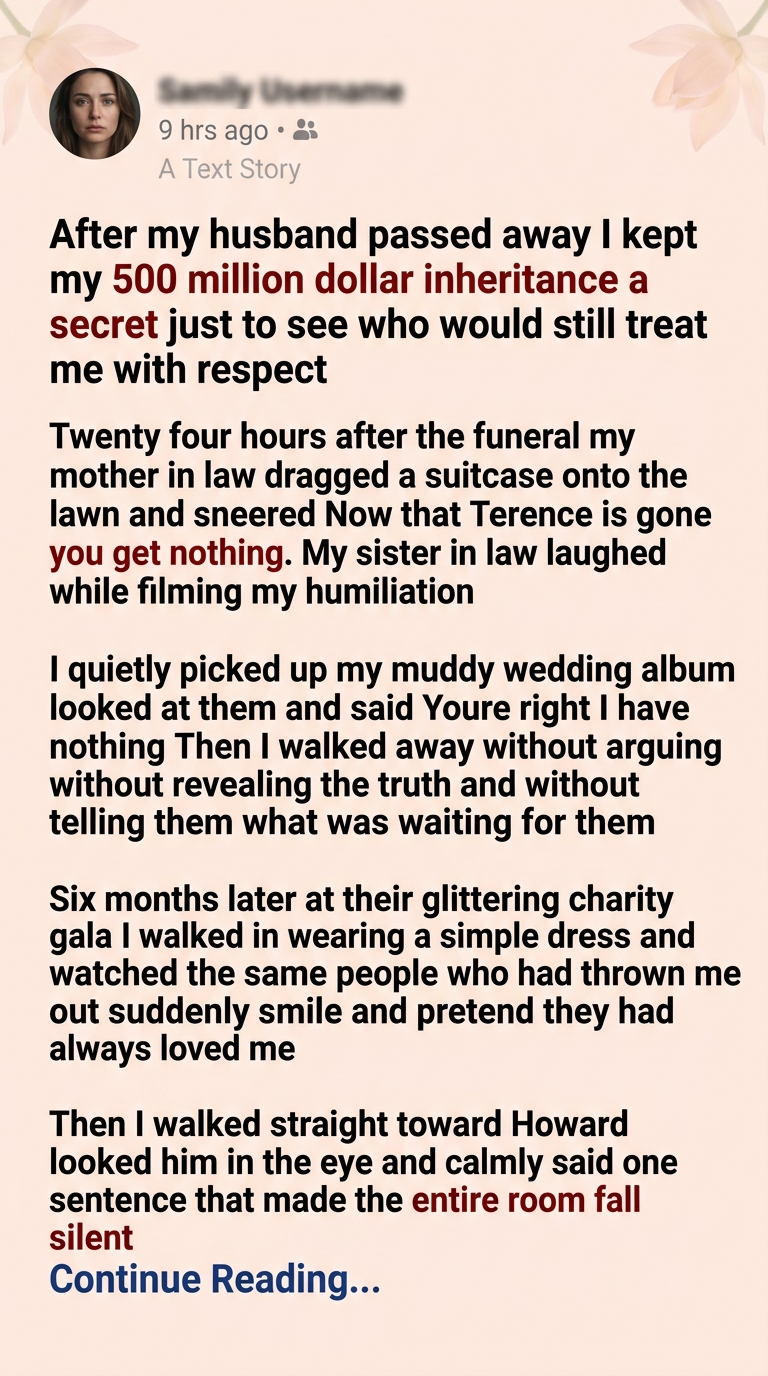
After my husband passed away, I inherited $500 million.
But I told no one.
Not my mother-in-law.
Not my sister-in-law.
Not even the distant relatives who suddenly appeared with sympathetic smiles.
I kept it secret for one reason.
I wanted to know who would still treat me with respect when they believed I had nothing.
My husband, Terence, had always told me something that I didn’t fully understand until after his death.
“Money doesn’t change people,” he once said.
“It reveals them.”
I didn’t know how right he was.
The day after his funeral, I was standing outside our house when my mother-in-law arrived.
She wasn’t alone.
My sister-in-law was behind her, holding up her phone.
Recording.
My mother-in-law dragged a suitcase across the lawn and dropped it near my feet.
“Now that Terence is gone, you get nothing.”
I stared at her.
“What?”
She laughed.
“You heard me.”
My sister-in-law giggled behind her phone.
“Maybe this will teach her a lesson.”
My mother-in-law pointed toward the suitcase.
“Pack your things. This house belongs to the family.”
I looked at the house.
The place where Terence and I had built our life.
The kitchen where we’d cooked together.
The garden where he’d planted roses.
The bedroom where we’d spent years planning our future.
Now they were telling me I had no right to any of it.
I could have shown them the documents.
I could have told them about the inheritance.
I could have called the attorney.
Instead, I bent down and picked up my wedding album.
It had fallen into the mud.
I wiped the cover with my sleeve.
Then I looked at them.
“You’re right.”
My sister-in-law stopped laughing.
“I have nothing.”
I picked up my suitcase.
And I walked away.
I didn’t argue.
I didn’t explain.
I didn’t tell them about the inheritance.
I didn’t tell them that Terence had left me everything.
I simply disappeared.
For the next six months, I lived quietly.
I moved into a small apartment.
I donated most of my old belongings.
I changed my phone number.
I stopped answering calls from relatives.
Meanwhile, I watched from a distance as my husband’s family continued living their lives.
They sold several of Terence’s belongings.
They told people I had taken advantage of him.
They claimed I had been desperate for his money.
My sister-in-law even posted the funeral video online.
She thought humiliating me had made her powerful.
I never responded.
Instead, I worked with Terence’s attorney.
The inheritance was real.
The estate had been carefully structured years before his death.
And there was one more thing I discovered.
Terence had anticipated exactly what might happen.
In a private letter, he had written:
“If they treat her differently because they believe I left her with nothing, let them reveal themselves.”
I cried when I read that.
He had known.
He had understood his family better than I ever had.
Six months later, my husband’s family hosted a huge charity gala.
It was one of those glittering events where everyone dressed beautifully and pretended their lives were perfect.
They had invited business leaders, wealthy donors, and people who could improve their social standing.
I received an invitation too.
I almost threw it away.
Then I decided to go.
Not for revenge.
For closure.
I arrived wearing a simple black dress.
No expensive jewelry.
No designer handbag.
Nothing that announced what I had inherited.
When I entered the ballroom, people barely noticed me.
Then my mother-in-law saw me.
Her smile disappeared.
My sister-in-law stared.
Then, surprisingly, they both smiled.
They walked toward me.
“It’s so good to see you!”
My mother-in-law hugged me as if nothing had happened.
“We’ve missed you so much.”
I looked at her.
Six months earlier, she had thrown my suitcase onto a lawn.
Now she was calling me family.
My sister-in-law touched my arm.
“I always knew you were strong.”
I almost laughed.
Then I saw Howard.
Terence’s older brother.
He had been one of the people who stood silently while I was thrown out of the house.
He approached me with a champagne glass in his hand.
“I’m glad you came.”
I looked around the room.
The same people who had treated me like I was worthless were suddenly smiling.
Why?
Because they thought I might still be connected to Terence’s wealth.
Or perhaps they had heard rumors.
I didn’t know.
Then the host announced a special presentation.
A large screen appeared behind the stage.
“Tonight,” the host said, “we’re honoring the legacy of the late Terence.”
Everyone applauded.
I watched quietly.
Then the host announced that the charity would be receiving a major donation from the Terence Walker Family Foundation.
My mother-in-law smiled proudly.
Howard raised his glass.
My sister-in-law applauded.
Then the host said something that made the entire room go quiet.
“The foundation’s sole controlling trustee is Terence’s surviving spouse.”
Everyone turned toward me.
My mother-in-law’s smile disappeared.
Howard’s glass stopped halfway to his mouth.
My sister-in-law looked at me in disbelief.
The host continued.
“And tonight, she has agreed to address the guests.”
I walked onto the stage.
Hundreds of people were staring at me.
Howard stepped forward.
“What is this?”
I looked directly at him.
Then I said the sentence I had been waiting six months to say.
“You were right when you said I had nothing—but you were wrong about what that meant.”
Silence.
I continued.
“Six months ago, you judged me because you thought my husband had left me with nothing.”
I looked at my mother-in-law.
“You threw my belongings onto the lawn.”
Then I looked at my sister-in-law.
“You filmed it.”
The room became completely silent.
“But Terence didn’t leave me with nothing.”
I paused.
“He left me with a responsibility.”
A screen behind me displayed the estate documents.
The room erupted in whispers.
Terence had left me the majority of his estate.
Five hundred million dollars.
But I wasn’t there to brag about it.
I was there because the charity gala was connected to a foundation Terence had established secretly.
And he had given me complete control.
I announced that the foundation would fund scholarships, housing programs, and community projects in his name.
Then I turned toward Howard.
“But there is one condition.”
He looked nervous.
“The foundation will never fund anyone who uses Terence’s name to mistreat the people he loved.”
My mother-in-law looked horrified.
“You can’t do this.”
I smiled calmly.
“I can.”
Howard stepped forward.
“You’re trying to punish us.”
“No.”
I shook my head.
“I’m not punishing anyone.”
I looked around the room.
“I’m simply making sure Terence’s money is used according to the values he believed in.”
Then I turned toward the audience.
“I kept my inheritance secret because I wanted to know who would treat me like a human being when they believed I had nothing.”
No one spoke.
“I learned everything I needed to know.”
I stepped away from the microphone.
That night, I didn’t take revenge.
I didn’t insult them.
I didn’t humiliate them the way they had humiliated me.
I simply walked out.
A week later, my mother-in-law called.
She apologized.
For the first time, there were no excuses.
I listened.
Then I told her something Terence had taught me.
“Respect shouldn’t depend on someone’s bank account.”
She cried.
I didn’t know whether I could ever trust her again.
Maybe I never would.
But I no longer needed her approval.
I had learned something far more valuable than money.
People can pretend to love you when they think you are wealthy.
They can pretend to love you when they need something.
But when they believe you have nothing to offer them, their true character becomes much easier to see.
Terence left me $500 million.
But the greatest thing he left me wasn’t the money.
It was the freedom to choose who deserved a place in my life.
And this time, I chose carefully.