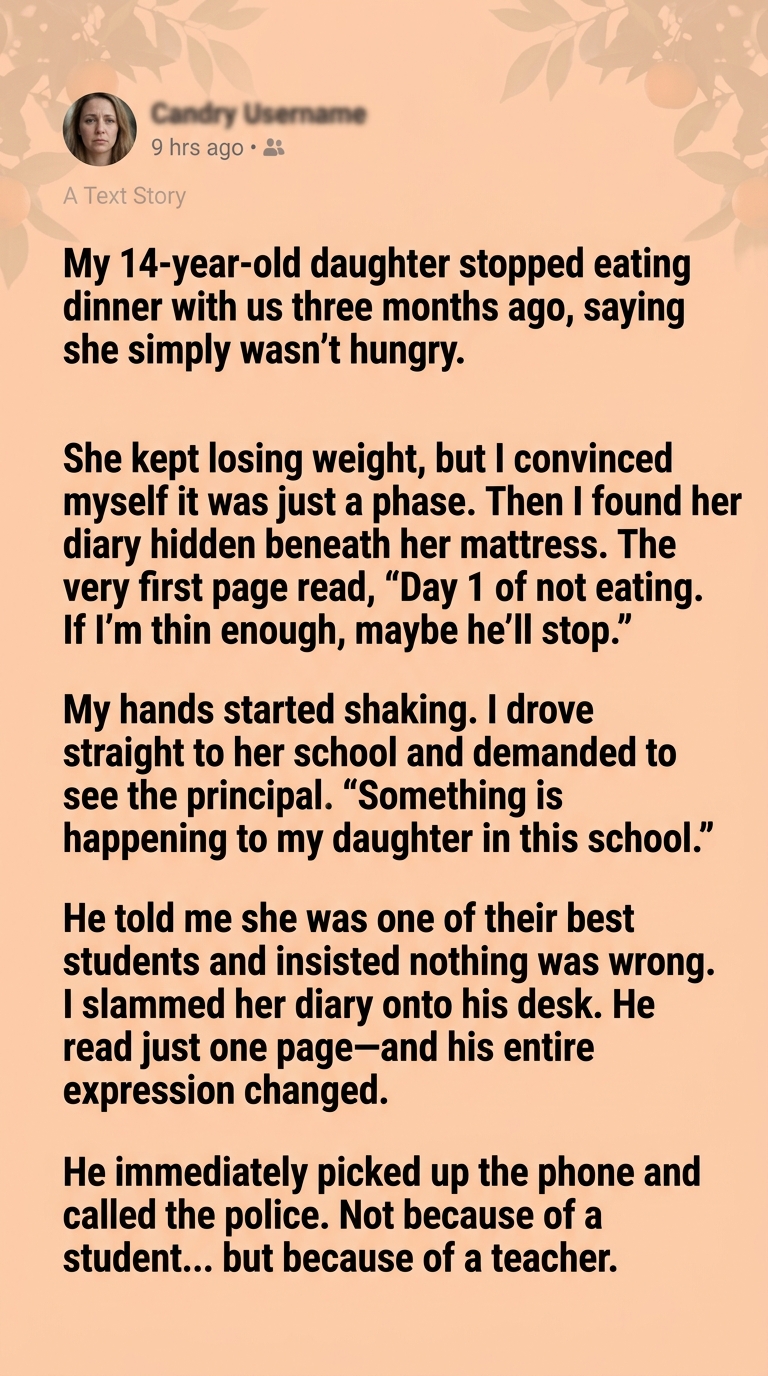
My 14-year-old daughter stopped eating dinner with us.
At first, she said she simply wasn’t hungry.
I believed her.
Teenagers go through phases, I told myself.
But over the next three months, I noticed she was losing weight.
She became quieter.
She stopped joining family conversations.
She spent more time alone in her room.
Every time I asked if something was wrong, she smiled and said,
“I’m fine, Mom.”
I wanted to believe her.
Then one afternoon, while changing the sheets, I found a diary hidden beneath her mattress.
I knew I shouldn’t read it.
But something made me open it.
The first page said:
“Day 1 of not eating. If I’m thin enough, maybe he’ll stop.”
My hands started shaking.
I turned the page.
Then another.
And another.
There were weeks of entries.
My daughter wasn’t trying to lose weight for herself.
She was afraid of someone.
I grabbed my keys and drove straight to her school.
I demanded to see the principal.
When he finally came into his office, I put the diary on his desk.
“Something is happening to my daughter in this school.”
He frowned.
“She is one of our best students. We’ve never received a complaint about her.”
I pushed the diary toward him.
“Read it.”
He opened it.
His expression changed after the first few lines.
He turned another page.
Then another.
Suddenly, he reached for the phone.
“I’m calling the police.”
I stared at him.
“Why?”
He looked at me.
“Because this isn’t about another student.”
His voice dropped.
“It’s about one of our teachers.”
The police arrived within minutes.
They spoke with the principal.
Then they asked me to bring my daughter to a private room.
At first, she refused to talk.
She kept saying she didn’t want to cause trouble.
Finally, she looked at me and started crying.
“Mom, please don’t be angry.”
“I could never be angry with you for telling me the truth.”
She took a deep breath.
“There is a teacher who keeps telling me I need to look different.”
I asked who.
She gave me the name.
It was a teacher everyone respected.
He had won awards.
Parents praised him.
The school considered him one of its most dedicated educators.
My daughter explained that he had started making comments about her appearance.
At first, she thought he was simply being strict.
Then the comments became more personal.
He told her that certain students received more attention because they “looked better.”
He began criticizing her in front of other students.
Then he started sending her private messages about her appearance and what she ate.
My daughter became convinced that if she became thin enough, he would stop criticizing her.
That’s when she started skipping meals.
I felt sick.
The principal immediately suspended the teacher while the police investigated.
But then my daughter revealed something even more disturbing.
She wasn’t the only student.
There were other girls who had received similar messages.
The police began interviewing families.
Several parents came forward.
Some had noticed changes in their daughters but had never understood why.
The teacher denied everything.
He claimed he was simply trying to motivate students.
But investigators recovered messages from his school account.
They also found records showing that he had repeatedly singled out certain students.
The evidence was enough for the school to remove him from contact with students while the investigation continued.
My daughter eventually told the truth about everything.
She admitted she had been scared that people would blame her.
She thought nobody would believe her because the teacher was popular.
I hugged her.
“You did nothing wrong.”
She cried.
“I should have told you sooner.”
“No.”
I held her tighter.
“You told me when you were ready.”
The months that followed were difficult.
We worked with doctors and counselors to help her rebuild a healthy relationship with food and with herself.
We also made sure she understood something I wished she had known from the beginning.
Her worth had never depended on her appearance.
Not her weight.
Not her grades.
Not what a teacher thought of her.
Not what anyone else thought.
She was valuable simply because she was herself.
The school eventually changed its reporting procedures.
Students were given safer ways to report inappropriate behavior.
Parents were encouraged to pay attention when children suddenly changed their eating habits, friendships, moods, or routines.
And my daughter slowly began coming back to herself.
One evening, months later, she sat down at the dinner table.
I looked at her.
She smiled.
“What?”
“Nothing.”
“You’re staring.”
“I missed this.”
She rolled her eyes.
“Mom.”
I laughed.
Then she reached for the bread.
It was such a small thing.
But to me, it felt enormous.
Later that night, she brought me her diary.
“I don’t need this anymore.”
I looked at it.
“You’re sure?”
She nodded.
“I think I want to write about other things now.”
She smiled.
Then she hugged me.
I held her tightly.
I still remember the first sentence I read in that diary.
“If I’m thin enough, maybe he’ll stop.”
My daughter had spent months believing she needed to change herself to make someone else behave appropriately.
But the truth was never about her.
The problem was someone else’s behavior.
And the most important thing she learned wasn’t how to become different.
It was how to recognize that she deserved to feel safe, respected, and heard exactly as she was.