My Parents Threw Me Out at 16, Then Returned for My Uncle’s $42 Million Fortune
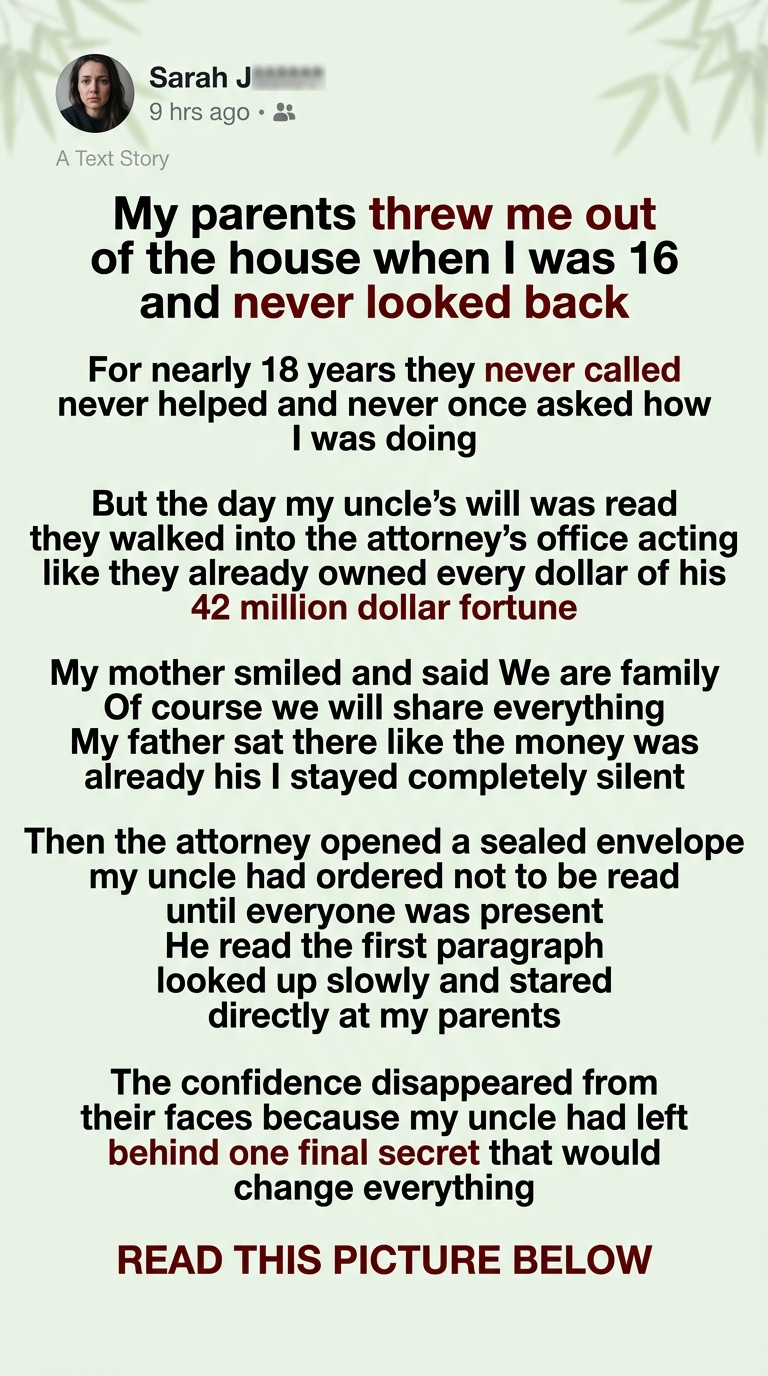
When I was sixteen, my father stood in the doorway of our house and told me I was no longer welcome there.
“Pack your things and leave,” he said coldly.
My mother stood behind him with her arms crossed. She didn’t ask him to reconsider. She didn’t offer me a place to sleep or even ask where I would go.
I looked at her, waiting for some sign that she still cared.
She turned away.
That night, I left with a small suitcase, a little cash, and nowhere certain to go.
For the next eighteen years, my parents never called to ask whether I was safe. They never offered help when I struggled to pay rent, worked exhausting shifts, or wondered how I would afford my next meal.
I learned to survive without them.
I finished school while working part-time, rented a tiny apartment, and gradually built a stable life. It wasn’t easy, but every small achievement reminded me that I could stand on my own.
The one person who never made me feel unwanted was my uncle, Richard.
He was my father’s older brother, a quiet businessman who had never approved of the way my parents treated me.
When I was seventeen, he found me working at a small restaurant and asked me to have dinner with him.
He didn’t lecture me or demand an explanation.
He simply said, “You deserve a chance to build a good life. Don’t let anyone convince you otherwise.”
Over the years, Uncle Richard became the closest thing I had to a parent. He encouraged me to continue my education, listened when I needed advice, and reminded me that family was supposed to offer support, not use love as a weapon.
I never asked him for money. I wanted to build my future myself.
And he respected that.
Then, shortly before my thirty-fourth birthday, I received a call from his attorney.
My uncle had passed away.
He had left behind an estate valued at approximately $42 million.
And everyone named in his will was required to attend a meeting at the attorney’s office.
I had no idea that the reading of his will would bring my parents back into my life.
The Family That Suddenly Remembered Me
The attorney’s office was quiet when I arrived.
A long conference table stood in the center of the room. Several relatives were already seated, whispering about the estate.
Then the door opened.
My parents walked in.
My mother wore an elegant designer coat. My father carried a leather briefcase and greeted the attorney as though they were old friends.
Neither of them asked how I had been.
My mother noticed me sitting near the end of the table and gave me a polite, almost dismissive smile.
“Well, look at that,” she said. “It’s been a long time.”
Eighteen years.
That was how casually she greeted the daughter she had left to fend for herself.
My father took his seat and immediately began discussing my uncle’s businesses, properties, and investments.
“Richard always understood that family assets should remain with the family,” he announced. “Naturally, we need to make sure everything is distributed properly.”
My mother nodded.
“We are family. Of course, we will share everything.”
She said it with such confidence that anyone listening might have believed she had spent the last eighteen years caring for me.
I remained silent.
I hadn’t come to fight with them. I had come to honor the uncle who had stood beside me when they wouldn’t.
The attorney, Mr. Collins, opened a folder and reviewed several documents.
“Before we proceed,” he said, “Mr. Richard Bennett left specific instructions concerning a sealed envelope. It may only be opened when all designated parties are present.”
My father’s expression brightened.
“Excellent. Let’s get on with it.”
Mr. Collins removed a thick envelope from a locked drawer.
My uncle’s signature crossed the seal.
The attorney opened it carefully and began to read.
After the first paragraph, he stopped.
He looked up slowly and stared directly at my parents.
For the first time that morning, my father’s confident expression disappeared.
My mother leaned forward.
“What does it say?”
The attorney adjusted his glasses.
“Your late brother left a separate letter explaining why he made the decisions in his will. He specifically instructed me to read it aloud to everyone present.”
He unfolded the remaining pages.
And then he began.
The Letter That Changed Everything
“To my family,
If you are hearing these words, I am no longer here to explain my decisions in person.
I have spent many years observing the people around me. Some have offered kindness when they expected nothing in return. Others have remembered the word ‘family’ only when money was involved.
There is one person I want to acknowledge above everyone else.
My niece.”
My throat tightened.
I stared at the paper in the attorney’s hands, barely breathing.
The letter continued.
“When she was sixteen, her parents sent her away from the only home she knew. They left her to face adulthood without the support every child deserves.
I watched her struggle, but I also watched her grow stronger. She worked, studied, and built her life without demanding that anyone rescue her.
She never asked me to reward her for what happened to her. She never used her pain to manipulate me. She simply kept moving forward.
I helped her when I could because she deserved kindness, not because I expected anything in return.
I want everyone to understand that my decisions regarding my estate are based on my own judgment, my wishes, and the legal documents I have prepared.”
My mother shifted uncomfortably.
My father interrupted.
“Surely this is unnecessary. Richard was generous, but we all know how much family meant to him.”
Mr. Collins raised a hand.
“Please allow me to finish.”
He continued reading.
“To my brother and his wife:
You may believe that sharing a surname creates an automatic claim to everything I own. It does not.
You made your choices eighteen years ago. You chose to turn away a sixteen-year-old girl who needed her parents.
You were entitled to make decisions about your household, but those decisions had consequences. You cannot erase them simply because my death has created an opportunity for financial gain.
I have made my inheritance decisions deliberately. They are set out in my executed will and related estate documents. I ask that they be respected.”
My mother’s face had gone pale.
My father sat motionless.
Then the attorney placed the letter on the table and opened the official will.
“Now,” he said, “we will proceed with the legally operative distribution provisions.”
The Inheritance No One Expected
Mr. Collins explained that the $42 million estate included business interests, investment accounts, and several properties.
He read through the specific bequests and the provisions governing the remaining assets.
My parents listened eagerly, expecting to hear their names attached to substantial sums.
Instead, they discovered that my uncle had not left them the inheritance they had assumed was theirs.
The will named me as the principal beneficiary of the remaining estate, subject to the stated bequests, estate expenses, and applicable legal requirements.
I sat frozen.
I had never known my uncle intended to leave me such a significant inheritance.
Mr. Collins explained that the will had been properly executed and that the estate would be administered according to its terms.
My father finally found his voice.
“This cannot be right. I’m his brother! I should have received a substantial share.”
The attorney remained composed.
“Your relationship to the deceased does not override a valid will. The distribution will follow the terms of the document, subject to the applicable law.”
My mother turned toward me.
“You knew about this, didn’t you?”
I shook my head.
“No. I didn’t.”
“Then you must understand that we’re still your parents,” she said quickly. “We should discuss how to divide the money fairly.”
I looked at her for a long moment.
When I was sixteen, I had stood in front of her begging for a chance to stay.
She had turned away.
Now she was asking me to share a fortune because we were family.
I felt no satisfaction in seeing her frightened. I simply understood, more clearly than ever, that she had returned for something I possessed, not because she missed the daughter she had abandoned.
“My uncle made his own decision,” I said. “I’m going to respect it.”
My father slammed his palm against the table.
“You can’t just keep everything!”
Mr. Collins immediately intervened and reminded everyone that the estate would be handled through the proper legal process. Any legitimate questions or challenges would need to be addressed through the appropriate channels.
I stood, thanked the attorney, and left the room.
For the first time in eighteen years, I walked away from my parents without wondering whether I had done something wrong.
The Secret Behind My Uncle’s Final Decision
A week later, Mr. Collins invited me back to his office.
He handed me a smaller envelope with my name written across the front.
“This was meant for you personally,” he explained. “Your uncle asked that you receive it after the will had been read.”
I opened it carefully.
Inside was a handwritten letter.
My dear girl,
If you’re reading this, I hope you have found some peace.
I know that money cannot replace the years you lost or give you back the childhood you deserved. I wish I could have done more when you were younger.
But I want you to remember something important: I did not leave you this inheritance because I pitied you. I left it because I believe in the person you became.
You showed courage when life was unfair. You worked for your future when others might have given up. You treated people with kindness even after experiencing unkindness yourself.
Use what I leave you to build a life that feels meaningful to you. Help people when you can, protect what matters, and never believe you owe anyone access to your life simply because they share your blood.
You were worthy of love before you inherited a single dollar.
You will remain worthy long after the money is gone.
With all my love,
Uncle Richard.
I read the letter twice.
Then I pressed it against my chest and cried.
Not because I had inherited millions.
Because the one person who had truly understood me had left behind proof that he had always believed I was worth something.
When My Parents Came Knocking
News of the inheritance spread quickly through the extended family.
Within days, my phone began ringing.
My mother left several voicemails. At first, she talked about family unity. Later, she spoke about how difficult things had been for her and my father.
Finally, she asked whether we could have dinner.
I agreed to meet them in a public restaurant.
When I arrived, they were already seated.
My mother stood and tried to hug me.
I politely stepped back.
She looked hurt, but I sat down without arguing.
“We know we made mistakes,” she began. “Things were complicated when you were young.”
My father stared at the table.
“We thought you would be fine,” he muttered.
I looked at him.
“I was sixteen.”
Neither of them answered.
“I needed parents,” I continued. “I needed somewhere safe to live, someone to help me finish school, and someone who cared whether I was okay. You didn’t call for eighteen years. You didn’t even ask if I was alive and well.”
My mother wiped her eyes.
“We’re sorry.”
I wanted to believe her. A part of me had spent years wishing to hear those words.
But another part of me knew that an apology could not erase nearly two decades of absence.
“I’m willing to listen to what you have to say,” I told them. “But I’m not going to give you money to prove that I love you. And I’m not going to pretend our relationship is suddenly repaired because Uncle Richard left me an inheritance.”
My father looked up.
“So you’re refusing to help your own parents?”
“I’m refusing to let money become the price of having a relationship with me.”
The conversation ended without an agreement about money.
For once, I didn’t feel guilty about that.
What I Did With the $42 Million
Over the following months, I worked with qualified financial and legal advisers to settle the estate, understand my responsibilities, and make careful decisions about the inheritance.
I didn’t rush to buy mansions or expensive cars. I paid attention to taxes, investment planning, and the long-term management of the assets.
I also remembered the people who had helped me when I had very little.
I established a charitable program to support teenagers facing housing insecurity, especially young people who had been forced to leave their homes without adequate support.
The program helped fund emergency accommodation, educational expenses, and practical assistance for young adults trying to become independent.
I named it the Richard Bennett Foundation.
At its opening, I stood before a small gathering of volunteers and young people.
I told them that nobody’s future should be determined by the worst thing that had ever happened to them.
I couldn’t change what had happened when I was sixteen. But I could help make the road ahead a little less frightening for someone else.
My uncle would have understood.
As for my parents, I didn’t make any dramatic public announcement about cutting them out of my life forever. I simply established boundaries and allowed their future actions to speak for themselves.
If they wanted a relationship, they would have to build one through honesty, consistency, and respect—not through demands for money.
Some relatives criticized my decision. Others supported it.
I learned that people often have strong opinions about how you should use your resources when they aren’t the ones who earned or inherited them.
I stopped trying to satisfy everyone.
The Real Meaning of My Uncle’s Legacy
Nearly a year after the will reading, I returned to the little restaurant where my uncle had once found me working as a teenager.
The place had changed very little. The tables were worn, the windows were scratched, and the coffee still smelled exactly as I remembered.
I ordered a cup and sat by the window.
For a moment, I imagined Uncle Richard sitting across from me, asking about my work and reminding me not to forget what mattered.
I took the letter from my bag and read his final words again.
You were worthy of love before you inherited a single dollar.
That was the secret my parents had never understood.
The $42 million was life-changing, but it wasn’t what made me valuable.
I had been valuable when I was sixteen, standing outside a locked door with a suitcase in my hand. I had been valuable when I was working long hours just to afford rent. I had been valuable throughout every year my parents chose not to call.
And I would have been valuable even if my uncle had left me nothing.
My parents had walked into that attorney’s office believing family meant an automatic claim to a fortune.
My uncle had left me something far more important: the freedom to decide what family would mean in my own life.
I finished my coffee, folded the letter, and placed it carefully in my bag.
Then I walked outside into the afternoon sunlight.
I couldn’t recover the childhood I had lost.
But I could build a future that no one had the power to take away from me.
And for the first time in my life, I understood that the greatest inheritance wasn’t the $42 million. It was knowing I no longer had to beg anyone to choose me.