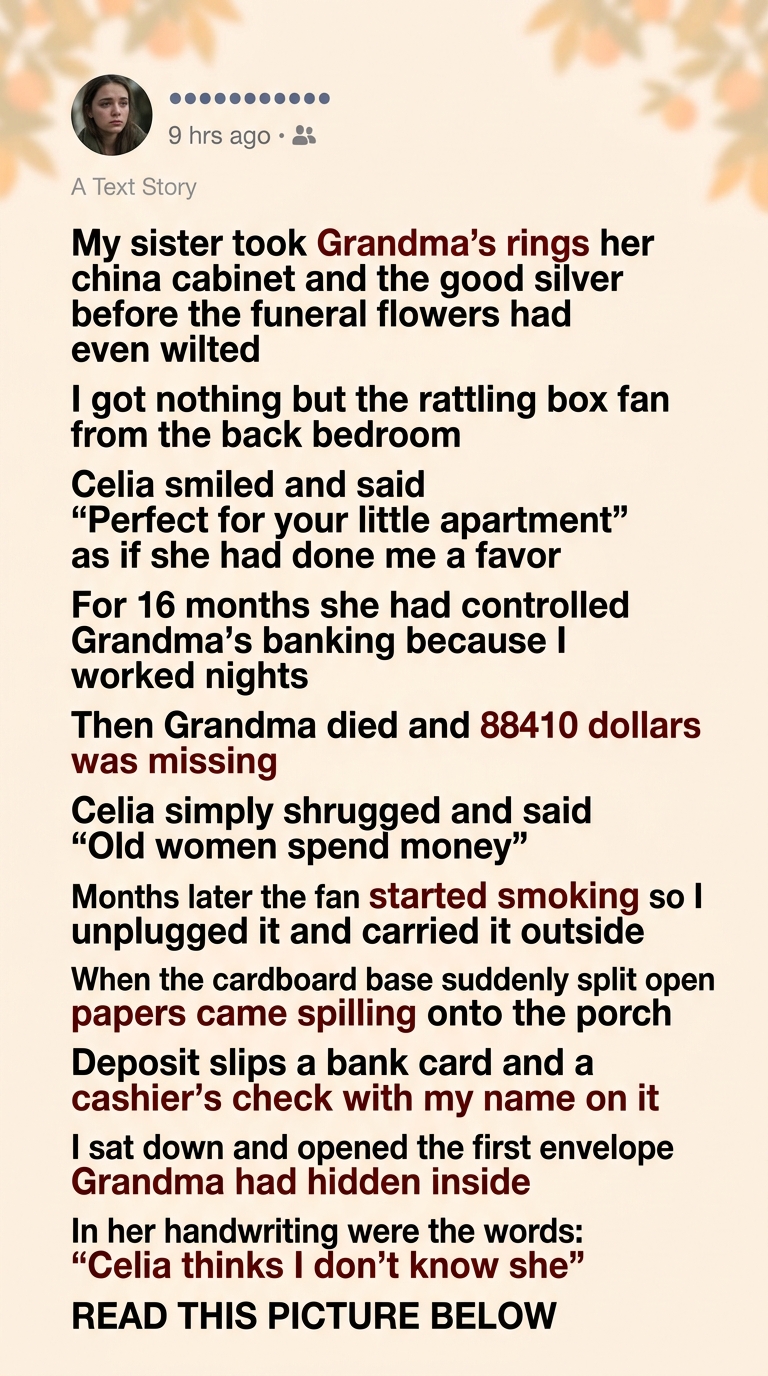
My sister took Grandma’s rings, her china cabinet, and the good silver before the funeral flowers had even wilted.
I got nothing but the rattling box fan from the back bedroom.
Celia smiled as she handed it to me.
“Perfect for your little apartment,” she said, as if she had done me a favor.
I stood there holding that dusty, yellowed fan, trying to understand how my grandmother’s belongings had been divided so quickly—and why I seemed to have been forgotten.
For sixteen months, Celia had managed Grandma’s banking. I worked nights, and Celia insisted that handling the bills, checking deposits, and keeping track of expenses was too much for Grandma to manage alone.
I trusted my sister.
That was my first mistake.
After Grandma died, I learned that $88,410 was missing from her accounts.
When I asked Celia about it, she barely looked up from her phone.
“Old women spend money,” she said with a shrug. “You know how it is. Nursing supplies, groceries, bills. It adds up.”
Her explanation sounded possible, but something about it bothered me. Grandma had always been careful with money. She saved grocery receipts, reused envelopes, and kept a handwritten record of every deposit.
I asked Celia if she had any statements or records I could review.
She became defensive immediately.
“Why are you questioning me? I was the one taking care of her while you were busy working.”
Those words silenced me.
Perhaps I had been too busy. Perhaps I should have visited more often. Guilt made it easier to accept her explanation, even though the numbers never quite made sense.
Months passed.
Celia displayed Grandma’s china in her dining room and wore her rings to family gatherings. Whenever someone asked about Grandma’s savings, Celia repeated the same explanation: the money had gone toward expenses during her final years.
I tried to move on.
Then the old fan started smoking.
One evening, I switched it off, unplugged it, and carried it outside. As I lifted it by the base, the cardboard underneath suddenly split.
Papers spilled across my porch.
At first, I thought they were old receipts and scraps of packaging. Then I noticed bank deposit slips, a bank card, and a cashier’s check bearing my name.
My hands began to tremble.
I gathered everything and brought it inside. Beneath the paperwork was a sealed envelope with my name written in Grandma’s unmistakable handwriting.
I opened it carefully.
The first line read:
“Celia thinks I don’t know what she has been doing.”
I stopped breathing for a moment.
I read the sentence again.
Grandma had known something was wrong.
The letter explained that she had noticed withdrawals she had never authorized. At first, she believed there had been a mistake. When the withdrawals continued, she began keeping copies of her bank statements and recording the dates and amounts.
She had confronted Celia privately.
According to the letter, Celia had insisted that everything was being handled properly. She even accused Grandma of forgetting conversations and confusing her own expenses.
Grandma wrote that she had wanted to believe her granddaughter. But the records told a different story.
Inside the envelope were copies of transactions showing repeated withdrawals and transfers. Some amounts matched entries in a notebook Grandma had kept in her bedroom.
The total was devastating.
The missing $88,410 was not simply a mystery. There was documentation that needed to be examined.
I looked at the cashier’s check again.
It was payable to me.
The amount was $25,000.
A second letter explained why.
Grandma had wanted to help me establish a stable life of my own. She knew I worked long nights and rarely complained, even when money was tight. She had intended to give me the money as a gift, but she had delayed telling the family because she feared Celia would interfere.
Grandma had also hidden copies of her records in the fan because she believed Celia would search her desk and filing cabinet.
The fan Celia had mocked as worthless had become Grandma’s hiding place.
I cried that night—not because of the money, but because Grandma had apparently spent her final months worrying about someone she loved and trying to protect the truth.
The next morning, I contacted the bank.
I explained that I had discovered financial records belonging to my deceased grandmother and asked how to verify the transactions and the cashier’s check. The bank advised me on the proper procedures and told me what documentation would be needed.
I did not accuse Celia publicly or spend the money immediately.
Instead, I organized every paper by date, made copies, and contacted an attorney who handled estate matters.
The records raised serious questions. Some withdrawals appeared inconsistent with Grandma’s written notes, and certain transfers required explanations that Celia had never provided.
Through the appropriate legal process, the records were reviewed.
Celia initially claimed that Grandma had given her permission to use the money. However, she could not adequately explain several transactions, and the evidence warranted further investigation.
For the first time, I was no longer relying on my sister’s version of events.
I had Grandma’s own records.
The estate process took months. There were difficult conversations, formal requests for financial documents, and family members who insisted that I should stop asking questions to keep the peace.
Celia was furious.
“You’re destroying this family over money,” she told me during one heated phone call.
“No,” I replied quietly. “I’m asking what happened to Grandma’s money.”
She had no answer that resolved the questions in the records.
Eventually, the legal review established that some funds had been improperly transferred. The estate pursued recovery through the appropriate channels, and Celia was required to account for the disputed transactions. The exact recovery was handled according to the evidence and the estate proceedings.
I also worked with the bank and the estate representative to verify the cashier’s check Grandma had left for me. Once its validity and the necessary estate requirements were confirmed, I was able to claim the gift.
The $25,000 helped me pay off debts, build an emergency fund, and move into a better apartment.
But the money was not the greatest gift Grandma had left me.
It was the knowledge that she had seen my struggles, remembered my kindness, and wanted me to have a chance at a more secure future.
Celia stopped calling after the investigation progressed. Some relatives eventually apologized for believing her explanation without asking questions. Others never did.
I learned that I could not force everyone to accept the truth. I could only preserve the evidence and let the facts speak for themselves.
One afternoon, while cleaning my apartment, I looked at the old fan sitting beside the door.
It was broken beyond repair. I had kept it for months because throwing it away felt like throwing away the last physical connection to Grandma’s final act of courage.
I finally removed the papers that remained inside and placed them safely with her letters.
Then I let the fan go.
I no longer needed it to remember her.
I remembered the woman who saved every receipt, who noticed when something was wrong, and who found a way to leave me the truth when she could no longer explain it herself.
Celia had thought she was giving me something worthless.
Instead, she had handed me the one thing she could not take away: the evidence that Grandma had never forgotten me.
And whenever I think about that terrible period after the funeral, I remember Grandma’s final words in the letter:
“Never let anyone convince you that asking for the truth makes you a bad person. The people who love you should never need you to stay silent to protect them.”