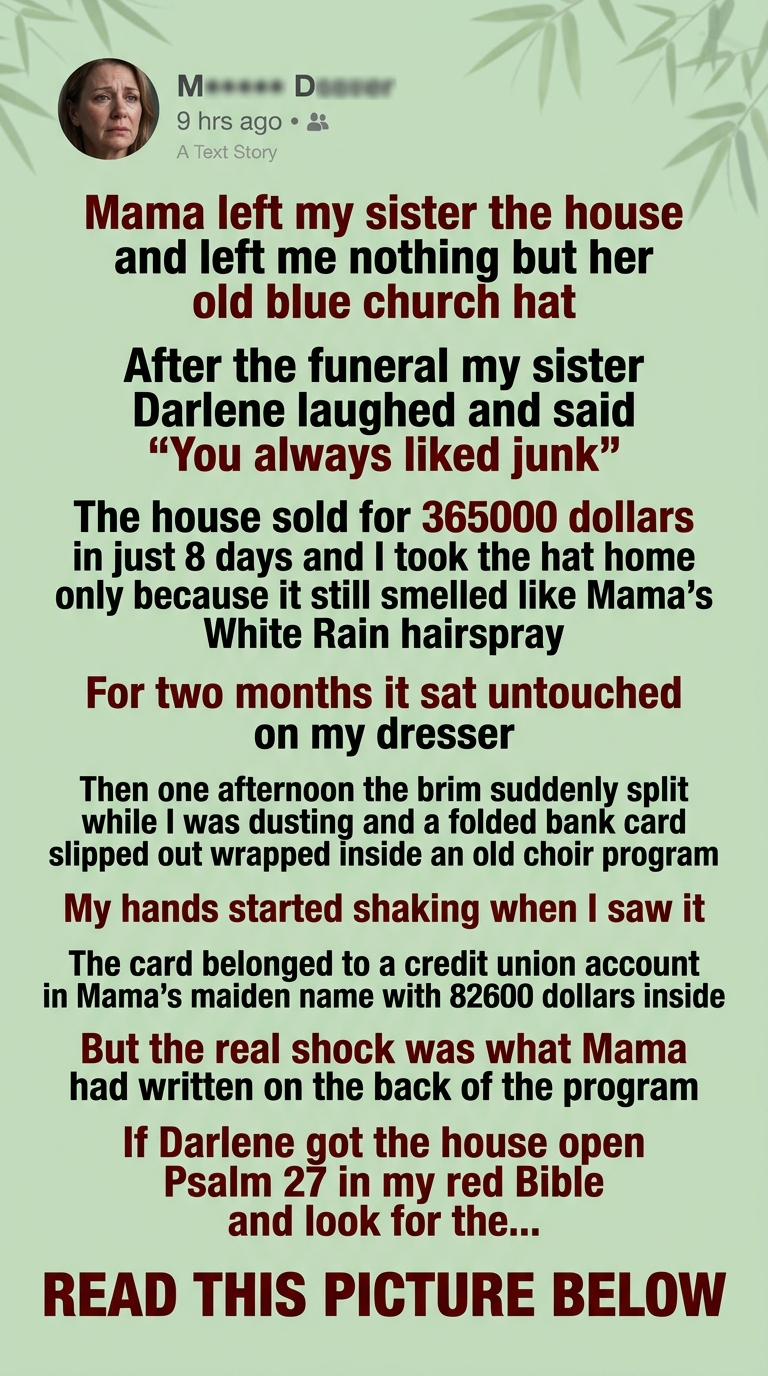
Full Story: Mama Left My Sister a $365,000 House and Me Her Old Blue Church Hat—Until I Discovered What She Had Hidden Inside It
Mama always said that a person’s true worth wasn’t measured by what they owned, but by what they left behind in the hearts of others.
I believed her.
At least, I thought I did.
Then she died, and my older sister, Darlene, inherited the family house while I received nothing but Mama’s old blue church hat.
The house sold for $365,000 in just eight days.
And the hat?
Darlene laughed when she saw me carrying it out of Mama’s bedroom.
“You always did like junk,” she said.
I didn’t answer. I simply held the hat against my chest and walked to my car.
I had no idea that the faded blue hat would eventually reveal a secret Mama had protected for decades—and expose a truth about my family that I had never imagined.
Chapter 1: The Daughter Who Received Nothing
Mama’s funeral was held on a rainy Saturday morning at the little church where she had worshipped for nearly forty years.
She had been a quiet woman, the kind who remembered everyone’s birthday, brought casseroles to grieving neighbors, and prayed for people who had treated her badly.
Her favorite possession was an old blue church hat with a wide brim and a small ribbon tied around the crown.
She wore it every Sunday.
Even when the ribbon faded and the brim began to curl, she refused to replace it.
“Some things don’t need to be new to be beautiful,” she’d tell me whenever I suggested buying her another one.
I was the younger daughter, and unlike Darlene, I had never been particularly good at pretending that everything was fine.
I had spent the last six years helping Mama through doctor’s appointments, grocery shopping, and the ordinary difficulties of growing older. I lived close enough to stop by after work, and I called her almost every evening.
Darlene lived two hours away.
She visited on holidays, sent flowers on Mother’s Day, and occasionally called when she needed advice. Mama never complained about the difference between us.
“Your sister has her own life,” she’d say.
I accepted that explanation because I loved them both.
After the funeral, we gathered at Mama’s lawyer’s office to hear the contents of her will.
Darlene sat beside her husband, Robert, wearing a black dress and a pearl necklace. She looked composed, almost impatient.
I sat across from them with my hands folded in my lap.
The lawyer read through the arrangements for Mama’s personal belongings before reaching the property.
“The family home is to be inherited by Darlene,” he announced.
My sister’s eyes immediately brightened.
“The remaining household furnishings and personal effects are to be distributed according to the attached list.”
The lawyer turned a page.
“And the blue church hat is specifically left to her younger daughter.”
For a moment, I thought there had to be some mistake.
The house was worth hundreds of thousands of dollars. Mama had spent her entire life making it a home, and I had assumed she would divide its value fairly between us.
Instead, Darlene received the house, while I received a hat that probably wasn’t worth ten dollars at a secondhand store.
I looked at the lawyer.
“Was there anything else?”
He reviewed the page.
“Not in the will.”
Darlene leaned back in her chair.
“Well,” she said, “I suppose Mama knew who could actually make use of the house.”
I stared at her.
“What does that mean?”
She shrugged.
“You have your job. You have your apartment. I have a family to take care of.”
I wanted to remind her that I had been the one taking Mama to appointments when she couldn’t drive anymore.
I wanted to tell her about the nights I stayed awake because Mama was frightened and didn’t want to be alone.
But I didn’t.
I took the hat.
And I went home.
Chapter 2: The House Sold in Eight Days
Darlene wasted no time.
Within a week, a real estate agent had photographed the house, listed it, and arranged several viewings.
The property sold for $365,000 in just eight days.
I learned about the sale from a relative who congratulated Darlene on her good fortune.
Good fortune.
Those words stayed with me.
I wasn’t angry because Darlene had received money. I was hurt because she seemed to have forgotten that our mother was more than an asset to be divided.
When I called her, she answered cheerfully.
“It’s done,” she said. “Robert thinks we’ll use the money to pay down the mortgage and finally take that trip we’ve been planning.”
“I’m glad you have a plan,” I replied.
There was a pause.
“Are you still upset about the hat?”
“No.”
“Because you know Mama loved you. You don’t need a house to prove that.”
I almost laughed at the irony.
“You’re right, Darlene. I don’t.”
“Good. Then let’s stop talking about it.”
She hung up before I could respond.
For the next two months, I kept Mama’s hat on my dresser.
Sometimes I picked it up and ran my fingers along the ribbon. It still carried the faint scent of her White Rain hairspray, and that small detail made me feel as though she had only stepped out to visit a neighbor.
I couldn’t bring myself to put it away.
It was the last thing I had that still felt like her.
Then, one Thursday afternoon, everything changed.
Chapter 3: The Card Hidden in the Brim
I was dusting my bedroom when I lifted the hat to wipe beneath it.
The brim caught against the corner of a picture frame.
A small section of the old material split with a dry crack.
I froze.
“Oh, Mama,” I whispered. “I’m sorry.”
I turned the hat over, examining the tear. The inside lining had loosened, revealing something folded into the narrow space between the layers.
At first, I thought it was a piece of paper.
Then a small bank card slipped into my palm.
My heart began to pound.
The card belonged to a local credit union. The name printed on it was Mama’s maiden name, the surname she had carried before marrying my father.
I sat on the edge of my bed and stared at it.
Why would Mama have hidden a bank card inside her church hat?
I called the credit union, but the representative couldn’t discuss an account without verifying my identity and establishing my authority to access the information.
The card alone proved nothing.
I needed to know more.
I searched the hat again and found a folded choir program tucked into the lining. It was yellowed with age, dated nearly thirty years earlier.
On the back, in Mama’s unmistakable handwriting, were these words:
“If Darlene got the house, open Psalm 27 in my red Bible and look for the envelope marked Ruth.”
I read the sentence three times.
Then I looked toward the bookshelf where I had placed Mama’s old red Bible after the funeral.
My hands were shaking.
Why had Mama mentioned Darlene receiving the house?
Had she known what would happen?
And who was Ruth?
I stood up, crossed the room, and pulled the Bible from the shelf.
I had read passages from it with Mama many times. Its pages were soft and worn, with handwritten notes tucked beside verses she had loved.
I opened Psalm 27.
Between the pages was a small, sealed envelope.
On the front, Mama had written one word.
RUTH.
I sat down before opening it.
Inside was a short letter and a credit union statement.
The statement showed an account balance of $82,600.
I covered my mouth.
Mama had left me nothing in the will, yet she had apparently known about money that wasn’t mentioned anywhere in the inheritance paperwork.
But the letter was even more surprising.
Chapter 4: The Letter Mama Never Sent
The letter began:
My dearest girl,
If you are reading this, then I am no longer here to explain everything myself. I am sorry you have had to discover these things alone.
You may be wondering why I left your sister the house and you only the blue hat.
Please understand that I did not measure my love for either of you by the things I left behind.
I stopped reading.
Tears blurred the page.
Then I continued.
The money connected to this account came from a decision I made long before either of you understood what money could mean.
Years ago, your grandmother’s sister, Ruth, helped me when your father and I were struggling. She gave me money to start over after a difficult period in our lives. I promised her I would protect it and use it to help my family when the time was right.
I kept that promise quietly. Some of the money was used over the years for emergencies, and the remainder stayed in the account.
I never wanted this money to become a reason for either of my daughters to resent the other.
I paused, trying to understand.
I had heard the name Ruth when I was a child, but I remembered very little about her. She had died before I was old enough to know her well.
Mama’s letter continued.
The account was opened in my maiden name because that was the name on the original documents. The money belongs to me, and I have kept the records together so that its purpose would not be forgotten.
Please do not assume that this account automatically belongs to you simply because you found the card. Speak with the credit union and a lawyer. I have left instructions about what I want done, but the legal documents must be followed.
I turned the page.
There was one more paragraph.
There is something else you deserve to know. Years ago, when you were struggling to finish school, I wanted to help you without making you feel that you owed me anything. I promised myself that if I could put aside enough money, I would make sure you had a chance to build a secure future.
You never asked me for anything. You simply kept showing up.
That meant more to me than you will ever know.
I lowered the letter.
For years, I had believed Mama’s decision meant she valued Darlene more than me.
Now I wondered whether there had been a reason I had never understood.
But the letter wasn’t a legal guarantee. It was a message, a clue, and a promise that needed to be checked against the actual records.
I gathered the card, statement, letter, and choir program into a folder.
The next morning, I made an appointment with an attorney.
Chapter 5: What the Records Revealed
The attorney listened carefully as I explained everything.
She examined the bank statement and the handwritten letter, then asked whether I had found any formal estate documents relating to the account.
I hadn’t.
“Your mother may have intended this money for you,” she explained, “but we need to establish who legally owns the account, whether it was included in her estate, and whether any valid beneficiary designation or other instruction exists.”
I nodded.
I didn’t want to take money that wasn’t mine.
I wanted to understand what Mama had been trying to tell me.
With the attorney’s guidance, I contacted the credit union and began the formal process of verifying the account.
The records confirmed that the account existed and had been maintained for many years.
But the most important discovery was in a file connected to Mama’s estate.
A separate document, properly signed and dated, described her intention for the remaining funds to be used to support me. The attorney still had to verify how that document interacted with the account and the rest of the estate, but it provided something the letter alone could not: evidence of Mama’s wishes in a form that could be legally reviewed.
The process took several weeks.
During that time, I told no one about the money.
Not even Darlene.
I wasn’t trying to keep a secret out of spite. I simply didn’t want to turn Mama’s final gift into another family argument before I knew what the documents actually meant.
Eventually, the attorney called me with an update.
The credit union and estate records had been reviewed, and the legal arrangements supported transferring the remaining funds to me according to Mama’s documented instructions.
The verified balance, after the account’s final adjustments, was just over $82,600.
I sat in silence as the attorney explained the next steps.
I wasn’t suddenly rich.
But I had been given something that would make my future more secure: the chance to pay off my remaining student debt, build an emergency fund, and save toward a home of my own.
More importantly, I finally understood that Mama hadn’t forgotten me.
She had left me a message that took time, patience, and careful work to uncover.
Chapter 6: My Sister Came Knocking
Darlene found out about the account through a relative who had heard that I was dealing with an estate matter.
She called me that evening.
“Is it true?” she demanded.
“Is what true?”
“That Mama left you eighty thousand dollars?”
I closed my eyes.
“I found an account and documents connected to it. The lawyer has been handling everything properly.”
“Why didn’t you tell me?”
“Because I needed to understand what the documents meant first.”
She laughed bitterly.
“So you got the house and the money after all.”
I was stunned.
“The house was yours, Darlene. You sold it for $365,000.”
“And now you’ve got eighty thousand dollars hidden in a hat. You don’t think that’s unfair?”
I took a deep breath.
“No. I don’t think it’s unfair that Mama made different arrangements for each of us. I think it would be unfair if either of us tried to claim something without understanding her wishes.”
She went quiet.
Then she asked the question I had been expecting.
“Did Mama know she was giving you more than she gave me?”
I thought about the letter.
“I don’t know exactly what she expected each of us to receive. But she clearly wanted this account handled separately, and the documents are being followed.”
Darlene’s voice grew cold.
“You always were her favorite.”
That hurt because it was the same accusation she had made when we were children.
Whenever Mama helped me with something, Darlene believed she was being overlooked. Whenever Mama bought Darlene something special, I told myself it was because she needed it more.
We had spent years comparing things that should never have been a competition.
“I never wanted to compete with you,” I said.
“Easy for you to say.”
She ended the call.
For several days, I felt the weight of the argument.
I had gained financial security, but I had also lost some of the peace I had hoped to preserve with my sister.
I wondered whether I should offer her a portion of the money simply to make the conflict disappear.
Then I remembered Mama’s letter.
She had written that I should follow the legal documents and use the money responsibly.
She hadn’t asked me to buy my sister’s forgiveness.
And she hadn’t asked me to surrender something simply because someone else was unhappy.
I decided I would not make a financial decision out of guilt.
If Darlene and I were ever going to repair our relationship, it would have to begin with honesty.
Chapter 7: The Truth About Ruth
A few weeks later, I visited the church where Mama had worshipped.
I brought the old blue hat with me.
The pastor remembered Mama immediately. He smiled when I showed him the faded ribbon.
“She wore that hat every Sunday,” he said. “Even when she could barely walk, she insisted on coming to church.”
We sat in the quiet fellowship hall and talked about her life.
When I mentioned Ruth, his expression changed with recognition.
“Ruth was a generous woman,” he said. “Your mother used to tell me how Ruth helped her when your family was young.”
He explained that Ruth had believed in helping people quietly, without expecting public gratitude.
“She once told your mother that money should give people room to stand on their own feet, not give someone else a reason to control them.”
I wrote the words down when I got home.
They sounded exactly like Mama.
That evening, I read the letter again.
I finally understood why she had hidden the card in the hat.
The hat wasn’t valuable because of the money inside it.
It was valuable because it had carried a memory of the women who had helped her survive difficult years. Ruth had helped Mama. Mama had tried to help me. And now I had the chance to carry that kindness forward.
I decided to use the money carefully.
I paid off my remaining student debt, set aside savings for emergencies, and began saving toward a small home.
I also made a modest donation to the church’s community assistance fund in Mama’s memory.
I didn’t announce the donation.
I didn’t tell Darlene.
I simply wanted to honor the kind of person Mama had been.
Chapter 8: The Apology I Never Expected
Almost a year after Mama’s funeral, Darlene called me again.
This time, she sounded different.
“Could we meet?” she asked.
We chose a small café halfway between our homes.
When she arrived, she looked tired. The money from the house sale had helped her and Robert pay down their mortgage, but they had also spent a portion of it on renovations and other expenses. Their lives were not as effortless as she had imagined they would be.
She sat across from me and stirred her coffee.
“I’ve been thinking about what happened,” she said.
I waited.
“When Mama left me the house, I thought it meant she trusted me more. And when you got the hat, I thought it meant she didn’t think you deserved anything else.”
She looked down.
“I made fun of you because I wanted to believe that.”
I felt something loosen in my chest.
“Why?”
“Because if Mama had loved us equally, then why did she leave us such different things?”
I didn’t have an easy answer.
“Maybe she had reasons we didn’t understand,” I said. “Maybe she made mistakes. I don’t know. But I don’t think she wanted us to spend the rest of our lives measuring her love in dollars.”
Darlene wiped her eyes.
“I shouldn’t have laughed at you.”
“No,” I said gently. “You shouldn’t have.”
She nodded.
“I’m sorry.”
I believed she meant it.
We didn’t resolve every hurt that afternoon. We still had different memories of our childhood, and there were things we needed to discuss honestly.
But for the first time since the will had been read, we were speaking to each other as sisters rather than competitors.
Before we left, Darlene asked if she could see the hat.
I had brought it with me.
She held it carefully, turning it over in her hands.
“She really loved this thing,” she whispered.
“She did.”
Darlene ran her finger over the ribbon.
“I wish I’d kept something like this.”
I looked at her.
“You still have the things she gave you. The house was one of them. Maybe you could find something in there that reminds you of her.”
She smiled sadly.
“I sold the house.”
“I know.”
For a moment, we sat quietly.
Then she handed the hat back to me.
“Take good care of it.”
“I will.”
Chapter 9: What Mama Really Left Me
Two years later, I moved into a modest little house of my own.
It wasn’t grand, and it wasn’t anywhere near the size of the home Darlene had inherited.
But it was mine.
I painted the kitchen a soft cream color and planted flowers along the front walkway. On a sunny Sunday morning, I placed Mama’s blue church hat on a shelf beside a framed photograph of her.
I no longer kept it because I was afraid of forgetting her.
I kept it because it reminded me of what I had learned.
People sometimes leave behind things that seem unequal.
A house.
A bank account.
An old hat.
But the value of those things doesn’t always tell the whole story.
Mama’s letter had given me financial security, but it had also forced me to confront my resentment and reconsider the way I understood love.
I had spent months believing I was the daughter who received nothing.
In reality, I had received something that couldn’t be measured by the size of a house or the balance of a bank account.
I had received a reminder that my mother had seen me, even when I felt overlooked.
And I had learned that being loved doesn’t mean being given the same things as someone else. It means being treated with care, honesty, and respect.
On the anniversary of Mama’s death, I wore the blue hat to church.
The ribbon was still faded. The brim had been carefully repaired, and the lining had been stitched back into place.
After the service, an elderly woman approached me.
“That’s a lovely hat,” she said.
I smiled.
“Thank you. It belonged to my mother.”
“She must have been a special woman.”
I looked at the photograph I carried in my purse.
“She was.”
That afternoon, I returned home and placed the hat on its shelf.
For years, I had thought the story of Mama’s will was about who received more and who received less.
Now I understood that the real story was about what happened when two daughters were forced to confront their assumptions, their jealousy, and their grief.
My sister received a house worth $365,000.
I received a blue church hat that concealed an account containing more than $82,600.
But neither gift could tell us everything about our mother’s heart.
The house gave Darlene a financial head start. The hidden account gave me a chance to build a more secure future. And the letter gave both of us something we had nearly lost forever: an opportunity to understand the woman who had raised us.
Mama’s greatest gift wasn’t the money hidden inside the hat. It was the truth that finally helped me stop measuring my worth against my sister’s—and begin living a life that was mine.