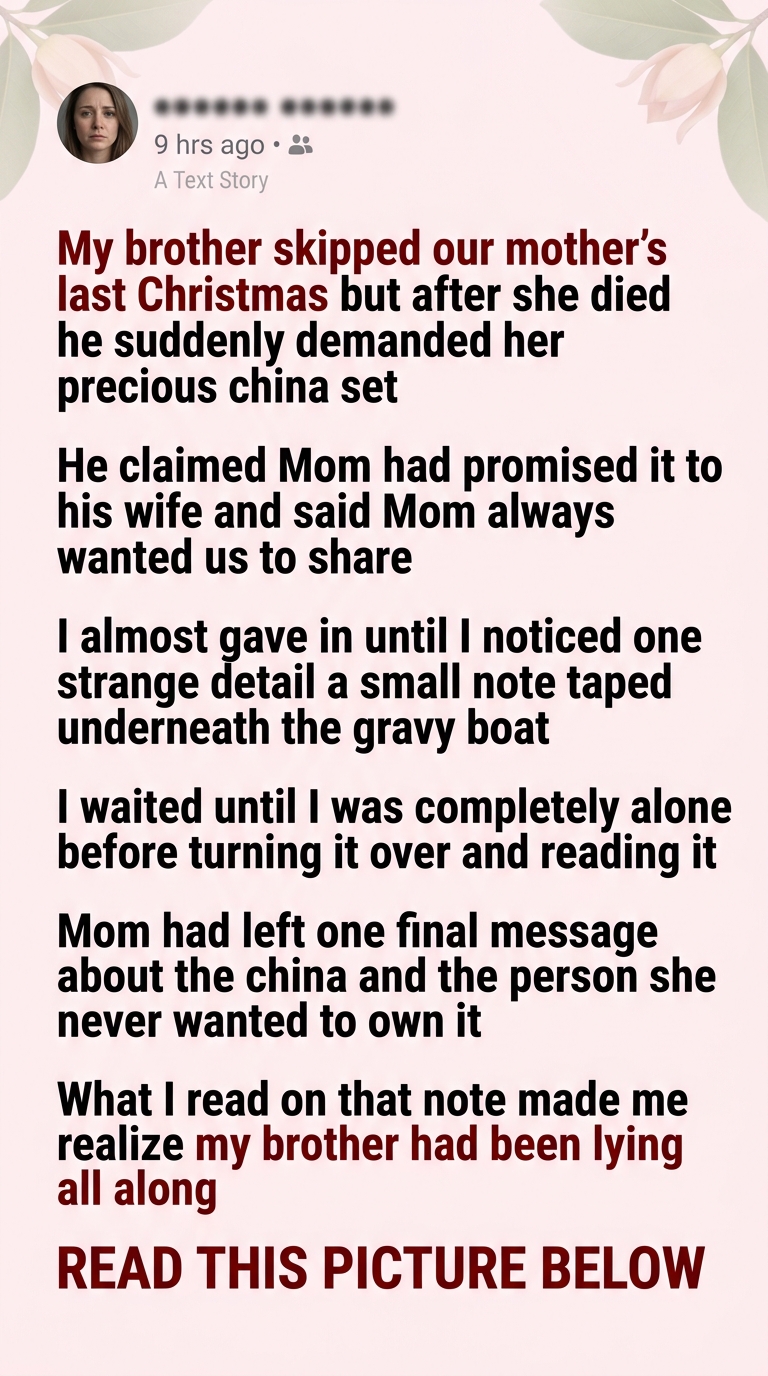
My Brother Skipped Our Mother’s Last Christmas—Then Demanded Her China
My brother, Daniel, didn’t come home for our mother’s last Christmas.
He called that morning, said he had a headache, and promised he’d visit soon. Mom smiled when she heard his excuse, but I saw her glance at the empty chair she’d set for him.
“Maybe next year,” she said.
There wasn’t a next year.
Mom died in February. After the funeral, Daniel came to my house to discuss her belongings. He barely mentioned the months he’d spent away or the calls he hadn’t returned. Instead, he asked about the china.
“You know she promised that set to Lauren,” he said, referring to his wife. “Mom always wanted us to share.”
I remembered Mom saying the china should stay in the family. I didn’t remember her promising it to Lauren. Still, grief had worn me down, and I didn’t want another fight.
“Let me think about it,” I said.
The china had been packed carefully in Mom’s dining room cabinet. I brought it home because Daniel said he’d help sort everything after the funeral, then never showed up. I’d wrapped each plate in tissue paper, just as Mom had taught me.
A week later, while unpacking the pieces, I noticed a small strip of paper taped beneath the gravy boat. It had been folded twice and pressed flat against the porcelain.
I waited until I was alone before peeling it away.
Mom’s handwriting was unmistakable.
“If Daniel asks for the china, don’t give it to him. He told me he wanted it for Lauren, but he has already sold the matching pieces I gave him last year. This set belongs with the person who stayed and cared for it. Please give it to her.”
I read the note again.
The year before, Mom had given Daniel and Lauren a smaller set of matching dishes. Mom had been proud of that gift. She’d told me Lauren loved them.
Now I understood why Mom had stopped asking about those dishes.
I called Daniel and asked him directly whether he’d sold them.
There was a long silence.
“Lauren needed the money,” he finally said. “It wasn’t a big deal. Mom didn’t use them.”
“But you told me she promised you this set.”
“She said we could have it someday.”
“Someday isn’t the same as promising it to Lauren.”
He sighed, as if I were making things difficult on purpose. “You always were Mom’s favorite.”
I looked at the note in my hand. “This isn’t about being anyone’s favorite. Mom made her wishes clear.”
Daniel hung up.
I put the china back into its cabinet, then called Lauren. I told her what I’d found and read Mom’s message aloud. Lauren grew quiet.
“I didn’t know,” she said. “Daniel told me your mom had offered it to us.”
“I’m sorry he put you in the middle.”
“So am I,” she replied. “But I don’t want it if it was meant for you.”
Mom’s note said the set should go to the person who stayed and cared for it. I hadn’t cared for the china because I expected to inherit it. I’d cared for Mom—and for the things she loved—because she was my mother.
I kept the set.
On the first Christmas without her, I brought out the plates and gravy boat. Lauren came over with a pie. Daniel didn’t.
We left an empty chair for Mom, and for the first time, it didn’t feel like waiting for someone who might still arrive. It felt like making room for the memories she’d left behind.
If you found a note like this, would you have told your brother—or quietly kept the china?