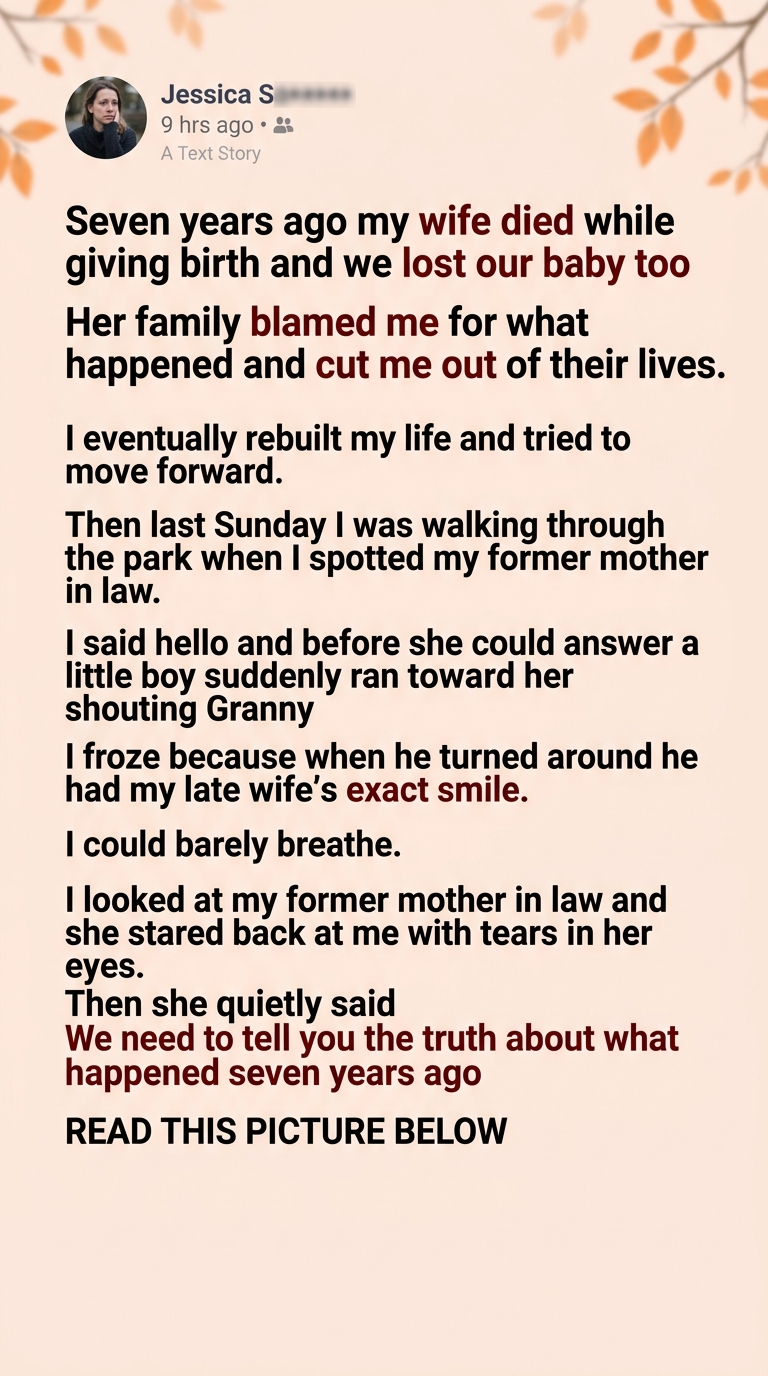
Seven years ago, my wife, Leah, died giving birth to our child.
At least, that was what I was told.
The delivery had been difficult. I remember the bright hospital lights, the nurse asking me to wait in the hallway, and the doctor coming toward me with a face I still see in my dreams.
“I’m sorry,” he said. “Your wife didn’t make it.”
Then he told me the baby had died too.
I don’t remember how I got home. I only remember Leah’s family surrounding me at the funeral, their grief hardening into blame.
“You should have taken her in sooner,” her mother, Ruth, said. “You knew she wasn’t well.”
I tried to explain that Leah had insisted she was fine until the pain became unbearable. I told them we had called the doctor and followed every instruction. But they had already chosen a story in which I was responsible.
After the funeral, Ruth told me not to contact the family again. Leah’s sister blocked my number. Their relatives stopped answering my messages. I had lost my wife, my baby, and the people I had once called family.
For a long time, I could barely function. Eventually, I moved to another town, found work, and learned to get through one day at a time. I didn’t stop missing Leah. I simply learned how to carry the grief without letting it swallow everything.
Then, last Sunday, I saw Ruth in the park.
She was sitting on a bench while a little boy played nearby. I nearly walked past. But after seven years of silence, I found myself stepping toward her.
“Hello, Ruth.”
She looked up, startled. Before she could answer, the boy ran across the path.
“Granny!”
He reached for her hand. When he turned toward me, I felt the air leave my lungs. He had Leah’s smile—the same bright, crooked grin and the same dimple in his left cheek.
I stared at him, unable to speak.
Ruth’s eyes filled with tears.
“We need to tell you the truth about what happened seven years ago,” she whispered.
The boy looked up at her. “Who’s he?”
Ruth swallowed. “This is Ben. He’s your father.”
I couldn’t take my eyes off the child. “You told me he died.”
“I know,” she said. “I’m sorry.”
She explained that the baby had been born alive but needed urgent care. The doctors had taken him to the neonatal unit while they tried to save Leah. I had been taken to another room after collapsing from shock. Ruth said that, in the confusion, she had been told the baby might not survive.
But he did survive.
“Why didn’t anyone tell me?” I asked.
Ruth twisted a tissue in her hands. “I was furious. I blamed you. When the doctor said the baby was stable, I panicked. I thought you’d take him away. I thought you’d move on and leave us with nothing of Leah.”
“So you let me believe my child was dead.”
“Yes.”
There was no version of that truth that didn’t hurt. I had spent seven years mourning a son who was alive, while Ruth raised him without telling him who I was.
“What’s his name?” I asked.
“Noah,” she said. “Leah chose it.”
The boy watched me carefully. “Are you really my dad?”
I lowered myself to his height. “Yes. I’m Ben. I’m sorry I wasn’t there when you were little.”
He didn’t run into my arms. He didn’t know me, and he had every reason to be cautious. He reached for Ruth’s hand instead.
I let him.
Ruth gave me the hospital’s contact information and agreed to a paternity test. She also said she would answer any questions Noah had truthfully. I wanted to take him home that day, but I knew he needed time, stability, and the chance to decide how he felt.
The test confirmed what I already suspected: Noah was my son.
We began with short visits in the park, with Ruth nearby. I brought picture books and listened to his stories about school. I learned that he loved dinosaurs, hated peas, and was afraid of thunderstorms. He learned that I was still figuring out what to say when I missed his mother.
One afternoon, he asked, “Did Mom know she was going to die?”
“I don’t know,” I said honestly. “But I know she loved you. She talked about meeting you all the time.”
“What was she like?”
I told him about Leah’s terrible singing, her love of rainy mornings, and the way she always made room at the table for anyone who showed up hungry. Noah laughed at the singing story.
After that, we began making a small album together. I brought the photographs I had saved: Leah holding a mug with both hands, laughing in the kitchen, standing in our garden with dirt on her cheek. Ruth added a few pictures of Noah as a baby. We didn’t pretend the past was simple. We let him see the people who loved him and the truth about how badly the adults had failed him.
Ruth and I spoke privately too. I told her that I couldn’t forgive her on command. She said she understood. She apologized without asking me to make her feel better.
Trust returned slowly, and only in small pieces. Ruth continued to be Noah’s grandmother, and I became his father one visit at a time. We agreed that Noah would have space to love both of us without being asked to take sides.
On Noah’s eighth birthday, we visited Leah’s grave together. He brought a small toy dinosaur and set it beside the flowers.
“I wish I could have met her,” he said.
“I wish that too,” I told him. “But I can tell you about her whenever you want.”
He took my hand as we walked back to the car.
That night, after I dropped him off, I sat alone and cried for the years we had lost. I was grateful to have found him, but gratitude didn’t erase the truth: I should have been there from the beginning.
The next weekend, Noah came to my home for lunch. He placed his backpack beside the door and asked if we could make pancakes. We burned the first batch. He laughed so hard he had to sit down.
When he left, he hugged me.
“Can I come back next Saturday?” he asked.
“Whenever you’re ready,” I said.
“I think I’m ready.”
The following Saturday, we made pancakes again. We talked about school, and he asked me to show him the pictures of his mother one more time. I did.
I could never get back the years we lost, and nothing could make Ruth’s choice harmless. But Noah and I still had time to build something honest.
For the first time in seven years, I was no longer imagining the family I had lost. I was learning how to be present for the family I still had.