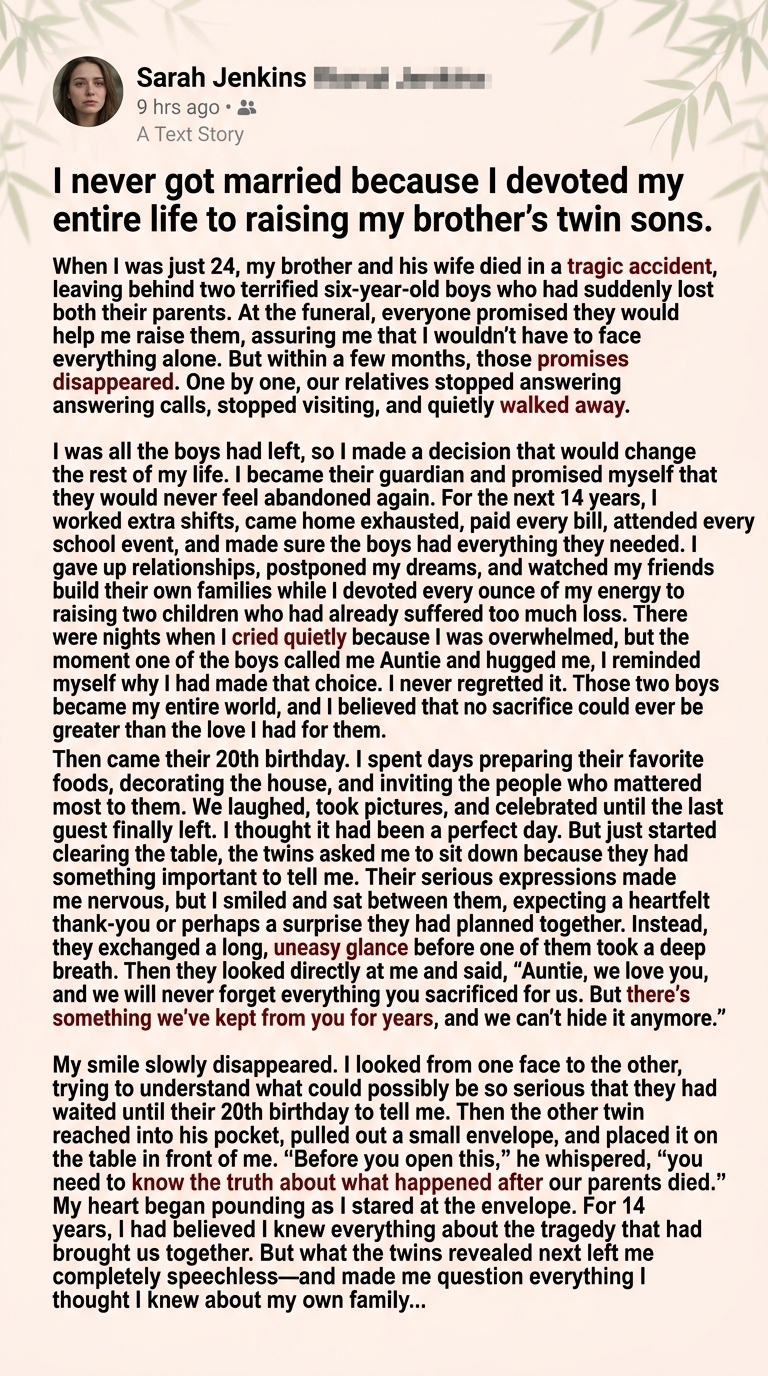
For a moment, I couldn’t bring myself to touch the envelope.
My nephews, Daniel and David, sat on either side of me. They were twenty years old now—tall, confident young men with their father’s eyes and their mother’s gentle smiles. Yet as they watched me stare at that envelope, I saw something I hadn’t seen in them since they were little boys.
Fear.
“What’s inside?” I whispered.
Daniel swallowed hard. “Letters. And some documents.”
“From whom?”
David lowered his eyes.
“From our mother.”
The room seemed to tilt around me.
Their mother, Rachel, had been dead for fourteen years. I still remembered the morning I received the phone call telling me that she and my brother, Michael, had died in a car accident. I remembered the unbearable silence that followed, the two little boys clinging to me at the funeral, and the way Daniel had asked whether his mother would be cold in the ground.
I had promised those boys that they would never have to face the world alone.
And I had kept that promise.
But now they were telling me their mother had left something behind that I had never seen.
“Why are you only showing me this now?” I asked.
Daniel took my hand.
“Because we only found out the truth three months ago.”
He explained that while cleaning out a storage unit their father had rented years before the accident, they had discovered a small metal box tucked inside an old suitcase. Their names were written on the lid in their mother’s handwriting.
Inside were letters, photographs, bank statements, and a sealed envelope marked:
For my sons, when you are old enough to understand.
They had opened it together.
And what they read had changed everything they thought they knew about the final months of their parents’ lives.
David slid the envelope toward me.
“Please read it, Auntie. Then we’ll explain.”
My fingers trembled as I unfolded the letter.
My precious boys,
If you are reading this, something has happened to your father and me before we could explain things to you ourselves.
There is something you deserve to know about your Aunt Claire.
If she has raised you, then she has given you more love than I could ever have asked for. But I need you to understand that she was never supposed to carry this burden alone.
I stopped reading.
My throat tightened.
The letter continued.
Before the accident, your father and I knew that our family was going through a difficult time. We had discovered that someone we trusted had been taking money from our savings. Your father wanted to confront that person, but I begged him to wait until we had proof.
We were afraid that the truth would destroy the family.
Your father made a decision that I did not entirely agree with. He set aside money for your future and asked Claire to help us if anything ever happened to us.
We intended to explain everything to her. We never got the chance.
I looked up.
“Someone was taking their money?”
Daniel nodded.
“We found the bank statements. There were several withdrawals before the accident, and the amounts didn’t match anything Dad had told Mom.”
“Who did it?” I asked.
Neither boy answered immediately.
David pulled another sheet from the envelope.
It was a photocopy of a handwritten note bearing my brother’s signature.
If Claire ends up raising the boys, make sure she receives what we promised her. She has spent her whole life putting everyone else first. She deserves a chance at a life of her own, too.
Below that sentence was a list of figures and an account number.
I stared at it.
My brother had apparently planned to provide money for the twins’ education and for my support as their guardian. I had never received a cent beyond the modest insurance payment that had helped cover the immediate expenses after the accident.
For fourteen years, I had worked overtime to pay for school uniforms, groceries, rent, medical appointments, and university savings.
If this money had existed, why hadn’t I known?
“Did someone steal it?” I asked.
“We don’t know for certain,” Daniel said. “The records show money being moved, but we haven’t found enough to prove who authorized every transaction. We’re getting professional advice before making any accusations.”
That answer was careful, but it frightened me more than a simple accusation would have.
Because it meant the truth was still waiting to be uncovered.
I continued reading the letter.
Claire, if you are reading this, please forgive me for not telling you everything. I wanted to protect you from the uglier parts of our family’s problems. I thought I had more time.
You have always been the person who shows up when everyone else disappears. If our boys ever need you, I know you will be there.
But I don’t want your love to become a prison. Please promise me that if you raise them, you will still make room for yourself. Don’t let our tragedy convince you that you must spend the rest of your life alone.
You deserve love, laughter, and dreams of your own.
Thank you for being the sister I could always count on.
Michael.
By the time I finished, tears were running down my cheeks.
I had spent fourteen years believing my brother had left me with nothing but grief and two children who needed me.
Now I was discovering that he had tried to leave us something else: security, protection, and the hope that I wouldn’t have to sacrifice everything.
“Why didn’t you tell me when you first found the box?” I asked.
Daniel’s face crumpled.
“Because we were angry.”
“At me?”
“No!” he said quickly. “At the person who might have taken the money. At the fact that Mom and Dad had been dealing with something so serious and we never knew. And because we started wondering whether you had known about it.”
I felt as if someone had reached inside my chest and twisted my heart.
“You thought I knew?”
“We didn’t know what to think,” David admitted. “We were afraid to ask you. We didn’t want to hurt you if it turned out you had been hiding something. But the more we read, the more we realized we couldn’t keep it from you.”
I looked at the two young men I had raised.
For one painful moment, I felt all the old exhaustion return—the years of worrying about money, the missed opportunities, the lonely evenings, the birthdays when I had pretended I didn’t mind being the only adult at the table.
Then I noticed Daniel’s hand resting over mine.
“We’re sorry, Auntie,” he whispered. “You gave us everything. We should have trusted you enough to talk about it.”
I squeezed his fingers.
“You were trying to understand something frightening. I won’t blame you for having questions.”
David took a shaky breath.
“There’s one more thing.”
He reached into the envelope and pulled out a photograph.
It showed my brother standing outside our childhood home beside our mother, Eleanor. Both were smiling, but my brother held a folder against his chest.
On the back, in his handwriting, were the words:
The day I finally told Mom what was happening.
I went cold.
Our mother had died five years after the accident. During those years, she had helped me occasionally, but she had also been distant, often saying she was too overwhelmed by her own grief to take the boys for more than a weekend.
I had never blamed her for that. We were all struggling.
But I remembered something now.
A few weeks after the funeral, Mother had asked whether my brother had left any paperwork behind. When I said I was still sorting through everything, she had told me not to worry about it.
She had offered to help handle the estate.
I had trusted her.
“Your grandmother’s name appears in the records,” David said gently. “But that doesn’t prove she did anything wrong. Some transfers might have been legitimate. We need to find out what happened.”
I stared at the photograph.
The person who might have known the most was no longer alive to answer our questions.
For years, I had believed our family had simply fallen apart after the accident. Relatives had promised help and disappeared. My mother had become withdrawn. I had buried myself in work and the boys’ needs, telling myself that if I kept moving, grief couldn’t catch me.
Now I wondered whether some of that distance had been caused by a secret none of us had understood.
The next morning, Daniel and David accompanied me to a lawyer who specialized in estate and financial matters.
We brought every document we had found. The lawyer warned us that old records could be incomplete, that signatures and transfers needed verification, and that any legal claim would depend on the documents, the applicable law, and whether it was still possible to pursue one.
We agreed not to accuse anyone until we had evidence.
Over the following weeks, we requested archived statements and reviewed the paperwork connected to my brother’s estate. Some of the transactions turned out to have reasonable explanations. Others remained unclear. We learned that my brother had opened a separate savings account intended for the twins’ education, but the balance at the time of his death was much smaller than the amount his notes suggested he had set aside.
We could not prove exactly what had happened to every dollar.
We also could not ask my mother to explain the entries that bore her name.
That uncertainty hurt.
But something else became clear: my brother had wanted to provide for his children and make sure I wasn’t left alone with the burden of raising them. Even if we never recovered the money, his intention mattered.
And the boys had not brought me that envelope because they wanted to reopen old wounds.
They had brought it because they wanted me to know that my sacrifices had never been invisible to their parents.
A month later, Daniel and David asked me to meet them at the same dining table where we had opened the envelope.
This time, there were no documents between us.
There was only a small wooden box.
“What is this?” I asked.
“Something we should have given you a long time ago,” Daniel replied.
Inside were fourteen handwritten notes, one for each year I had raised them.
They had spent months writing them, beginning with their earliest memories and ending with the young men they were becoming.
The first note was written in a child’s uneven handwriting.
Dear Auntie, thank you for making pancakes when I missed Mommy.
Another said:
Thank you for coming to my school play even when you were tired.
Another:
Thank you for teaching us that family means showing up.
By the time I reached the last note, I could barely see the page through my tears.
It read:
Dear Auntie,
We used to think you were the strongest person in the world because you never seemed to need anything.
Now that we’re adults, we understand that you were tired sometimes. You were lonely sometimes. You had dreams you put aside because you wanted us to have a safe home.
We cannot give you back those fourteen years. We cannot repay every sacrifice, and we don’t want you to think you need to keep sacrificing to prove you love us.
We want you to have a life that belongs to you, too.
So we have started saving money to help you take the trip you have talked about since we were little—the trip to see the ocean in another country. We know it won’t make up for everything, but we want to start giving some of that love back.
And when you return, we hope you’ll finally take the painting class you always wanted to try.
You raised us to become independent men. Let us be there for you now.
Love always,
Daniel and David.
I pressed the letter to my chest and cried.
Not because I regretted raising them.
Not because I wished I had chosen a different life.
I cried because, for the first time in fourteen years, I understood that loving them did not mean I had to disappear.
The following spring, I took my first overseas trip. I stood beside the ocean, listened to the waves roll across the shore, and thought of my brother and his wife. I imagined telling them that their boys were grown, kind, and brave—and that they had somehow found a way to take care of the person who had taken care of them.
When I returned home, I enrolled in a painting class.
I was the oldest student in the room, and on the first day I felt awkward holding a brush. But I kept going. Slowly, I began painting the things I had spent years rushing past: flowers on the kitchen windowsill, the light through my bedroom curtains, the faces of the two boys who had become men.
Daniel and David still visited every Sunday. Sometimes they brought groceries; sometimes we cooked together. They teased me about my paintings, and I teased them about their terrible attempts at making my favorite soup.
We never forgot the envelope.
We continued looking into the financial records when new information became available, but we stopped allowing unanswered questions to consume every family gathering. We accepted that some parts of the past might remain uncertain.
One evening, as the twins helped me hang a painting of the ocean in our living room, David stepped back to admire it.
“You look happy, Auntie,” he said.
I smiled.
“I am.”
Daniel wrapped an arm around my shoulders.
“We’re glad. You deserve that.”
I looked at the two men standing beside me and remembered the terrified six-year-old boys who had once clung to my hands at their parents’ funeral.
I had promised them they would never feel abandoned again.
I had kept that promise.
But I finally understood something my brother had tried to tell me in his last letter: a promise to love someone should never become a promise to stop living.
I had spent fourteen years giving my nephews a home.
Now, together, we were learning how to make room in that home for my future, too.
And when I looked at the painting on the wall, I realized that the most important truth revealed by the envelope wasn’t who had moved the money or why our family had fallen silent.
It was that love could survive grief, unanswered questions, and even years of sacrifice.
Sometimes, the people we raise become the people who help us find ourselves again.
And sometimes, after a lifetime of putting everyone else first, the most beautiful new beginning comes when the family you saved finally reminds you that you deserve to be cared for, too.