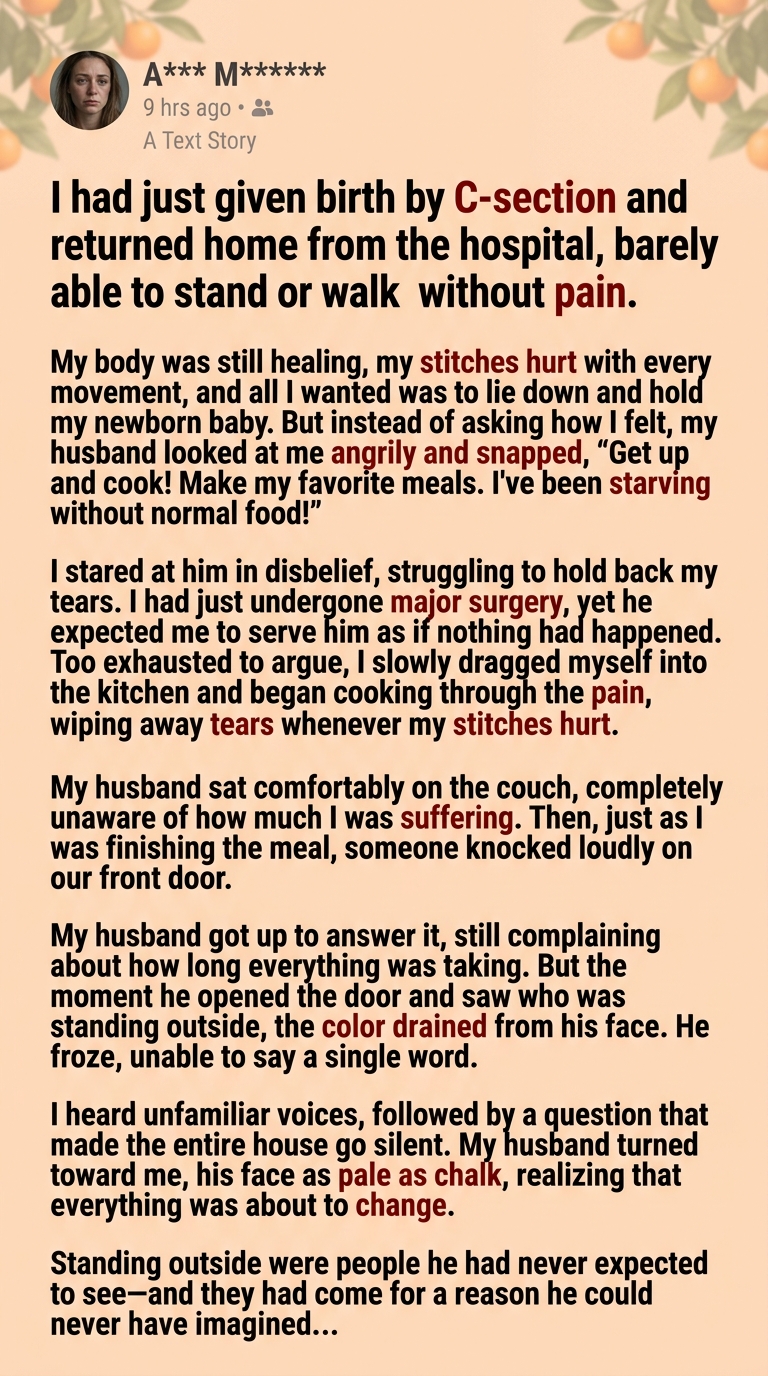
The first thing I noticed was the pain.
It followed me from the hospital bed to the car, from the car to our front door, and finally to the bedroom where I lay down with my newborn daughter in my arms.
Every movement pulled at my incision. Standing felt like an impossible task. Even laughing hurt.
My daughter, Lily, was only four days old.
I had imagined bringing her home as one of the happiest moments of my life. I thought my husband, Ryan, would help me settle in, bring me water, prepare simple meals, and spend those first precious days learning how to care for our little girl together.
Instead, he stood in the bedroom doorway with his arms crossed.
“When are you going to make something proper to eat?” he asked.
I looked up, confused.
“What do you mean?”
“I mean I’ve been eating takeout for days. I want a real meal. Make my favorite chicken curry, fried rice, and soup.”
I stared at him.
“Ryan, I just had surgery. The doctor told me I need to rest.”
He rolled his eyes.
“You’re home now, aren’t you? You can’t stay in bed forever.”
I looked down at Lily, who was sleeping against my chest.
I was so tired that even finding the words to answer him seemed difficult.
“Could you please make something simple yourself? I can barely stand.”
His expression hardened.
“So now I have to cook in my own house? I work all day. The least you can do is make me dinner.”
I wanted to remind him that I had spent nine months carrying our child, followed by hours of labor and major abdominal surgery.
But I didn’t have the energy to fight.
I carefully placed Lily in her bassinet, pushed myself upright, and slowly walked toward the kitchen.
Each step hurt.
I held the counter for support while taking ingredients out of the refrigerator. I moved carefully, trying not to bend too far or lift anything heavy.
Tears blurred my vision as I chopped vegetables.
I wasn’t crying because the cooking was difficult.
I was crying because the man I had expected to protect me seemed unable—or unwilling—to recognize that I was suffering.
From the living room, I could hear Ryan watching television.
“How much longer?” he called.
I wiped my face with the back of my hand.
“Almost done.”
I stirred the curry, checked the rice, and tried to ignore the ache spreading through my abdomen.
Then came a loud knock at the front door.
Ryan groaned.
“Finally. Maybe that’s the delivery I ordered.”
He walked toward the entrance, still complaining about how long dinner was taking.
I heard the door open.
Then silence.
Not ordinary silence.
The kind that comes when someone sees something they never expected.
“Good afternoon, Ryan,” a woman’s voice said.
I recognized it immediately.
It was my mother-in-law, Margaret.
But she wasn’t alone.
Another voice followed—a man’s deep, unmistakable voice.
“Is your wife home?”
My father.
I stopped stirring.
My father, David, lived several hours away. He had called me every day since the birth, but I had told him I was recovering well because I didn’t want him to worry.
I had not told him that Ryan was refusing to help me.
I heard Ryan stammer.
“Yes. She’s—she’s in the kitchen.”
“Why is she in the kitchen?” my father asked.
Nobody answered.
Then my mother-in-law spoke, and her voice was colder than I had ever heard it.
“Ryan, we need to talk.”
My father appeared in the kitchen doorway a moment later. Behind him stood my mother-in-law and my older sister, Anna.
My father’s eyes moved from my face to the knife on the cutting board, then to the pot on the stove.
Finally, he noticed the way I was leaning heavily against the counter.
His expression changed.
“Sweetheart,” he said softly, “what are you doing?”
I tried to smile.
“Making dinner.”
He looked at the food.
“How long have you been standing here?”
I opened my mouth, but no words came out.
My sister stepped forward and gently took the spoon from my hand.
“Sit down,” she said.
“I’m almost finished.”
“No,” my father replied. “You are finished.”
His voice wasn’t loud, but it left no room for argument.
He turned off the stove, pulled out a chair, and helped me sit down. Anna brought me a glass of water while Margaret went to check on Lily.
Then my father looked at Ryan, who had remained near the doorway.
“Explain to me why my daughter is cooking a full meal four days after major surgery.”
Ryan shifted uncomfortably.
“She said she was going to make dinner.”
My sister stared at him.
“Did you ask her to?”
He hesitated.
“I was hungry. I just wanted something homemade.”
My father looked at him for several seconds.
“Your wife has just given birth to your child. She is recovering from surgery. And you thought the appropriate thing to do was demand that she cook for you?”
Ryan’s face reddened.
“You’re making it sound worse than it was.”
“No,” Margaret said quietly. “We’re finally seeing it for what it is.”
Ryan turned toward his mother.
“Mom, stay out of this.”
She didn’t move.
“I will not stay out of this.”
She looked at me, and her eyes filled with tears.
“Sweetheart, I’m sorry.”
I blinked in surprise.
“Sorry for what?”
“For the way my son has treated you. And for not noticing sooner.”
I didn’t understand.
Then Anna pulled out her phone.
“Mom called me this morning,” she explained. “She wanted to know whether you needed anything. When she couldn’t get through to you, she asked me to stop by.”
My mother-in-law nodded.
“Ryan told me you were resting and that everything was fine. But when I spoke to your sister, she said you sounded exhausted on the phone yesterday.”
I looked down.
I had told Anna I was fine, too. I had only admitted that I was struggling to sleep and move comfortably.
“I didn’t want everyone worrying,” I whispered.
My father crouched beside my chair.
“You’re allowed to need help, sweetheart.”
Those words broke something inside me.
For days, I had tried to be the easy patient, the grateful new mother, the wife who didn’t complain.
I had convinced myself that if I just pushed through the pain, things would settle down.
But sitting there with my family around me, I finally allowed myself to cry.
My father wrapped his arms around me carefully, avoiding my incision.
“You don’t have to pretend with us,” he whispered.
Ryan watched in silence.
Then my mother-in-law turned toward him.
“Do you remember what you promised us before Lily was born?”
He looked at the floor.
She continued.
“You told us that you would take care of your wife during her recovery. You said you had arranged time off work and that you were ready to help with the baby.”
“I am helping,” he muttered.
“How?” Anna asked.
He didn’t answer.
Margaret took a slow breath.
“Ryan, when we heard that she had been cooking, we came here because we were concerned. We expected to find her resting. Instead, we found her standing at a stove while she was still recovering from surgery.”
She paused.
“And the question I want you to answer is this: If your wife had collapsed in that kitchen, what would you have told your daughter about the way you treated her mother?”
The entire house went silent.
Ryan stared at his mother.
For the first time, he seemed to understand that this wasn’t an argument about dinner.
It was about whether he considered my pain important.
He looked toward the kitchen counter, where I had left my dish towel.
“I didn’t think—”
“That’s the problem,” my father said. “You didn’t think about her.”
Ryan opened his mouth, then closed it.
My daughter began crying from the bedroom.
I instinctively started to rise.
Anna gently placed a hand on my shoulder.
“I’ll get her.”
She returned a moment later with Lily in her arms and settled beside me so I could hold my baby without standing.
As I looked at Lily’s tiny face, I felt something shift inside me.
I loved my husband. I wanted our daughter to grow up in a loving home. I wanted our family to work.
But I suddenly understood that wanting those things could not mean accepting any treatment simply to preserve the appearance of a happy marriage.
I needed help.
I needed rest.
And I needed Ryan to take responsibility.
My father stood.
“You’re coming with us for a few days,” he said to me. “You and Lily can stay at our house while you recover.”
Ryan immediately protested.
“You’re not taking my wife and daughter away from me.”
My father remained calm.
“Nobody is making a permanent decision today. Your wife needs a safe, supportive place to recover, and she has the right to choose where she feels comfortable.”
Everyone looked at me.
For a moment, I was afraid to speak.
Then I took a breath.
“I want to go with them,” I said.
Ryan looked stunned.
“You can’t be serious.”
“I am. I need to recover, and I can’t do that while I’m being pressured to work through my pain.”
He shook his head.
“So you’re just going to leave?”
“I’m going to rest. I’m going to take care of Lily. And I’m going to think about what I need from this marriage.”
He looked toward his mother, perhaps expecting her to defend him.
She didn’t.
Instead, she said, “You should be grateful that your wife has people willing to help her. You should be asking what you can do to make things right.”
Ryan’s shoulders dropped.
My father and Anna helped me gather a few essentials. Margaret prepared a bag for Lily and checked that we had her diapers, clothes, and feeding supplies.
Before we left, Ryan approached me.
“Can we talk privately?”
I nodded.
He stood a few feet away, looking uncomfortable.
“I didn’t realize you were in that much pain.”
I looked at him sadly.
“I told you I could barely stand.”
He lowered his eyes.
“I know.”
“You didn’t need to understand every detail of my recovery to know that I needed help. You only needed to listen.”
He was quiet for a long time.
Then he whispered, “I’m sorry.”
I believed that he was sorry in that moment.
But I also knew an apology wasn’t the same as change.
“I need you to understand something, Ryan,” I said. “I am not asking you to be perfect. I am asking you to care when I’m hurting. I need a partner, not another person I have to take care of.”
He nodded, his eyes wet.
“I’ll do better.”
“I hope you do.”
Then I left with my family.
For the next several days, I stayed at my parents’ house. My father prepared simple meals, Anna helped with the baby, and my mother-in-law visited with groceries and clean clothes.
Most importantly, I followed my medical team’s recovery instructions instead of pushing myself to meet someone else’s demands.
The first night, I slept for nearly five uninterrupted hours.
When I woke, Lily was resting in her bassinet, and my father was sitting in the next room, reading a book.
I had never felt so relieved to do so little.
Ryan called every day.
At first, he apologized repeatedly and asked when I was coming home.
I told him I wasn’t ready to decide.
Eventually, his questions changed.
He asked how my incision was healing. He asked whether Lily was feeding well. He asked what the doctor had said at my follow-up appointment.
He began attending appointments when I invited him, and he took a parenting class with me so we could learn how to care for our daughter together.
He also arranged counseling after I told him that his behavior had damaged my trust.
I made it clear that I would not return simply because he promised to change.
Over the following weeks, I watched what he did rather than relying only on what he said.
He learned to prepare meals. He helped with laundry. He took care of household tasks without treating them as favors. He began asking what I needed instead of assuming that I would manage everything myself.
There were difficult conversations, and some days I still felt angry.
But Ryan stopped telling me that I was exaggerating. He listened when I explained why his demands had frightened and hurt me. He accepted that rebuilding trust would take time.
When my doctor confirmed that I was recovering well enough to return home, Ryan asked whether I felt ready.
For the first time since Lily’s birth, he left the decision entirely to me.
I chose to return.
Not because I had forgotten what happened.
Not because I believed marriage required endless forgiveness.
I returned because I had seen consistent changes, because we had begun addressing the problem honestly, and because I wanted to give our family a chance to grow into something healthier.
The first evening back, Ryan made dinner.
It wasn’t particularly good.
The rice was slightly overcooked, and the vegetables were cut into uneven pieces. But he brought me a plate, placed a glass of water beside it, and asked whether I was comfortable before sitting down.
I looked at him.
“Thank you,” I said.
He nodded.
“I should have done this from the beginning.”
“Yes,” I replied. “You should have.”
We ate quietly for a while.
Then Lily began fussing in her bassinet, and Ryan stood to pick her up.
“I’ve got her,” he said. “You finish eating.”
I watched him cradle our daughter, speaking softly as he rocked her.
And for the first time in days, I felt a little hope.
Not because one dinner had fixed everything.
But because he was finally learning that caring for his family meant participating in the work, sharing the responsibility, and treating the people he loved with respect.
Months later, when Lily smiled at him for the first time, Ryan cried harder than I did.
He held her carefully and whispered, “I’ll spend my life trying to be worthy of your trust.”
I hoped he meant it.
But I also knew that love was not proved by one emotional promise. It was proved in the quiet moments that followed—in the meals prepared, the nights shared, the appointments attended, and the willingness to listen when someone said they were hurting.
As for me, I learned a lesson I wish I had understood earlier.
Recovering from childbirth is not a test of how much pain a woman can endure. And being a loving wife does not mean sacrificing your health to keep someone else comfortable.
My father and mother-in-law hadn’t arrived to destroy my marriage.
They had arrived because someone finally recognized that I needed help.
Their unexpected visit forced a conversation that should have happened long before I came home from the hospital.
And that conversation gave me the chance to protect my health, establish boundaries, and decide what kind of family I wanted my daughter to grow up in.
I still remember that afternoon—the unfinished curry, the tears on my face, and the look of shock on Ryan’s face when he opened the door.
But I no longer remember it as the day everything fell apart.
I remember it as the day I stopped pretending I was fine.
And the day I began to understand that a woman deserves care when she is vulnerable, respect when she speaks, and love that never asks her to suffer in silence.