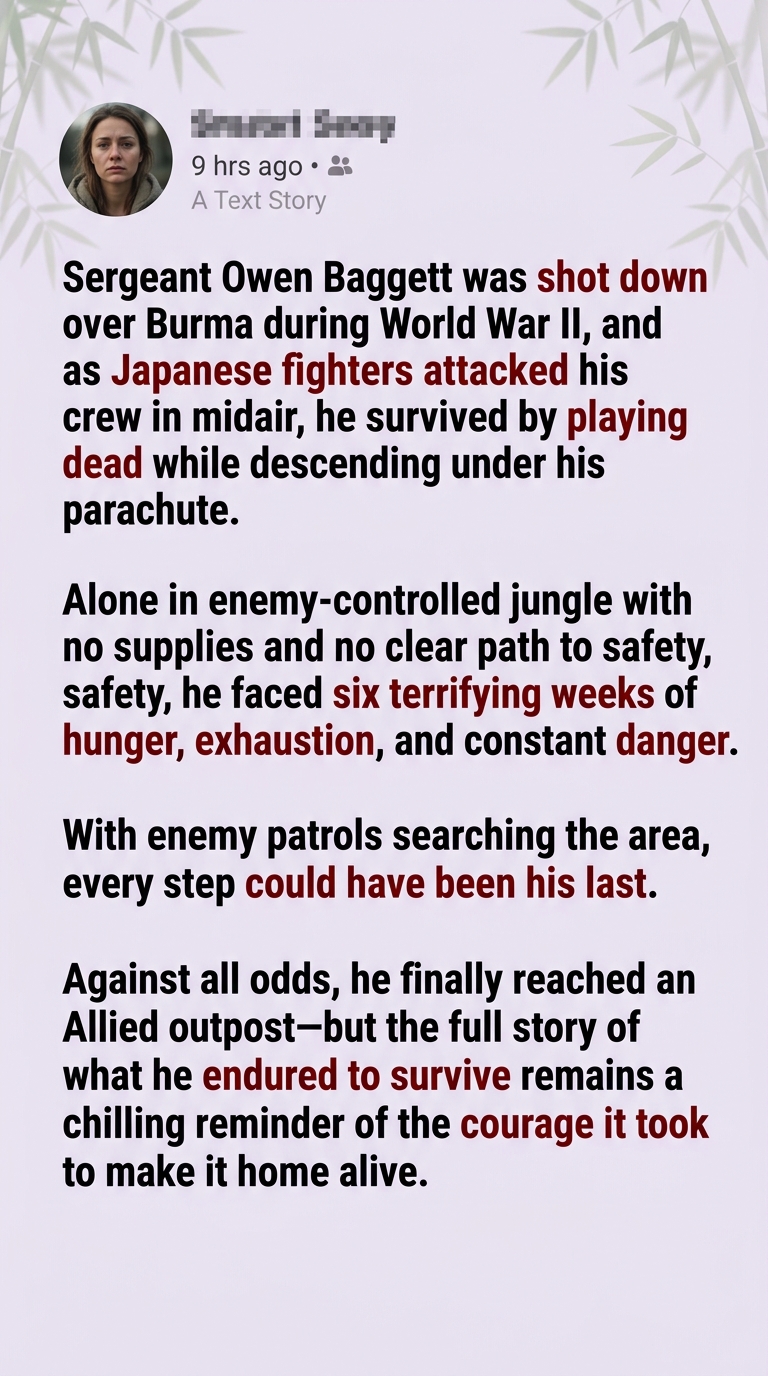
On March 31, 1943, high above the jungles of Burma, an American bomber was caught in a deadly battle with Japanese fighter aircraft.
Inside the burning B-24 Liberator was Second Lieutenant Owen J. Baggett.
He was young, far from home, and about to face one of the most extraordinary experiences of his life.
Baggett served with the United States Army Air Forces during World War II. His unit had been assigned a dangerous mission: strike a strategically important bridge near Pyinmana, Burma, which was being used to support Japanese operations.
But before the bombers could reach their target, Japanese fighters intercepted them.
Enemy aircraft attacked the American formation, tearing into the bombers with machine-gun fire. Baggett’s aircraft was hit, and the damage became critical. Flames spread through the plane, leaving the crew with little choice.
They had to abandon the bomber.
As the crew bailed out, the burning aircraft continued to fall toward the jungle below. Baggett opened his parachute and began descending into enemy-controlled territory.
But the danger was far from over.
Japanese fighters continued attacking the American airmen as they floated helplessly beneath their parachutes. In the open sky, there was little cover and almost nowhere to hide.
Two of Baggett’s fellow crewmen were killed during the attack, and Baggett himself was wounded in the arm.
He knew that the enemy aircraft might return.
So he made a desperate decision.
Baggett went limp in his parachute harness and pretended to be dead, hoping the Japanese pilots would lose interest and leave him alone.
For a moment, the deception appeared to work.
Then one Japanese fighter returned.
The pilot circled Baggett and approached remarkably close, apparently trying to determine whether the American airman was still alive. The fighter slowed as it came near his parachute, and the pilot opened the cockpit canopy.
Baggett saw an opportunity.
Despite his wound and the danger of falling through the air, he drew his .45-caliber M1911 pistol and fired four shots toward the fighter’s cockpit.
According to Baggett’s account, the aircraft suddenly stalled and spiraled downward.
For decades, this incident would become one of the most famous stories associated with the M1911 pistol: an American airman supposedly shooting down an enemy fighter while suspended beneath a parachute.
But there is an important distinction between the story and what historians can confirm.
Baggett believed he had hit the Japanese pilot. A later account relayed to him in captivity suggested that the pilot had died from a gunshot wound after the aircraft crashed.
However, Japanese wartime records do not clearly confirm that a fighter was lost in the incident. The aircraft may have recovered, or the precise circumstances may never be established.
The dramatic encounter remains a celebrated but disputed episode of World War II aviation history.
What happened to Baggett afterward is much less uncertain.
He reached the ground alive, but he had landed in hostile territory. He was soon captured and handed over to Japanese forces.
His battle for survival had changed dramatically.
Instead of fighting in the sky, Baggett now faced life as a prisoner of war.
He was transported to a prison camp near Singapore, where he endured more than two years of captivity. Conditions were harsh, food was inadequate, and prisoners faced disease, exhaustion, and mistreatment.
Baggett’s weight fell dramatically during his imprisonment.
The freedom he had once taken for granted was replaced by uncertainty about whether he would ever see home again.
Yet he survived.
In 1945, as Japan’s defeat approached, Allied personnel organized operations to locate and liberate prisoners of war. Baggett and other American prisoners were eventually freed in Singapore.
After more than two years in captivity, he had survived the destruction of his aircraft, enemy attacks in the air, capture on the ground, and the hardships of a Japanese prison camp.
His war was finally over.
But Baggett’s story did not end with his release.
He continued his military career after the war and later served in the newly established United States Air Force, eventually retiring as a colonel in 1973.
He lived a long life after the conflict, passing away in Texas in 2006.
Today, Owen Baggett is remembered for his extraordinary escape from a burning bomber, his desperate attempt to defend himself while descending under a parachute, and his endurance as a prisoner of war.
The famous pistol story remains part of his legacy, though the precise outcome of the encounter cannot be established with certainty.
And perhaps that uncertainty makes his story even more human.
War is often remembered through clear victories and defeats, confirmed kills and official records. But the experience of an individual caught in a collapsing aircraft, wounded in the open sky, and surrounded by enemy forces is rarely so simple.
Baggett had no guarantee that he would survive the next minute, let alone the next two years.
He acted with the information and opportunities available to him, then endured captivity until freedom finally came.
His story reminds us that surviving a war was not always about winning a battle. Sometimes, it meant making one desperate decision after another, holding on through terrible uncertainty, and finding the strength to continue.
This is the story of Owen J. Baggett, the American airman who survived a burning bomber, a perilous descent over Burma, and years of captivity during World War II.
You’re watching Battle Archives—where every battle tells a story.
Subscribe for more stories of courage, survival, and the people who lived through history.

