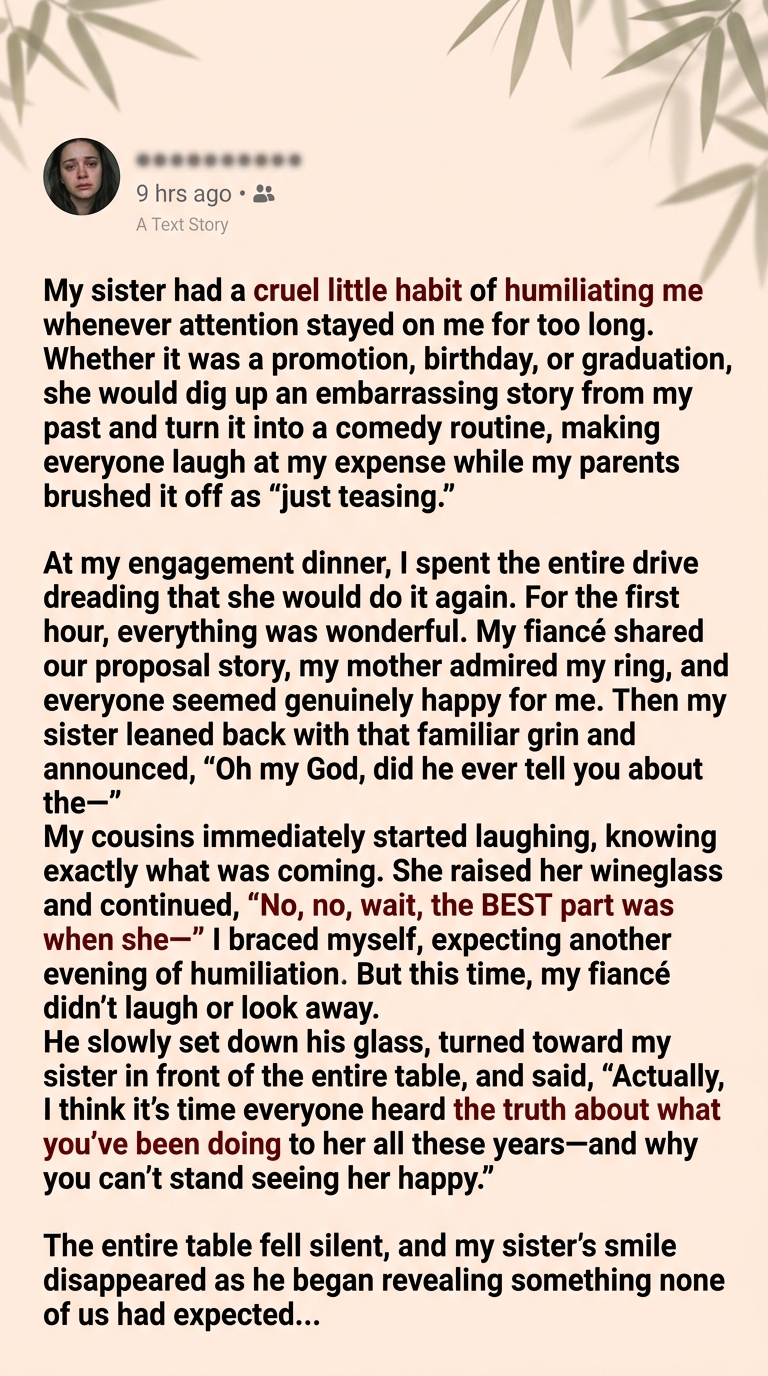
For as long as I could remember, my older sister, Vanessa, had a talent for making me feel small.
She never shouted at me. She never openly called me names. Instead, she waited until I was happy, surrounded by people, and finally enjoying a moment that belonged to me.
Then she would tell a story.
Sometimes it was about the time I tripped during a school performance. Sometimes it was about a teenage crush, an awkward haircut, or a mistake I had made years earlier.
She always told the stories with perfect comic timing. My cousins laughed. My parents smiled awkwardly. And Vanessa sat back, pleased with herself.
Whenever I confronted her afterward, she gave me the same answer.
“Oh, come on. It was just teasing.”
My mother would add, “You know how your sister is. Don’t take everything so personally.”
So I learned to laugh along, even when I wanted to disappear.
At my graduation dinner, Vanessa told everyone about a presentation I had stumbled through in college.
At my first major promotion celebration, she brought up an embarrassing mistake from my first job.
And at my birthday party, she managed to turn a heartfelt toast into a story about the time I cried over a boy in high school.
Every time, the message was the same: I wasn’t allowed to enjoy my achievements without paying for them with a little humiliation.
When I became engaged to Daniel, I hoped things might finally be different.
Daniel was thoughtful, observant, and quietly confident. He had met my family several times, and he had noticed how Vanessa treated me long before I admitted how much it hurt.
“You don’t have to pretend it’s funny when it isn’t,” he once told me.
I shrugged.
“It’s easier than arguing with everyone.”
He didn’t push me, but I could tell he didn’t agree.
Then came our engagement dinner.
I spent the entire drive to the restaurant worrying about what Vanessa might say.
Daniel noticed my silence and reached over to hold my hand.
“Tonight is about us,” he said. “You deserve to enjoy it.”
For the first hour, everything was wonderful.
My mother admired my ring. My father raised a glass to our future. Daniel told everyone how we had met and described the moment he realized he wanted to marry me.
Even Vanessa behaved herself.
I began to relax.
Then, just as dessert arrived, she leaned back in her chair with that familiar grin.
“Oh my God,” she announced. “Did he ever tell you about the—”
My cousins immediately started laughing.
I knew that sound. They were already anticipating the punchline.
“No, no, wait,” Vanessa continued, raising her wineglass. “The BEST part was when she—”
I felt my shoulders tighten.
I stared at my plate, preparing to endure another story about a version of myself I had worked hard to leave behind.
But Daniel didn’t laugh.
He slowly placed his glass on the table.
“Actually, Vanessa,” he said calmly, “I think it’s time everyone heard the truth about what you’ve been doing to her all these years.”
The laughter stopped.
Vanessa blinked.
“Excuse me?”
Daniel turned slightly toward the rest of the table.
“I’ve heard you make jokes about her mistakes, her insecurities, and things she told you in confidence. Every time she achieves something, you find a way to embarrass her. And when she gets upset, you tell everyone she’s too sensitive.”
Vanessa gave a short laugh.
“Oh, please. We’re sisters. This is what families do.”
“No,” Daniel replied. “Families can joke with each other. But when one person repeatedly asks another to stop, and the behavior continues, it isn’t harmless teasing anymore.”
My father shifted uncomfortably in his chair.
My mother began to say something, but Daniel continued.
“What bothers me most is that you seem to need her to feel smaller whenever she’s happy.”
Vanessa’s smile faded.
“You have no idea what you’re talking about.”
“Maybe not everything,” Daniel said. “But I know what you told me when I first asked you about her.”
I looked at him, confused.
“What did she tell you?” I asked.
Daniel turned toward me.
“A few months ago, Vanessa called me. She said she wanted to warn me about marrying you.”
My stomach tightened.
“What?”
“She told me that you were insecure, that you couldn’t handle criticism, and that eventually you’d try to control our relationship. She said I should be careful because you always needed to be the center of attention.”
The room became completely silent.
I stared at my sister.
She looked down at her napkin.
Daniel continued carefully.
“I asked her why she was telling me these things. She said she was trying to protect me. But when I asked for specific examples, she couldn’t give me anything that matched the person I knew.”
“That’s not what happened,” Vanessa snapped.
“Then tell us what did happen,” Daniel replied.
For the first time that evening, Vanessa had no quick joke.
I felt hurt, but beneath the hurt was something else: a strange clarity.
For years, I had wondered whether I really was too sensitive. Maybe I couldn’t take a joke. Maybe I was the one making family gatherings uncomfortable by reacting to things everyone else found funny.
But now someone outside my family had noticed the pattern.
And he wasn’t asking me to laugh it off.
Vanessa finally spoke.
“I was only trying to make sure he knew what he was getting into.”
“By telling him private stories about me?” I asked. “By describing me as someone I’m not?”
She folded her arms.
“You’ve always had everything handed to you.”
I stared at her.
“Everything?”
“You were always the one everyone celebrated. Your achievements, your relationships, your plans. Everyone acts like you’re so wonderful.”
My father looked up.
“Vanessa, that’s not fair.”
She ignored him.
“You get one promotion, and everyone wants to hear about it. You get engaged, and suddenly the whole family has to gather around you. What about me?”
There it was.
Not an explanation that excused her behavior, but a glimpse of the resentment beneath it.
For years, she had felt overlooked, and instead of telling us she was hurting, she had learned to pull attention away from me.
Whenever I had a happy moment, she turned it into a competition.
Whenever I felt proud, she found a way to make me embarrassed.
And because the rest of us had laughed or stayed silent, the pattern had continued.
I took a slow breath.
“Vanessa, I’m sorry if you’ve ever felt overlooked. I really am. But you don’t get to punish me for it.”
She looked at me, her eyes filling with tears.
“I never thought you’d take it this seriously.”
“That is exactly the problem,” I replied. “I’ve told you it hurts me for years. You just never believed I would stop accepting it.”
Nobody spoke.
Then my mother reached across the table.
“I should have listened to you,” she said quietly. “I kept calling it teasing because I didn’t want to admit that one of my daughters was hurting the other.”
My father nodded.
“We should have stepped in.”
It wasn’t a perfect apology, and it didn’t erase years of painful memories. But it was the first time my parents had acknowledged what was happening without telling me to get over it.
Vanessa left the dinner early.
For a moment, I felt guilty. I wondered whether Daniel had ruined what should have been a happy evening.
Then he took my hand beneath the table.
“I’m sorry if I made things harder,” he whispered. “I just didn’t want you sitting here believing you had to accept that treatment.”
I squeezed his hand.
“Thank you for saying what I couldn’t.”
The rest of the evening wasn’t exactly a celebration. Some relatives tried to change the subject, while others quietly admitted that they had noticed Vanessa’s behavior but never known what to do.
But something important had changed.
I no longer felt obligated to pretend I was amused.
Over the following weeks, Vanessa sent several messages. The first blamed Daniel for embarrassing her. The second accused me of turning the family against her.
I didn’t respond immediately.
Eventually, she sent a different message.
She admitted that she had been jealous for years. She said she had felt as though my achievements made her own life look smaller, and making jokes about me had become a way to regain attention.
She also admitted that she shouldn’t have spoken to Daniel about our relationship behind my back.
Her apology was imperfect, but it was the first one that acknowledged what she had actually done.
I told her I was willing to work toward a better relationship, but things had to change. No more humiliating stories, no more private information used as entertainment, and no more pretending that my hurt was the real problem.
She agreed.
Rebuilding trust took time. We didn’t become inseparable overnight, and I didn’t forget what had happened simply because she apologized.
But at our wedding, Vanessa stood up during the reception and gave a short toast.
She talked about growing up together, about how we had often competed when we should have supported each other, and about how she wanted to do better.
Then she looked directly at me.
“You deserve to enjoy your happiness without feeling like you have to defend it,” she said.
For once, there was no punchline.
I smiled through my tears.
Our relationship wasn’t magically perfect, but it had a chance to become something healthier because the truth had finally been spoken.
And Daniel taught me something that night that I carry with me even now:
Love doesn’t mean laughing when someone hurts you. Family doesn’t get unlimited permission to cross your boundaries. And sometimes, the person who changes a painful family pattern is the first one brave enough to say, “This isn’t funny anymore.”
My engagement dinner didn’t end with everyone laughing.
It ended with everyone finally listening.
And that was the moment I stopped being the punchline in my own life.

