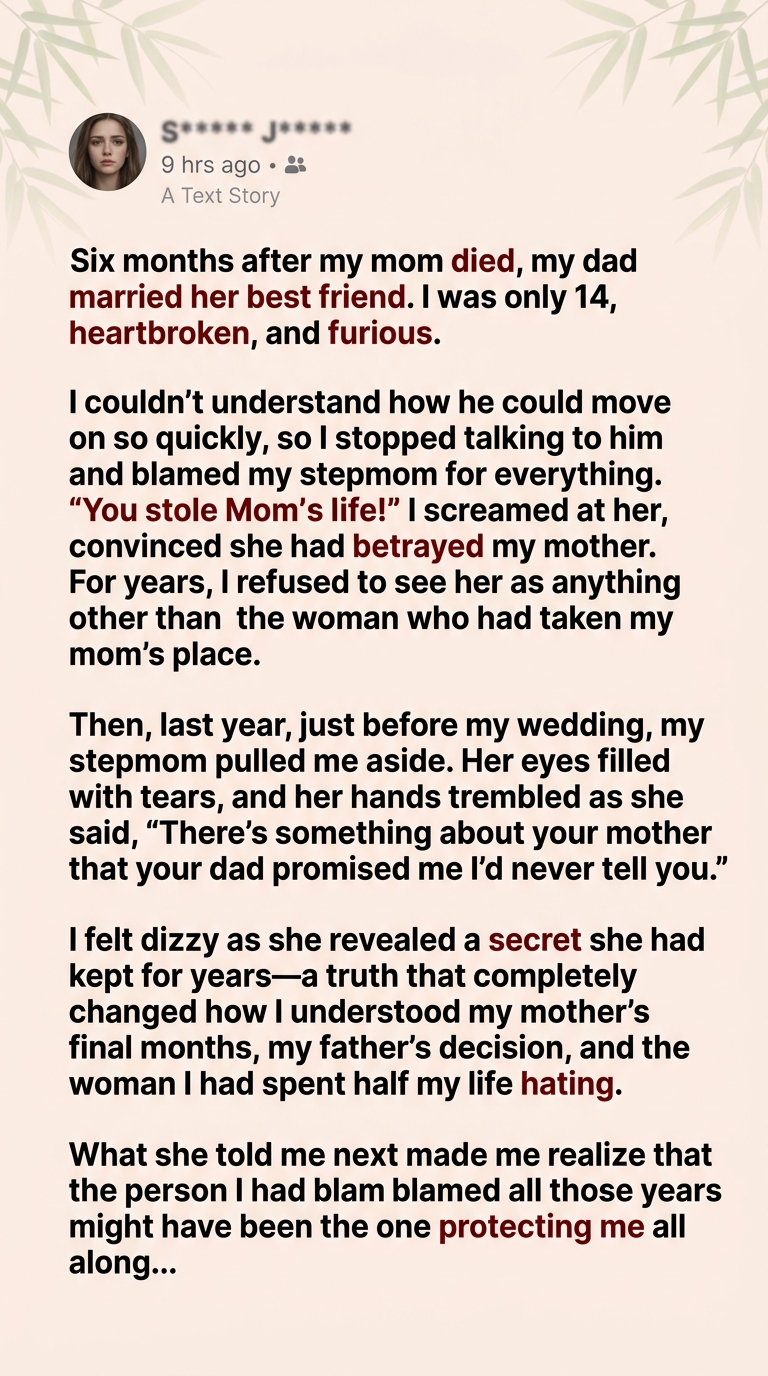
Six months after my mother died, my father married her best friend.
I was fourteen years old, and I considered it the cruelest thing he could possibly have done.
My mother, Laura, had been the center of my world. She was the person who braided my hair before school, remembered every small detail about my life, and sat beside my bed whenever I was afraid of the dark.
When she died, I felt as though someone had removed the foundation beneath my feet.
And then my father, Daniel, announced that he was marrying Margaret—the woman who had stood beside my mother for nearly twenty years.
Margaret had been at our house constantly during Mom’s final months. She brought groceries, helped with appointments, and sometimes stayed late when Dad looked too exhausted to keep his eyes open.
At the time, I had been grateful for her kindness.
After the wedding announcement, I questioned every memory.
Had she been waiting for my mother to die?
Had my father already fallen in love with her while Mom was still alive?
And how could either of them look at me and expect me to accept what they had done?
I confronted Margaret in the kitchen one afternoon.
“You stole Mom’s life!” I screamed.
She stood motionless, her eyes filling with tears.
“I never wanted to take your mother’s place,” she whispered.
“Then why are you marrying my dad?”
She had no answer I was willing to hear.
I ran upstairs and slammed my bedroom door.
From that day forward, I refused to call her anything except Margaret. I ignored her attempts to comfort me and rejected every birthday card she sent me. When she cooked my favorite meals, I accused her of trying to make me love her.
My father tried to explain, but I wouldn’t listen.
Eventually, I stopped visiting them altogether.
I built my life around the belief that Margaret had betrayed my mother and that my father had chosen his own happiness over the memory of the woman he claimed to love.
Years passed.
I graduated from college, started my career, and fell in love with a kind man named Ethan. My father attended our engagement dinner, but Margaret stayed home because she didn’t want to make the evening uncomfortable.
I told myself I was relieved.
Still, whenever I saw photographs of the two of them together, I felt the same anger I had carried since I was fourteen.
Then, three weeks before my wedding, Margaret called.
“Could we meet?” she asked. “Just the two of us?”
I almost said no.
But something in her voice made me hesitate.
We met at a quiet café near the park where my mother used to take me on Sunday afternoons. Margaret looked older than I remembered, with silver strands in her hair and deep lines around her eyes.
She held a small envelope in both hands.
“I’ve waited a long time to tell you something,” she said. “Your father asked me to keep a promise, and I believed I was doing the right thing. But you’re about to begin your own marriage, and I don’t want you to enter it carrying a story that isn’t true.”
My stomach tightened.
“What story?”
She took a slow breath.
“Your mother knew she was seriously ill long before your father told you how bad it was.”
I stared at her.
Mom had died after months of treatment for an aggressive illness. I remembered the hospital visits, the whispered conversations, and the way the adults stopped talking whenever I entered a room.
But I had always believed that the worst news had come suddenly.
Margaret explained that my mother had learned, several months before her death, that treatment was no longer likely to give her much more time.
She had asked Margaret to help her prepare for what would happen afterward.
Not because she wanted another woman to replace her, but because she was terrified of leaving her family behind.
“She worried about your father,” Margaret said. “He loved her deeply, but he had spent so much of his life caring for her that he didn’t know how to imagine a future without her. She worried that he would shut everyone out, stop taking care of himself, and become a stranger to you while you were both grieving.”
I shook my head.
“That doesn’t explain why you married him six months later.”
“No,” Margaret replied quietly. “It doesn’t explain everything.”
She opened the envelope.
Inside was a letter written in my mother’s familiar handwriting.
My fingers trembled as I unfolded it.
The letter was dated two weeks before Mom died.
My darling girl,
If you’re reading this someday, I hope you’ve grown into someone who knows that love is not a competition. Loving one person does not erase another.
Margaret has been my friend for almost twenty years. She knows the little things about our family that I sometimes forget to explain. She knows how your father worries when he cannot fix something, and she knows how you pretend to be strong when you’re hurting.
I have asked her to stay close to both of you after I’m gone. Not to replace me. No one could do that. I simply don’t want the two people I love most to face their grief completely alone.
You may be angry. You may not understand. You may even believe that people who love each other should never find happiness again after a terrible loss. But please remember that grief changes people, and sometimes they make decisions that are difficult for others to understand.
Whatever happens, never believe that my place in your life can be taken away.
You were my greatest joy.
Love always, Mom.
I read the letter twice.
Then I read it a third time.
For years, I had imagined my mother as a woman who would have been devastated by the thought of her best friend marrying her husband.
Now I was holding a letter that suggested she had trusted Margaret enough to ask her to care for us after she was gone.
But I still had questions.
“Did Mom ask you to marry Dad?”
Margaret shook her head immediately.
“No. She never asked that. She asked me to stay close to you both. The marriage was our decision, made after she was gone. Your father and I were grieving, and we grew close while trying to help each other. We knew it would hurt you. We convinced ourselves that if we kept quiet about your mother’s wishes, we could spare you more pain.”
She looked down at her hands.
“That was our mistake. We used your mother’s private wishes to justify a decision we should have explained honestly. You deserved the truth, even if you weren’t ready to accept it.”
I felt tears slide down my cheeks.
For the first time, I wondered whether I had misunderstood not only Margaret, but my father as well.
I called him that evening and asked him to meet me.
When he arrived, I placed Mom’s letter on the table between us.
He read it silently.
Then his shoulders began to shake.
“I should have told you,” he said. “I was afraid you’d think I’d forgotten your mother. I was afraid you’d hate Margaret. And I was afraid that if I explained how close we’d become, you’d believe I’d betrayed your mom.”
“So you let me believe the worst about her instead?”
He closed his eyes.
“Yes.”
It was the first time I had heard my father admit that he had been wrong without trying to defend himself.
He told me that he had struggled to function after Mom died. Margaret had been the person who answered his late-night calls, reminded him to eat, and encouraged him to keep showing up for me even when neither of us knew how to talk about our grief.
Their friendship had gradually become love.
He hadn’t planned it, and he didn’t believe it erased his love for Mom. But he had been so afraid of my reaction that he chose silence over honesty.
“I thought you would eventually understand,” he said. “Instead, I let years pass while you carried that anger. I’m sorry.”
I wanted to forgive him immediately.
I wanted to say that everything was fine now that I knew the truth.
But it wasn’t that simple.
A letter could explain my mother’s wishes. It couldn’t erase the years of resentment, the birthdays Margaret had spent alone, or the conversations my father and I had lost because neither of us knew how to face the past.
“I can’t promise that I’ll stop feeling hurt overnight,” I told them. “But I don’t want to spend the rest of my life punishing you for something I finally understand.”
Margaret reached across the table, then stopped before touching my hand.
I took it myself.
For the first time in nearly two decades, I looked at her without seeing a woman who had stolen my mother’s place.
I saw my mother’s friend—a woman who had tried to help us, made mistakes of her own, and allowed a promise to become a wall between us.
The weeks before my wedding were emotional.
Margaret never asked to walk me down the aisle or to take my mother’s place in any of the plans. Instead, she offered to help me find the small silver hairpin Mom had worn on her own wedding day.
We found it in an old jewelry box at my father’s house.
On my wedding morning, I placed it carefully in my hair.
Just before the ceremony, Margaret knocked on the dressing-room door.
“I don’t want to intrude,” she said. “I just wanted to tell you that your mother would have been proud of you.”
I turned toward her.
For years, I had imagined that hearing those words from Margaret would feel like an insult.
Instead, they felt like a gift.
“Would you sit with Dad during the ceremony?” I asked. “I think he might need you.”
Her eyes filled with tears.
“Of course.”
At the reception, my father gave a short speech. He spoke about my mother, about the way she had laughed at his terrible jokes, and about how proud she would have been to see me begin a new chapter.
Then he turned to Margaret.
“She helped me survive the hardest years of my life,” he said. “But I made a mistake when I believed silence would protect my daughter. Love deserves honesty, especially when the truth is difficult.”
He didn’t ask anyone to excuse him.
He simply acknowledged what he had done.
Later that night, I danced with my father beneath the warm lights of the reception hall. Halfway through the song, he whispered, “I miss your mom every day.”
“So do I,” I replied.
And for the first time, neither of us tried to hide our tears.
Before leaving, I hugged Margaret.
“I’m sorry I blamed you for everything,” I told her.
She shook her head gently.
“You were a child who had lost her mother. You deserved adults who knew how to help you through it.”
We both cried.
Our relationship didn’t become perfect overnight. Trust had to be rebuilt through honest conversations and small acts of kindness. But I stopped treating Margaret as an enemy, and my father and I began speaking openly about the woman we both still loved.
I kept Mom’s letter in the drawer beside my bed.
Sometimes, when I miss her, I take it out and read it again.
The letter didn’t prove that every decision my father and Margaret had made was right. It didn’t mean I had been wrong to feel hurt, or that their secrecy hadn’t caused real damage.
It simply helped me understand that love and grief can exist together—and that the people who make mistakes while grieving are still responsible for those mistakes, but they are not always the villains we imagine them to be.
For half my life, I believed Margaret had taken my mother’s place.
Now I understand that my mother’s place had never been available for anyone to take.
My mother was gone, but her love had never left me. And the woman I had spent years hating had been trying, imperfectly, to help our family survive the loss.
The greatest gift Margaret gave me wasn’t a secret.
It was the chance to stop living inside one.
And on the day I became a wife, I finally began to make peace with the daughter I had been—the angry fourteen-year-old who missed her mother so much that she couldn’t imagine a world in which anyone else could be loved, too.