The Secret Behind My Son’s Other Name
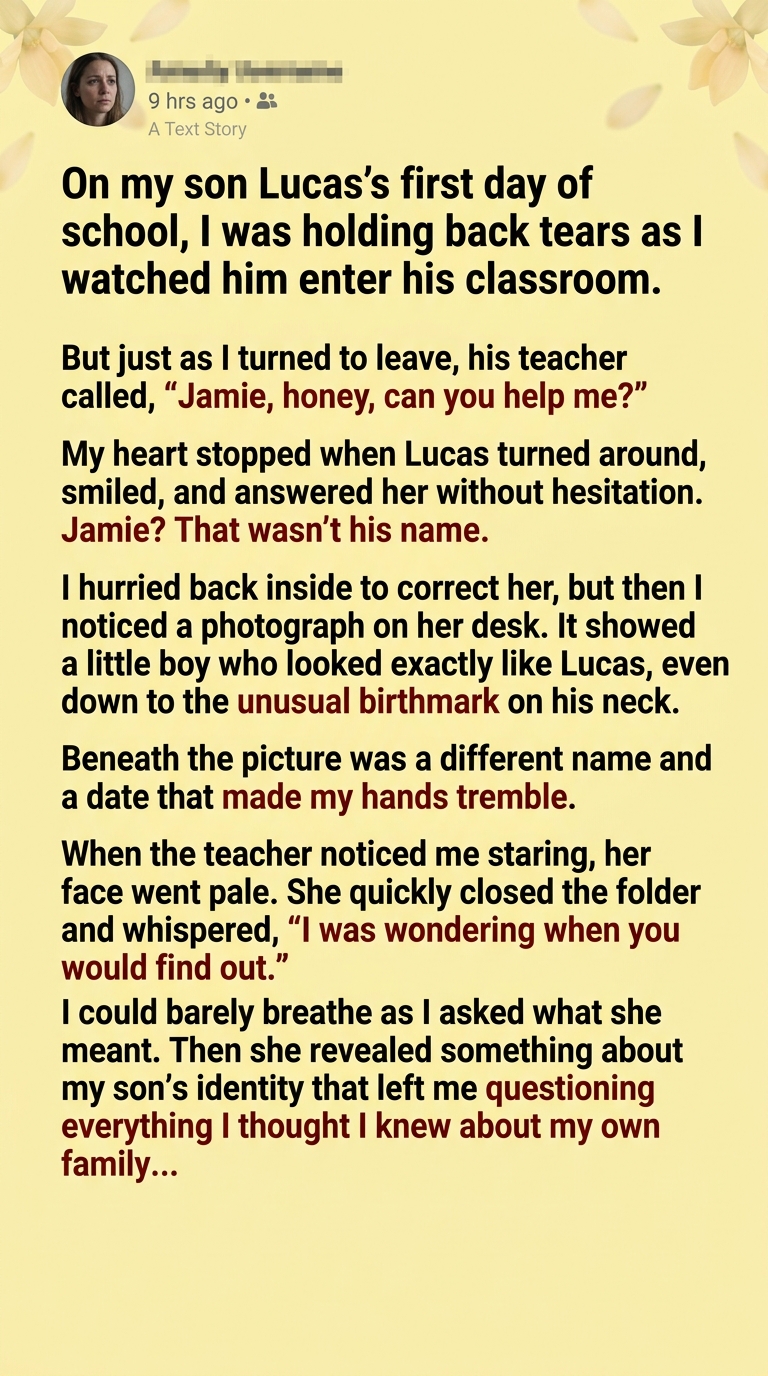
On Lucas’s first day of school, I promised myself I wouldn’t cry until I reached the car.
He was five years old, wearing a tiny blue backpack that seemed almost as big as his body. His hair was neatly combed, his shoes were brand-new, and he held my hand so tightly that I could feel his excitement trembling through his fingers.
“Will you be here when school ends, Mommy?” he asked.
“Of course,” I said, kneeling to straighten his collar. “I’ll be the first person you see.”
He smiled, released my hand, and hurried toward his classroom.
I watched him disappear through the doorway, feeling the strange mixture of pride and sadness that comes with watching your child take his first independent step into the world.
Then I heard his teacher call after him.
“Jamie, honey, can you help me with these books?”
I froze.
Lucas turned around immediately.
“Sure!” he answered cheerfully.
My heart gave a strange, painful thump.
Jamie?
That wasn’t his name.
I walked back toward the classroom, preparing to explain that perhaps she had confused him with another student.
But before I could speak, something on her desk caught my attention.
It was a framed photograph of a little boy standing beside a woman. The boy had dark, curly hair, a small dimple in his left cheek, and a distinctive crescent-shaped birthmark on the right side of his neck.
I stared at the photograph.
Lucas had the exact same birthmark.
Beneath the picture was a handwritten note:
Jamie Bennett — October 14, 2020.
The date was especially unsettling because it was the date on Lucas’s original hospital bracelet, which I had kept in a small memory box at home.
I looked from the photograph to my son.
The resemblance was impossible to ignore.
“Excuse me,” I said quietly. “Why did you call my son Jamie?”
His teacher turned toward me.
The moment she saw what I was looking at, the color drained from her face. She quickly turned the photograph facedown and closed the folder beneath it.
“I was wondering when you would find out,” she whispered.
My hands began to shake.
“Find out what?”
She glanced toward the other children, then asked whether we could speak privately after dismissal.
I wanted answers immediately, but Lucas was watching us with a bright, trusting smile. I forced myself to smile back and told him I would see him later.
The longest school day of my life had begun.
For years, I had believed I knew everything important about my son.
My husband, Daniel, and I had adopted Lucas as a newborn after a long, difficult journey to become parents. We had been told that his birth mother was unable to care for him and had chosen adoption through an agency.
We had received the records we were permitted to see, completed every requirement, and brought him home when he was just days old.
Daniel had cried when he first held him.
I had promised Lucas that I would love him every day of my life.
We never hid the fact that he was adopted. We planned to explain his story in age-appropriate ways as he grew older.
But we had never heard the name Jamie Bennett.
And we had never been told that another child might share Lucas’s unusual birthmark.
When the final bell rang, I collected Lucas and took him home. I made him his favorite snack, listened to him describe the classroom toys, and tried not to let my fear show.
At four o’clock, I returned to the school alone.
His teacher was waiting in an empty classroom.
“My name is Mrs. Harper,” she began. “Before I tell you anything, I need you to understand that I should have handled this differently. I should never have used that name without speaking to you first.”
“Who is Jamie Bennett?” I asked.
She opened the folder.
Inside were several documents and a photograph of two newborn babies lying in hospital bassinets.
One bracelet read Jamie Bennett.
The other read Lucas Bennett.
I gripped the edge of the desk.
“Why are there two babies?”
Mrs. Harper swallowed.
“Jamie was my nephew.”
She explained that her younger sister, Emily, had given birth to twin boys in October 2020. The boys had been named Jamie and Lucas. They had been born prematurely and spent time receiving medical care before they could go home.
Emily had struggled with serious health and personal difficulties after the birth. She had eventually made an adoption plan for one of the boys, believing that her family situation would make it impossible for her to raise both children safely.
The other boy, Jamie, had remained with Emily’s family for a time.
“But where is Jamie now?” I asked.
Mrs. Harper’s eyes filled with tears.
“Jamie died when he was still a baby.”
The room seemed to go silent.
She explained that Jamie had died following a sudden medical emergency. The family had been devastated, and Emily had withdrawn from nearly everyone afterward.
Lucas, meanwhile, had been placed with us through the adoption agency.
Mrs. Harper had known Emily’s family for years. When she saw Lucas’s school registration and recognized the birthmark, she had suspected who he was. She had asked the school administration to verify the adoption records through the proper channels, but the school could not simply disclose confidential family information.
She had kept the photograph because it was one of the few pictures she had of the twins together.
“I’m sorry,” she said. “When Lucas walked into my classroom, I saw my nephew’s face. I called him Jamie before I could stop myself.”
I struggled to process her words.
“So Lucas is Jamie’s twin brother?”
She nodded.
I wanted to be angry. I wanted to demand why no one had told me. But beneath the shock, I felt a deeper sadness for a woman who had lost one child and made the painful decision to place another for adoption.
Still, I needed to know whether everything I had just heard was true.
“Does Emily know where Lucas is?”
Mrs. Harper shook her head.
“I don’t know what information she received from the agency. I haven’t spoken to her about Lucas in years. I don’t want you to think I have proof of anything beyond what I have explained.”
That night, I told Daniel everything.
He listened without interrupting. When I finished, he sat beside me at the kitchen table and took my hand.
“Then we need to find out the truth,” he said. “Not because Lucas is any less our son, but because he deserves an honest story about where he came from.”
The following week, we contacted the adoption agency and requested a review of the records. They confirmed that Lucas had a biological twin brother who had died in infancy.
They also explained that some family details had been withheld under the confidentiality rules and circumstances that applied to the adoption.
We asked whether contact with Lucas’s biological relatives was possible. The agency explained the appropriate consent and privacy procedures, and we agreed to follow them.
Several weeks later, we received a letter from Emily.
She had been informed that her surviving son had reached school age and that his adoptive family was willing to consider contact, subject to the proper arrangements.
Her letter was short.
I have thought about both my boys every day. I don’t expect you to forgive me for the decisions I made, and I don’t want to disrupt the life you’ve given Lucas. I only hope that one day, if you and Lucas are comfortable, I can tell him about his brother.
I read the letter twice.
For days, I wrestled with conflicting emotions. I wanted to protect Lucas from confusion, but I also knew that his story belonged to him. His biological family was part of that story, even though Daniel and I were the parents raising him.
After speaking with an adoption counselor, we agreed to a carefully planned meeting with Emily.
We met in a quiet room at the agency.
Emily looked nervous and older than I had expected. She held a small box on her lap and kept her eyes lowered until Lucas entered with Daniel.
When she saw him, she began to cry.
Lucas looked at her, then at us.
“Mommy, who is she?”
I knelt beside him.
“This is Emily. She is your birth mother. She is part of the story of how you came into our family.”
He thought about that for a moment.
“Did you know me when I was a baby?”
Emily nodded through her tears.
“Yes, sweetheart. And you had a twin brother named Jamie.”
Lucas’s eyes widened.
“I had a brother?”
She opened the little box. Inside was a photograph of the twins sleeping beside each other in their hospital bassinets.
Lucas studied the picture.
“He looks like me.”
“He did,” Emily whispered. “You two were very much alike.”
She told him simple things about Jamie: how he had been quiet when he slept, how his fingers curled around hers, and how the family had loved him. She did not burden him with adult details about the circumstances of the adoption or the medical emergency.
Before we left, she offered Lucas the photograph.
“You can keep this if you want,” she said. “And if you don’t want to, that’s okay too.”
Lucas held it carefully.
“I want to show Daddy.”
That small answer brought tears to my eyes.
The meeting did not magically make everything easy. We agreed to take things slowly, with support from the counselor, and to let Lucas’s needs guide any future contact.
I also spoke privately with Mrs. Harper. I told her I understood why seeing Lucas had affected her, but using Jamie’s name without warning had frightened me.
She apologized sincerely and promised to respect our family’s boundaries. She remained Lucas’s teacher, but she never again called him by another name.
Months later, Lucas asked me a question while I tucked him into bed.
“Mommy, am I Jamie too?”
I brushed his hair away from his forehead.
“No, sweetheart. Your name is Lucas. Jamie was your brother, and you can love him and remember him without having to be anyone other than yourself.”
He considered that carefully before wrapping his arms around my neck.
“I love you, Mommy.”
“I love you more than you can imagine.”
That night, I placed the photograph of the twins in Lucas’s memory box, beside his hospital bracelet and the first picture Daniel and I had taken with him at home.
The photograph no longer felt like evidence of a secret that could destroy our family.
It was a reminder that Lucas’s life had begun long before he entered our home—and that loving him meant making room for the truth, even when the truth was painful.
I had gone to school believing I was simply watching my little boy begin a new chapter.
Instead, I discovered a part of his story that had been waiting quietly for years.
And I learned something I would never forget: family is not made smaller by the truth. When handled with honesty, patience, and love, the truth can give a child a fuller understanding of who he is—without changing who has been there to raise him.