Leo Thorsness: The Fighter Pilot Who Survived Nearly Six Years as a Prisoner of War
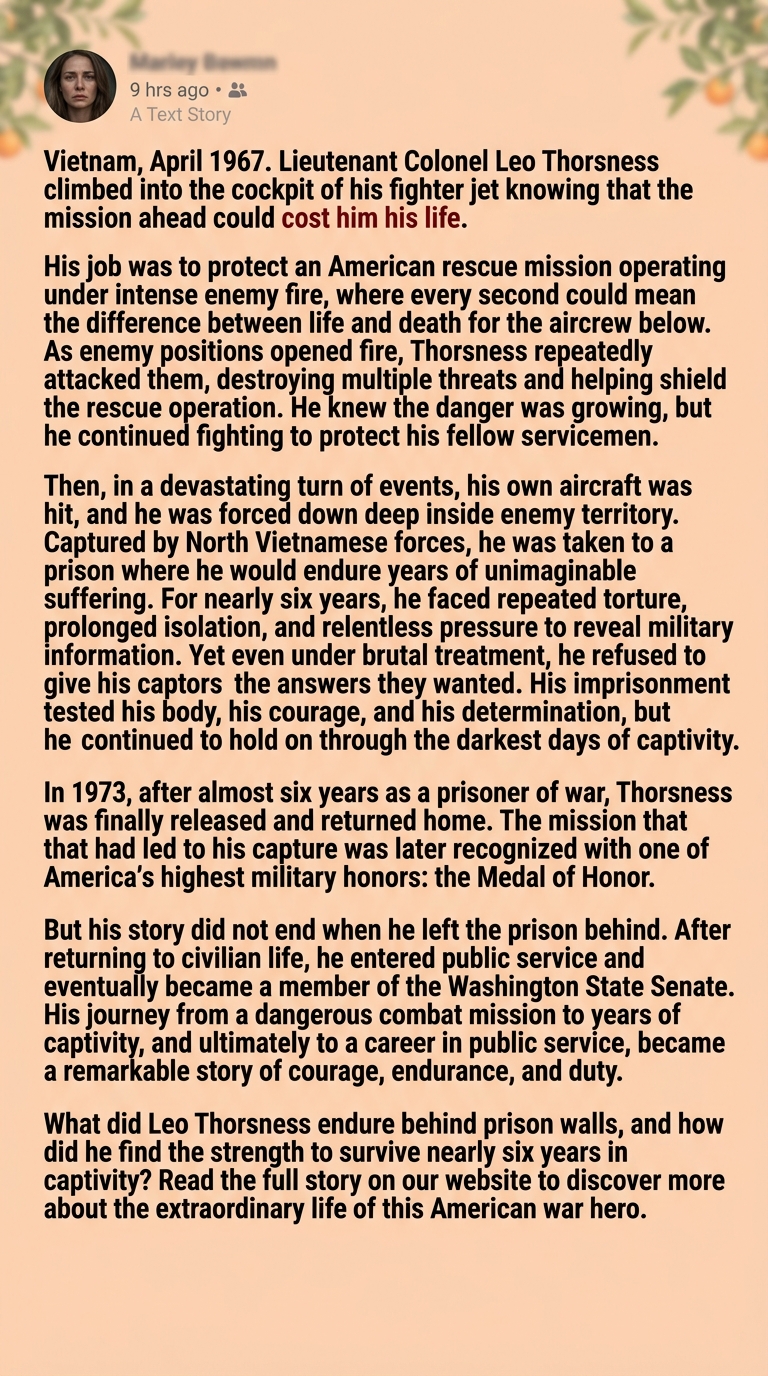
April 19, 1967. The skies over North Vietnam were filled with danger as U.S. Air Force Major Leo Keith Thorsness climbed into his F-105 Thunderchief for a mission that would test his courage far beyond the limits of an ordinary combat flight.
Thorsness was part of a Wild Weasel mission, a dangerous operation designed to locate and destroy enemy surface-to-air missile sites threatening American aircraft. He knew the risks. Enemy missiles and antiaircraft guns could strike without warning, leaving pilots only seconds to react.
But he also knew that the mission mattered. If his team could silence the missile sites, other American aircraft would have a better chance of completing their operations and returning safely.
Thorsness and his electronic warfare officer, Captain Harold Johnson, attacked and destroyed enemy missile positions. Then the situation took a dangerous turn. Another F-105, carrying two American airmen, was struck by enemy fire, forcing its crew to eject over hostile territory.
Thorsness could have concentrated on getting himself out of danger. Instead, he remained involved in the effort to protect the downed airmen.
He circled their parachutes, relayed their location to rescue personnel, and engaged an enemy MiG-17 fighter that threatened the area. After destroying the enemy aircraft, he left to seek fuel.
Then came another urgent call. Rescue helicopters were facing a serious threat from additional enemy fighters.
Despite his own aircraft’s dangerously low fuel supply, Thorsness returned toward the rescue area. He encountered four MiG-17s and attacked, damaging one and helping drive the enemy fighters away from the rescue operation.
His fuel situation grew increasingly critical. When another American pilot reported being dangerously low on fuel, Thorsness helped arrange for that aircraft to reach a tanker first. He then diverted to a forward air base, landing with almost no fuel remaining.
It had been an extraordinary display of courage and self-sacrifice. Yet Thorsness had no way of knowing that, less than two weeks later, he would face an ordeal that would last almost six years.
The Mission That Changed His Life
On April 30, 1967, Thorsness was flying another combat mission over North Vietnam when enemy fire brought down his aircraft.
He ejected, but survival was only the beginning of his struggle.
Captured by North Vietnamese forces, he was taken into captivity. The skilled pilot who had spent years mastering one of the most dangerous jobs in the military was now a prisoner, far from his family and unable to control what would happen next.
His captivity became a long test of physical endurance and mental strength. Like other American prisoners of war held during the conflict, he faced harsh interrogations, physical abuse, isolation, and pressure to provide military information.
The familiar world of flight plans, aircraft, and fellow airmen was replaced by uncertainty. Days passed without knowing when freedom might come. The future that once seemed measurable in missions and hours in the air became an open-ended struggle to endure another day.
For Thorsness, the challenge was not simply surviving his captors. It was holding on to his sense of duty and identity under circumstances designed to break a prisoner’s resistance.
He had entered combat knowing that courage sometimes meant putting himself in danger to protect others. In captivity, that same determination took a different form. There was no cockpit to return to, no friendly airfield on the horizon, and no immediate way to escape.
There was only the decision to keep going.
Nearly Six Years in Captivity
Thorsness spent almost six years as a prisoner of war, much of that time in the infamous prison complex commonly known as the Hanoi Hilton.
The experience left lasting physical and emotional consequences. He endured mistreatment and the uncertainty of not knowing when, or whether, he would return home.
For a military aviator accustomed to responsibility and movement, captivity meant losing control over even the most basic parts of daily life. News from home was limited, communication was uncertain, and the possibility of freedom remained beyond his control.
Yet the years did not erase the qualities that had defined him before his capture.
His story became part of the larger experience of American prisoners of war who endured years of separation from their families. Their survival depended on many things: personal resolve, hope, the ability to withstand uncertainty, and the determination to preserve their dignity in circumstances they could not change.
Thorsness could not know exactly when his captivity would end. He could only continue through the difficult days and hope that the war would eventually bring him home.
Then, in 1973, that moment finally arrived.
The Long-Awaited Return Home
On March 4, 1973, Thorsness was released as part of the return of American prisoners of war following the Paris Peace Accords.
After nearly six years away, he was free.
But coming home did not mean that the years of captivity could simply be forgotten. He had to recover from the physical effects of his ordeal and adjust to a world that had continued changing while he was imprisoned.
His return was also a moment of recognition for the courage he had demonstrated years earlier in the skies over North Vietnam.
On October 15, 1973, President Richard Nixon presented Thorsness with the Medal of Honor, the United States’ highest military decoration for valor in combat.
The award recognized his extraordinary actions during the April 19, 1967, mission, when he repeatedly risked his life to protect fellow airmen and support the rescue effort despite overwhelming danger.
The medal honored more than a successful attack or a single moment of bravery. It recognized a series of decisions in which he placed the safety of others ahead of his own.
For Thorsness, the ceremony marked an important chapter in a journey that had taken him from combat to captivity and finally back to freedom.
A New Chapter Beyond the Battlefield
Thorsness did not allow his years as a prisoner of war to define the entirety of his life.
After more than two decades of military service, he retired from the Air Force and continued serving the public in a different capacity.
He entered politics and served as a Washington State senator from 1988 to 1992. He also worked to support recognition for American service members, including efforts involving prisoners of war and those missing in action.
His commitment to service had taken a different direction, but the underlying principle remained familiar: responsibility did not end when one particular assignment was over.
In his later years, Thorsness remained associated with the military community and organizations honoring the courage and sacrifice of service members.
He died on May 2, 2017, leaving behind a legacy that extended beyond his Medal of Honor and his years in captivity.
His life reflected several forms of courage. There was the courage to face enemy fire while protecting fellow airmen. There was the endurance required to survive years of imprisonment. And there was the determination to build a meaningful life after returning home from an experience that could have consumed the rest of his story.
The Legacy of Leo Thorsness
Leo Thorsness’s story is not simply about a fighter pilot who performed an extraordinary act in combat. It is about a man whose sense of duty continued through circumstances he could never have anticipated.
On April 19, 1967, he risked his life to protect other airmen, even when his own aircraft was running critically low on fuel. Less than two weeks later, he was shot down and became a prisoner of war for almost six years.
He eventually returned home, received the Medal of Honor, and continued serving his country through public life and veterans’ causes.
His journey reminds us that courage does not always look the same. Sometimes it means taking action when others are in danger. Sometimes it means enduring a difficult situation when there is no quick way out. And sometimes it means finding a new purpose after surviving an experience that changes everything.
The young pilot who once faced enemy fighters above North Vietnam became a decorated veteran, a public servant, and a lasting example of determination.
His years in captivity could have been the final chapter of his life story. Instead, they became one part of a much larger legacy of service, resilience, and commitment to others.
Leo Thorsness’s life leaves us with a powerful question: When circumstances take away our freedom, our certainty, and our ability to control the future, what gives us the strength to keep going?
For Thorsness, the answer was reflected in the way he lived: through duty, perseverance, and a willingness to serve something greater than himself.
His story remains a reminder that true courage is measured not only by what a person does in a moment of danger, but also by how that person continues to live when the danger has passed.

