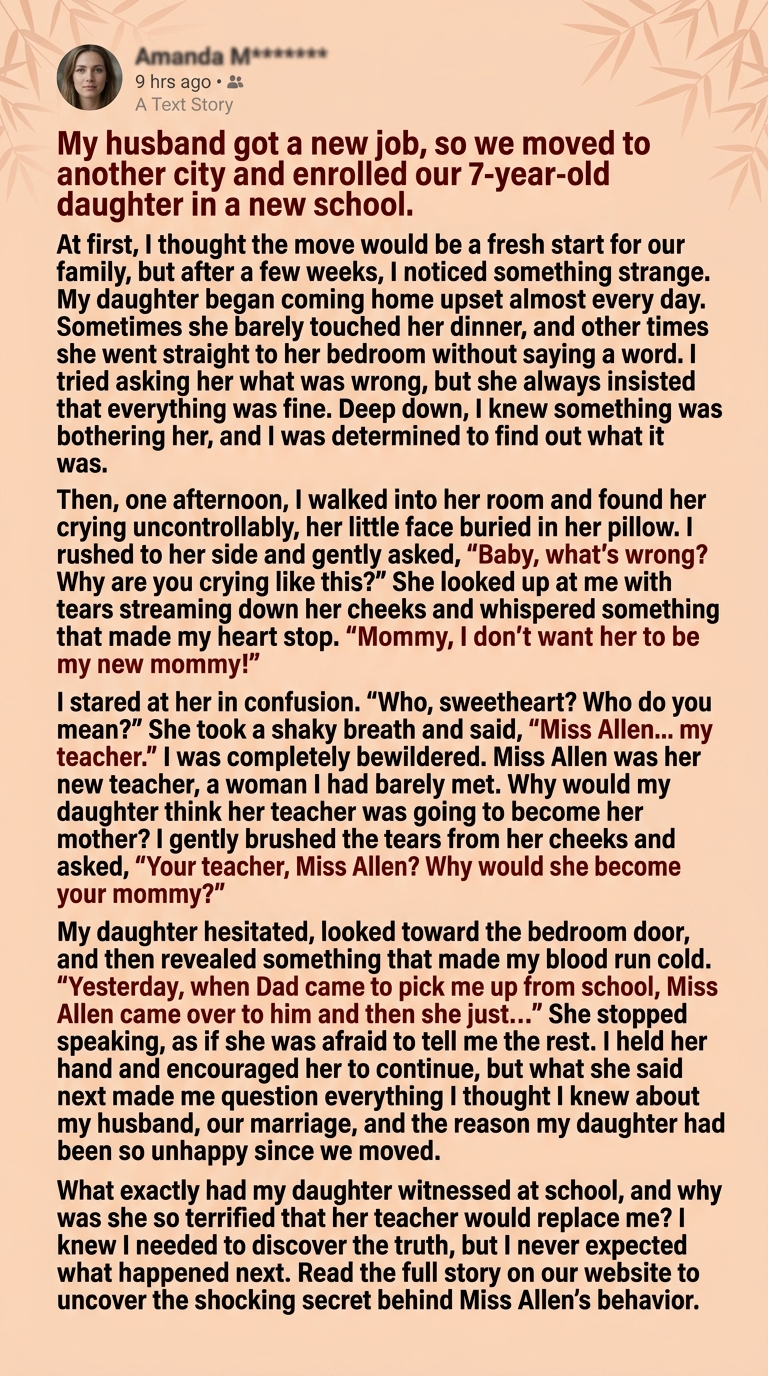
My Husband Got a New Job, So We Moved to Another City. But When My 7-Year-Old Daughter Began Crying Every Day, I Discovered a Secret That Changed Everything.
When my husband got a new job in another city, we decided it was the right time for our family to start a new chapter. We packed our belongings, left behind the home we had known for years, and enrolled our seven-year-old daughter in a new school. I thought the change would bring exciting opportunities and a fresh start for all of us.
At first, everything seemed normal. My daughter was quiet about her new school, but I assumed she simply needed time to adjust. Children often struggle with unfamiliar surroundings, new classmates, and different teachers. I wanted to give her space to settle in.
But after a few weeks, I began noticing a troubling pattern.
Almost every afternoon, she came home looking unhappy. Sometimes she barely touched her dinner. Other times, she went straight to her bedroom and closed the door. When I asked about her day, she gave me the same answer.
“Everything is fine, Mommy.”
But her eyes told a different story.
I tried not to pressure her. I asked about her classmates, her lessons, and whether she had made any friends. She answered my questions, but something about her behavior continued to worry me. My cheerful little girl was becoming withdrawn, and I couldn’t understand why.
Then, one afternoon, I found her crying uncontrollably in her bedroom.
She was curled up on her bed, her face buried in her pillow. When I approached her, she tried to wipe away her tears, but she couldn’t stop shaking.
I sat beside her and gently pulled her into my arms.
“Baby, what’s wrong? You can tell Mommy anything.”
She looked at me with red, swollen eyes. What she said next left me completely confused.
“Mommy, I don’t want her to be my new mommy!”
For a moment, I didn’t understand.
“Who, sweetheart? Who are you talking about?”
She swallowed hard before whispering, “Miss Allen. My teacher.”
I stared at her, trying to make sense of her words. Miss Allen was her new teacher, a woman I had met only briefly. As far as I knew, she had been kind and professional.
Why would my daughter believe her teacher was going to replace me?
I brushed the tears from her cheeks and asked as gently as I could, “Why do you think Miss Allen is going to be your mommy?”
My daughter glanced toward the bedroom door before looking back at me.
“Yesterday, when Dad came to pick me up from school, Miss Allen came over to him.”
I waited for her to continue.
“She smiled at him, and they talked for a long time. Then she hugged him.”
I felt a strange tightness in my chest, but I reminded myself that a hug didn’t necessarily mean anything. Teachers and parents sometimes greeted each other warmly. There could be a perfectly innocent explanation.
Still, my daughter wasn’t finished.
“She told Daddy that she missed him,” she whispered. “And Daddy said he missed her too.”
I felt as though the room had suddenly become smaller.
I wanted to ask a dozen questions at once, but I could see how frightened my daughter was. I didn’t want my reaction to make her feel that she had done something wrong by telling me.
So I took her hands and asked, “Did they say anything else, sweetheart?”
She nodded slowly.
“Miss Allen told Daddy that she hoped everything would be different now that we live here. Then Daddy told her not to worry because he would explain everything soon.”
My heart began racing.
What did that mean? Had my husband known Miss Allen before we moved? Was there something about his new job or our relocation that he had never told me?
I wanted to dismiss the entire conversation as a misunderstanding, but my daughter’s sadness had begun weeks earlier. She had been carrying this fear alone, believing that someone was going to take her place in our family.
I hugged her tightly.
“You are my daughter, and nothing will ever change that,” I told her. “You don’t have to be afraid to tell me what you see or hear.”
That evening, I watched my husband more carefully than I ever had before. When he came home from work, he greeted us as usual, asked about dinner, and talked about his new position. Everything seemed ordinary.
But I couldn’t stop thinking about Miss Allen.
Finally, after our daughter had gone to bed, I asked him a question I had been afraid to ask.
“Do you know your daughter’s new teacher outside of school?”
He looked up from his phone.
“Why are you asking me that?”
“Because our daughter told me she saw you hugging Miss Allen after school. She also said you told her you missed her.”
For several seconds, he said nothing.
Then he put down his phone and sighed.
“I was going to tell you,” he said.
Those five words made my stomach drop.
“Tell me what?”
He rubbed his face and looked away. He admitted that he had known Miss Allen before taking his new job. They had met several years earlier, before our relationship began, and they had briefly dated. They had lost contact, but when he accepted the position in the new city, he discovered that she worked at our daughter’s school.
He insisted that he hadn’t planned to see her again and that their conversation outside the school had been unexpected.
“Then why did you tell her you missed her?” I asked.
He hesitated.
He explained that their conversation had brought back memories of their past. He admitted that he had handled the situation badly and should have told me about their history instead of keeping it secret.
I was hurt, confused, and angry. What troubled me most wasn’t simply that he knew another woman. It was that he had allowed our daughter to witness a conversation she didn’t understand, leaving her frightened that her family was about to fall apart.
“She’s seven years old,” I told him. “She doesn’t understand your history with this woman. All she knows is that she saw something that made her afraid of losing her family.”
My husband lowered his head. For the first time that evening, he seemed to understand the impact his behavior had had on our daughter.
He apologized and promised to be honest with me about any further contact with Miss Allen. He also agreed that our daughter’s education and emotional well-being had to come first.
But I wasn’t ready to accept an apology and pretend nothing had happened.
The following day, I arranged a meeting with the school principal. I wanted to understand the boundaries between parents and teachers and make sure our daughter felt safe in her new classroom. I explained what she had witnessed without making accusations I couldn’t prove.
The principal listened carefully and agreed that any personal issues involving adults should never be allowed to make a child feel uncomfortable at school.
I also requested a meeting with Miss Allen, with the principal present. During that conversation, I learned that my husband and she had spoken privately about their past, but neither had considered how their behavior might appear to a young child who was already struggling with a major life change.
Miss Allen apologized for making our daughter uncomfortable and agreed to keep all future interactions with my husband strictly professional and related to school.
That conversation didn’t immediately repair the damage to my marriage. Trust takes time to rebuild, and I knew that my husband’s explanation wasn’t enough on its own. I needed honesty, consistency, and a willingness to put our family first.
Over the following weeks, I focused on helping my daughter feel secure again. We spent more time together after school, talked openly about her worries, and reminded her that adult relationships were not her responsibility to manage.
One evening, she climbed into my lap and asked, “Mommy, Miss Allen isn’t going to take you away, is she?”
I kissed the top of her head.
“No, sweetheart. You never have to compete with anyone for my love. And if something worries you, you can always tell me.”
She wrapped her arms around my neck and finally smiled in a way I hadn’t seen for weeks.
As for my marriage, I knew there were difficult conversations still ahead. My husband had to earn back my trust, and I had to decide what our relationship would look like moving forward. We couldn’t undo what had happened, but we could choose how honestly we dealt with it.
The move that I had once believed would be a fresh start had exposed a problem we could no longer ignore. It reminded me that children often notice far more than adults realize, even when they don’t fully understand what they are seeing.
My daughter’s fear had forced us to confront a difficult truth: the decisions adults make can have consequences for the people who depend on them most.
I still don’t know whether our marriage will ever feel exactly as it did before. But I know one thing for certain. My daughter will never have to face her fears alone, and I will never dismiss her feelings simply because the truth is uncomfortable.
Sometimes, the most important warning signs come from the smallest voices in the room. And sometimes, listening to a child is the first step toward uncovering a problem that adults have been trying not to see.