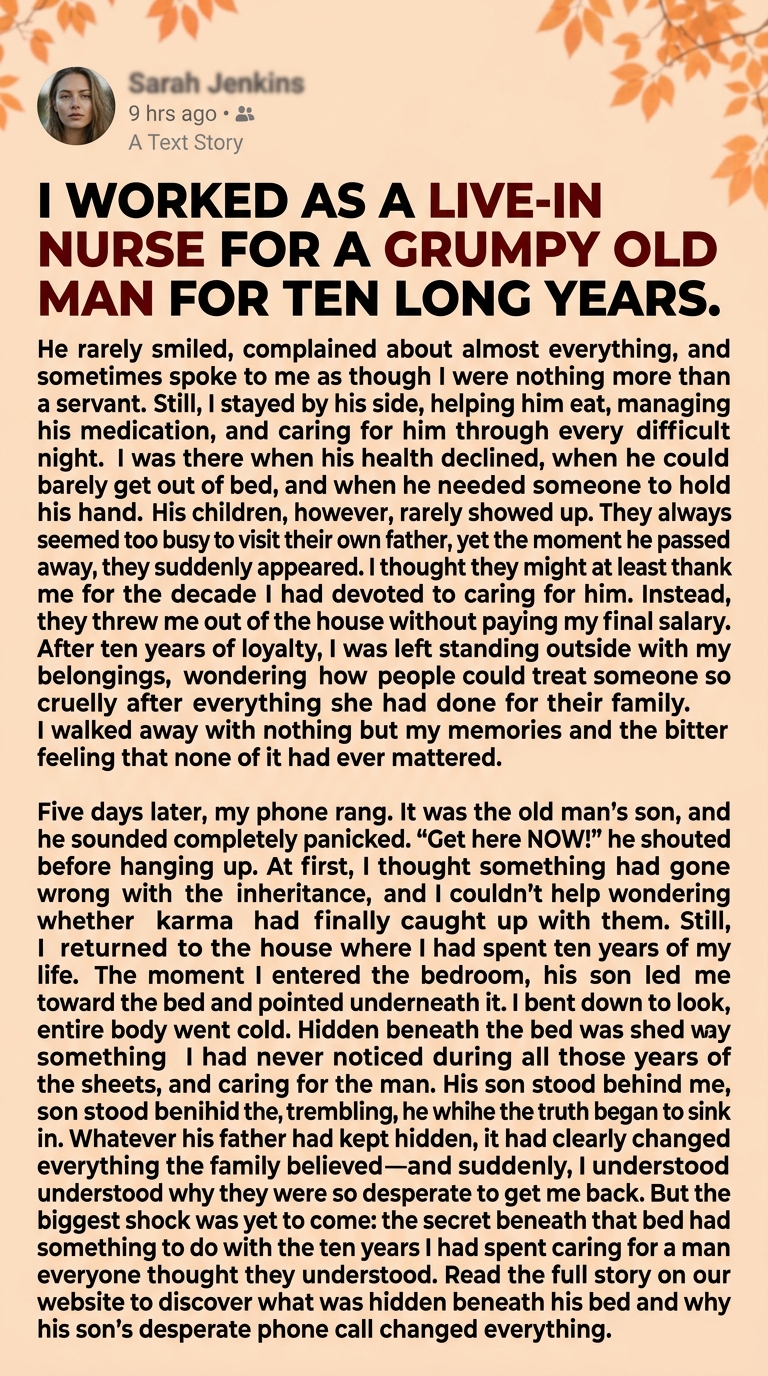
For ten years, I cared for a man who seemed determined to make my life difficult.
His name was Arthur Bennett. He was seventy-eight when I first became his live-in nurse, a widower with a sharp tongue, a stubborn personality, and a habit of finding fault with almost everything.
The soup was too cold. The pillows were too soft. The television was too loud, even when the volume was barely audible.
If I opened the curtains, he complained about the sunlight. If I closed them, he accused me of making the room gloomy.
Sometimes, when I brought him his medication, he wouldn’t even look at me.
“About time,” he would mutter.
I had worked in elder care for years, so I knew how to remain patient with difficult people. Illness, pain, and the loss of independence could make someone bitter. I tried not to take his words personally.
Still, there were days when I sat alone in the kitchen after putting him to bed and wondered how much longer I could keep going.
I stayed because Arthur needed me.
His children, Michael and Rebecca, lived less than an hour away, but their visits became increasingly rare. They always had reasons. Michael had business meetings. Rebecca had family obligations. Holidays passed, birthdays came and went, and Arthur often spent entire weeks without seeing either of them.
Whenever I asked whether he wanted me to call his children, he waved his hand dismissively.
“They have better things to do.”
He said it as though he didn’t care.
But sometimes, when he thought I wasn’t watching, I caught him staring at the family photographs on his bedside table.
On those occasions, I pretended not to notice.
Over the years, I learned his routines, his favorite meals, and the small things that made his days easier. I knew when his joints hurt before he admitted it. I recognized the sound of his breathing when he was uncomfortable, and I could tell from the way he held his cup whether he was having a particularly difficult morning.
I managed his medication, helped him bathe, prepared his meals, and stayed awake during nights when he was frightened by his worsening health.
When he could no longer walk without assistance, I helped him move from his bed to his chair. When his hands became too weak to hold a spoon, I fed him slowly, one bite at a time.
He rarely thanked me.
Sometimes he complained while I was doing something specifically to make him comfortable.
Yet I continued to care for him because I believed that every person deserved dignity, even when they struggled to show kindness in return.
By the tenth year, Arthur’s health had deteriorated significantly. He spent most of his time in bed, and even short conversations exhausted him.
One evening, while I was adjusting his blanket, he caught my wrist.
“Don’t let them take everything,” he murmured.
I leaned closer.
“Who, Arthur?”
He looked toward the bedroom door.
“Just promise me.”
Before I could ask what he meant, he released my hand and turned away.
I assumed he was confused or frightened. I had heard him say unusual things before, particularly when he was tired. I made sure he was comfortable and continued with my evening duties.
A few days later, Arthur passed away peacefully in his sleep.
I found him early in the morning when I entered his room with his usual cup of tea.
For several seconds, I stood beside the bed, unable to move.
Then I called for medical assistance and contacted his children.
Michael arrived first, followed by Rebecca. They were visibly upset, but their grief quickly became mixed with the practical business of death: phone calls, paperwork, funeral arrangements, and discussions about the house.
I stayed quietly in the background, answering questions about Arthur’s final days.
I thought that after ten years of caring for their father, they might at least acknowledge what I had done.
I wasn’t expecting a grand reward. I simply hoped they would treat me with the same basic respect I had shown their father.
Instead, two days after the funeral, Michael approached me in the hallway.
“We’ve decided we don’t need you anymore,” he said.
I stared at him.
“I understand. But I haven’t received my final salary.”
He sighed as though I had inconvenienced him.
“We’ll deal with that later.”
“When?”
“I’m busy right now. You need to pack your things and leave.”
I reminded him that I had worked through Arthur’s final days and was still owed money. Michael became irritated and told me that the family would review everything with their lawyer.
Rebecca stood nearby, saying nothing.
I packed my clothes, a few books, and the photographs I had kept in my room. Everything I owned fit into two bags.
After ten years in that house, I walked out without my final pay.
Michael didn’t even come to the door.
I stood on the pavement, looking back at the place where I had spent a decade of my life. I remembered the sleepless nights, the difficult mornings, and the countless small acts of care that had kept Arthur comfortable.
I wondered whether any of it had mattered.
For the next few days, I tried to move forward. I contacted former colleagues and began looking for another position. I was angry, but beneath the anger was a deep sadness.
I had cared for Arthur as though he were my own family, and when he died, I had been treated like an unwanted stranger.
Five days after I left, my phone rang.
Michael’s name appeared on the screen.
I nearly ignored it.
Then I answered.
“Hello?”
“Where are you?” he demanded.
“At home. Why?”
“You need to come here. Now.”
His voice was so tense that I sat up straight.
“What happened?”
“Just get here!”
The call ended.
I stared at my phone, wondering whether something had gone wrong with the estate. Perhaps he had found paperwork that mentioned me. Perhaps he wanted to argue about the money he owed me.
Part of me wanted to refuse.
But after ten years, I still couldn’t completely turn away from the house where Arthur had lived.
I took a taxi and arrived less than an hour later.
Michael opened the door before I could knock.
His face was pale, and his hair looked as though he had been pulling at it for hours.
“Come with me,” he said.
He led me down the hallway toward Arthur’s bedroom.
The room looked almost exactly as I had left it. The curtains were drawn, the bedside table was untouched, and the large wooden bed stood against the wall.
Michael stopped beside it.
“Look underneath.”
I frowned.
“What?”
“Just look!”
I knelt down and peered into the darkness beneath the bed.
At first, I saw only dust and a few storage boxes. Then my eyes adjusted, and I noticed a long, flat wooden compartment pushed against the wall.
I had cleaned that room hundreds of times. I had changed Arthur’s sheets, swept beneath the bed, and searched for dropped medication.
Yet I had never seen that compartment.
I pulled it forward.
It was heavier than I expected, and a small brass lock hung from its front. The lock had already been broken.
Inside were several thick envelopes, a black notebook, a bundle of legal documents, and a small wooden box.
My hands began to tremble.
Michael crouched beside me.
“We found it this morning,” he said. “Dad must have hidden it there years ago.”
I looked at the envelopes.
Several had my name written on them.
My name.
Not Michael’s. Not Rebecca’s.
Mine.
I opened the first envelope and pulled out a letter written in Arthur’s unmistakable handwriting.
“To the woman who stayed,” it began.
I stopped breathing for a moment.
The letter continued.
“If you are reading this, then I have probably left this world before finding the courage to say what I should have said years ago.”
I sat back on my heels.
Michael was watching me, his expression caught somewhere between fear and disbelief.
I continued reading.
“For ten years, you have cared for me when the people I expected to be there could not be bothered to come. You have fed me when I could not feed myself, stayed beside me when I was frightened, and treated me with dignity on days when I gave you very little reason to treat me kindly.
“I know I have been difficult. I know I have hurt you with my words. There were times when I wanted to thank you, but pride stopped me. I was wrong.”
My eyes filled with tears.
I remembered the mornings when Arthur had complained about breakfast, the nights when I had held his hand, and the countless times I had gone to bed wondering whether he understood how hard I was trying.
He had noticed.
He simply hadn’t known how to say it.
Then I reached the next paragraph.
“There is something else you deserve to know. My children have spent years believing that I am a wealthy man who owes them everything. They believe this house, my savings, and every possession I own should eventually belong to them.
“But they do not know the whole story.”
I looked up at Michael.
He had gone completely still.
“What does it say?” he asked.
I returned to the letter.
Arthur explained that years earlier, he had discovered irregularities in the way some of his financial affairs were being handled. He had begun keeping copies of bank statements, correspondence, and documents showing transactions he did not understand.
He had hired a lawyer to investigate the matter and had kept the relevant paperwork in the hidden compartment.
The documents did not prove that either child had committed a crime. But they raised serious questions about money that had moved through accounts connected to the family, and Arthur had wanted the records preserved until someone could review them properly.
I stared at the papers.
For years, Michael and Rebecca had presented themselves as too busy to help their father, yet both had occasionally asked him for financial assistance. Arthur had rarely discussed those requests with me, and I had never imagined that he might have been worried about his finances.
The notebook contained dates, account references, and brief notes about conversations with his bank and lawyer. The envelopes held copies of letters requesting clarification about certain transactions.
Then I found another document.
It was a signed letter from Arthur’s attorney, explaining that the original financial records should be reviewed before any disputed transactions were addressed or the estate distributed.
The final page was different.
It was a personal letter addressed to me.
“I do not expect you to solve my family’s problems,” Arthur had written. “Nor do I want you to become caught in a dispute that belongs to my children and me.
“But I want you to understand why I sometimes seemed frightened when they visited. I knew there were questions I could not answer, and I was ashamed that I had allowed money and pride to damage my relationship with them.
“You were the person who stayed beside me, even when I made it difficult. I cannot repay ten years of kindness with a letter, but I can at least tell you that it mattered.”
I pressed the paper against my chest.
For the first time since Arthur’s death, I cried without trying to stop myself.
Behind me, Michael made a strangled sound.
“He never told us any of this,” he whispered.
I turned toward him.
“Did you know about the money?”
He shook his head, then looked away.
“I knew Dad had become suspicious of some things. I thought he was being paranoid. I didn’t know he’d kept all these records.”
His voice faltered.
“Why did he leave letters for you?”
I had no answer.
I opened the wooden box.
Inside was a small collection of photographs, a watch, and a sealed envelope marked with the name of Arthur’s lawyer. There was also a separate document stating that Arthur wanted his outstanding household expenses, including my unpaid salary, to be reviewed and settled from his estate.
I read that part twice.
After ten years of work, I had been left without the money I was owed. Arthur had known that I was entitled to be paid, and he had wanted his records organized so that the matter would not be overlooked.
Michael sat down on the edge of the bed.
“I thought you were just his nurse,” he said quietly.
I looked at him.
“I was his nurse. I was also the person who cared for him every day.”
He lowered his head.
For once, he had nothing to say.
I did not feel triumphant. I wasn’t happy to see him frightened, and I didn’t want the documents to become a weapon in a family argument.
Arthur’s letter had made something clear: he wanted the truth examined, not used to punish people before the facts were established.
I gathered the papers carefully and suggested that Michael contact the lawyer named in the envelope. He agreed, and we arranged for the documents to be handed over for a proper review.
Over the following weeks, the lawyer examined the records, contacted the relevant financial institutions, and clarified which transactions required further explanation. Some of the questions had innocent answers. Others needed more investigation.
The process was slow and uncomfortable, but it prevented the family from making assumptions based on incomplete information.
During that time, Michael contacted me again.
This time, he didn’t shout.
He apologized for the way he had treated me after his father’s death and arranged for my outstanding salary to be paid. He also asked whether I would be willing to share what I remembered about Arthur’s final years.
I agreed, but I made one thing clear.
“I will tell the truth about what I saw and what I didn’t see,” I said. “I won’t invent anything to help you or hurt anyone else.”
He nodded.
For the first time, I felt that he understood the difference between caring for someone and simply being entitled to what they leave behind.
A few months later, the estate matters were still being resolved, but the most urgent questions had been addressed. I had received the money I was owed, and I had found a new nursing position with a family who treated me with respect.
I kept a copy of Arthur’s letter.
Sometimes, after a difficult day, I would take it out and read the first lines again.
“For ten years, you have cared for me when the people I expected to be there could not be bothered to come.”
I never needed Arthur to be a perfect man. He wasn’t. He could be stubborn, rude, and painfully difficult to live with.
But in the end, he acknowledged something that had mattered to me all along: the work I had done, the nights I had stayed awake, and the dignity I had tried to preserve for him had not gone unnoticed.
I also learned that the hidden compartment beneath his bed was not simply a place where he had stored financial documents.
It was where he had placed the words he had been unable to say aloud.
I had spent ten years caring for a man who rarely thanked me. I left his house believing that my efforts had meant nothing.
Then, five days later, a desperate phone call brought me back to the room where I had worked so hard, and I discovered that he had remembered far more than he had ever admitted.
I cannot say that the discovery made every painful moment worthwhile. I cannot pretend that his children’s treatment of me didn’t hurt, or that a letter could replace the respect I should have received from the beginning.
But I no longer think those ten years were wasted.
I helped a man live his final years with care and dignity. And before he died, he found a way to tell me that he knew it.
Sometimes, the people who seem least capable of expressing gratitude are carrying words they have never learned how to say.
And sometimes, the truth waits in the quietest place in the house, beneath the bed where someone spent years hoping that, one day, the people around him would finally understand.

