My Mother Begged Me Not to Marry My Wife—Two Years After Her Death, I Found the Secret She Had Hidden Under Her Bed
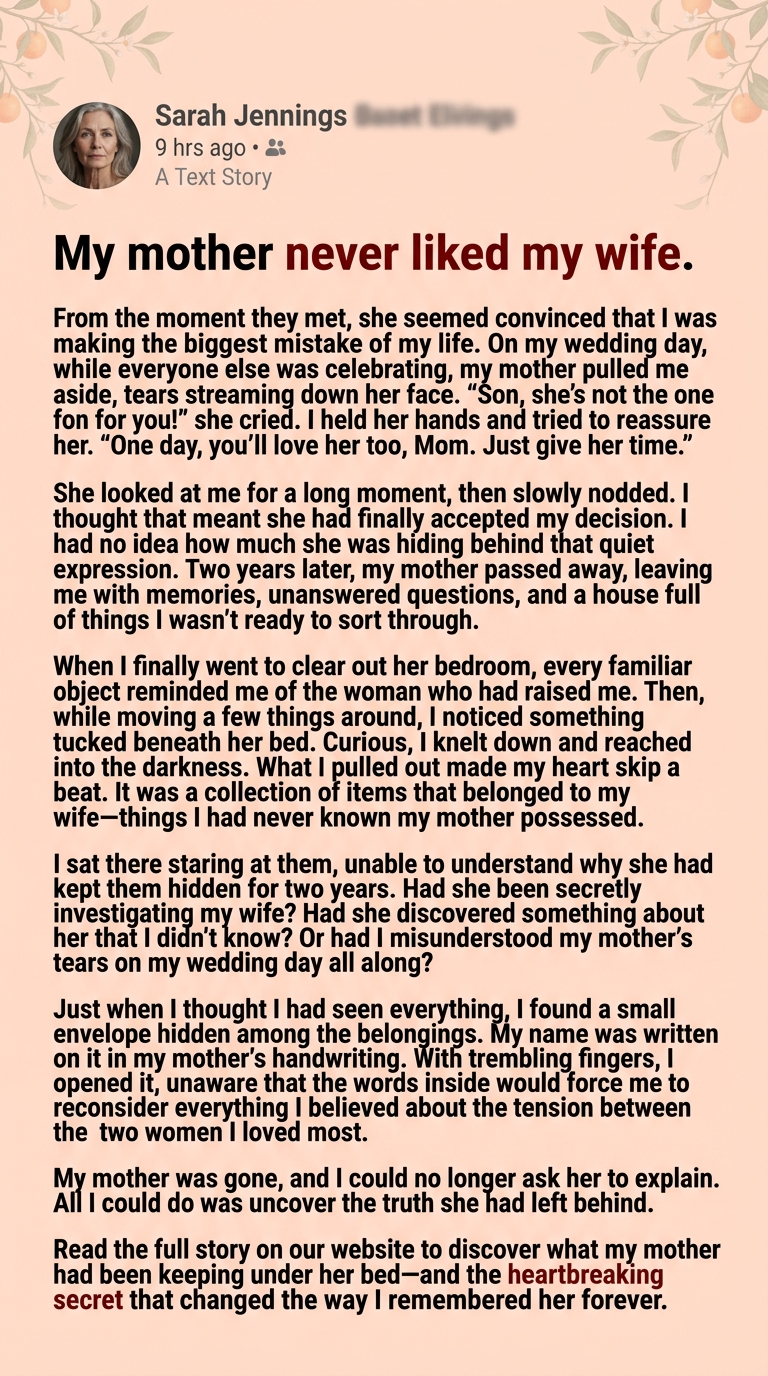
My mother never liked my wife.
From the moment they met, she seemed convinced that I was making the biggest mistake of my life. She never insulted my wife directly, never raised her voice in public, and never openly tried to break us apart. Instead, she watched her with a quiet suspicion that made every family gathering uncomfortable.
My wife, Sarah, tried everything to win her over.
She brought my mother flowers on her birthday, remembered her favorite meals, and called her every Sunday just to ask how she was feeling. When my mother became ill, Sarah offered to take her to appointments and helped around her house without being asked.
But nothing seemed to change my mother’s mind.
Whenever I asked what was wrong, she gave me the same answer.
“There’s something about her, son. I can’t explain it.”
I would sigh and remind her that Sarah was a good woman.
“You haven’t given her a fair chance, Mom.”
My mother would look away, as though there were words she desperately wanted to say but couldn’t bring herself to speak.
On my wedding day, I finally saw how deeply her disapproval affected her.
I was standing near the garden entrance, waiting for the photographer to gather everyone for the next round of pictures, when my mother approached me. Her eyes were red, and she was holding a tissue so tightly that her fingers had turned white.
“Son, please,” she whispered. “She’s not the one for you.”
I stared at her in disbelief.
“Mom, we’re getting married in a few minutes. Please don’t do this today.”
Tears rolled down her cheeks.
“I just want you to be happy.”
“I am happy.”
She looked at me for a long moment. Then she reached up, straightened my tie, and gave me a small, heartbreaking smile.
“One day, you’ll understand.”
I thought she was simply struggling to let go of her only son. I believed she was afraid that another woman would take my place in her life.
I held her hands and kissed her forehead.
“One day, you’ll love Sarah too. Just give her time.”
My mother nodded slowly.
Then she hugged me so tightly that I could barely breathe.
I didn’t understand why she held on for so long.
I didn’t understand why, when she finally released me, she whispered, “I’m sorry.”
I assumed she was apologizing for the tears.
I never imagined those words would haunt me for the rest of my life.
For the next two years, my mother and Sarah maintained a strained but polite relationship. They never argued openly, but there was always a distance between them.
My mother attended our family dinners and sent birthday cards. Sarah continued trying to include her in our lives.
And I convinced myself that things were slowly improving.
Then, two years after my wedding, my mother died unexpectedly following a stroke.
The phone call came on a Tuesday morning.
I remember standing in our kitchen, holding my phone against my ear, listening to the doctor explain what had happened. Sarah was beside me, asking questions I couldn’t answer.
All I could think about was the last conversation I had with my mother.
A week earlier, she had called to ask whether I was eating properly. I had been busy with work and had promised to visit her that weekend.
I never got the chance.
At her funeral, Sarah stood beside me and held my hand. She cried quietly, and when people offered their condolences, she thanked them through trembling lips.
For the first time, I wondered whether I had been unfair to her.
My mother had spent years treating Sarah as though she didn’t belong, yet Sarah had shown up for her until the very end.
After the funeral, I returned to my mother’s house to begin sorting through her belongings.
I postponed it for nearly three months.
Every time I drove past her street, I told myself I wasn’t ready. I couldn’t bear the thought of opening her wardrobe, seeing her slippers beside the bed, or finding the glasses she always left on the kitchen counter.
Eventually, I knew I had to go.
Sarah offered to come with me, but I declined.
“I think I need to do this alone,” I told her.
She kissed my cheek.
“Take your time. I’ll be here when you get back.”
I arrived at my mother’s house on a cold Saturday morning. The moment I unlocked the front door, I was overwhelmed by the familiar smell of lavender soap and old books.
Everything looked exactly as she had left it.
Her coat still hung behind the door. A half-finished crossword puzzle lay beside her favorite armchair. On the kitchen table sat a small ceramic bowl filled with the hard candies she used to offer every visitor.
I walked through the rooms slowly, touching things I remembered from childhood.
Then I entered her bedroom.
I sat on the edge of her bed and cried.
For several minutes, I allowed myself to be a little boy again, wishing my mother could walk through the door and tell me everything would be all right.
When I finally stood, I began opening drawers and sorting through her clothes. I placed items she had worn frequently into boxes and set aside the things I wanted to keep.
It was an ordinary task, painful but manageable.
Until I noticed something beneath the bed.
At first, I thought it was an old storage box. But when I knelt and reached underneath, my fingers touched a large, flat bundle wrapped in a faded blue cloth.
I pulled it into the light.
My heart began to pound.
Inside were several items that belonged to Sarah.
A silver bracelet she had lost shortly before our wedding.
A photograph of Sarah standing outside the small café where we had our first date.
A folded receipt from a pharmacy.
A printed photograph of Sarah speaking to a man I didn’t recognize.
And beneath those things was a small notebook filled with dates, addresses, and handwritten observations.
I sat motionless on the floor.
Why would my mother have these things?
Had she been following my wife?
Had she hired someone to investigate her?
Or had she discovered a secret that she believed I was too blind to see?
My hands began to shake as I turned the pages of the notebook.
Most entries were brief.
“Tuesday, 4:15 p.m. — Sarah visited the pharmacy.”
“Friday, 6:30 p.m. — Met the same man near the old shopping center.”
“Sunday — Returned to the house after visiting the hospital.”
The dates stretched across nearly two years.
My stomach tightened.
The photograph of Sarah with the unfamiliar man seemed to confirm the worst possibility. I could imagine a thousand explanations, and every one of them made me feel sick.
Then I noticed the envelope.
It had been tucked beneath the notebook, sealed carefully, with my name written across the front in my mother’s familiar handwriting.
I knew that handwriting better than my own.
For several minutes, I couldn’t bring myself to open it.
Finally, I broke the seal.
Inside was a letter.
“My dearest son,
“If you are reading this, then I am no longer here to explain what I should have told you a long time ago.
“I know you thought I disliked Sarah because I was jealous of the place she held in your life. I know you believed I was simply afraid of losing you.
“I wish that were the truth.
“It would have been much easier for all of us.
“On the day you introduced Sarah to me, I recognized her name before I recognized her face. At the time, I couldn’t be certain she was the same person. I was afraid of making an accusation that could destroy your happiness, so I began looking for answers.
“I never wanted to spy on the woman you loved. I only wanted to know whether the fear I felt was justified.
“Two months before your wedding, I found out something that changed everything I believed about her.
“But I was too late to stop you from marrying her, and by then, I had learned something even more painful.
“Sarah had not come into your life by accident.”
I stopped reading.
My mouth went dry.
I read the sentence again, hoping I had misunderstood it.
Then I turned the page.
The next paragraph was worse.
“Twenty-five years ago, when you were still a child, your father had a daughter from a relationship he never told me about. Her name was Claire.
“I discovered the truth shortly before he died. I also discovered that he had left behind money intended for her, but the arrangements were never completed. I spent years trying to find her, and eventually, I learned that she had grown up in another family.
“Sarah is Claire’s daughter.
“She is your half-sister’s child.”
I stared at the page.
For a moment, the words made no sense.
Sarah and I had been married for two years. We had shared a home, made plans for children, and built a life together.
And my mother was telling me that the woman I had married was my niece.
I felt the room closing in around me.
I read the letter again, then searched through the bundle for anything that could prove it was true.
There was a photocopy of an old birth certificate, a newspaper clipping about Claire’s adoption, and a letter from a family-services office confirming the connection between Claire and my father.
But there was no evidence that Sarah knew any of this.
I returned to the letter.
“My son, I confronted Sarah after I learned who she was. She was shocked. She told me that her mother had never known the identity of her biological father and that she had grown up without answers about that side of her family.
“Sarah was not trying to deceive you. She did not know the truth when she met you.
“I believe her.
“I have spent the last two years trying to confirm everything, but I could never bring myself to tell you before I was certain. I was afraid you would hate me for interfering in your marriage, and I was afraid that if I told you too soon, I would destroy your life over something that might not be true.
“I know now that my silence was wrong.
“I should have told you the moment I had enough evidence to be concerned. Instead, I watched you build your future without giving you the information you needed.
“The things beneath my bed are the evidence I collected while trying to understand the truth. I kept them hidden because I was ashamed of what I had done and because I could not bear to look at them without remembering the pain I had caused.
“I am sorry, my son.
“I was not trying to punish Sarah. I was trying to protect you, but I chose the wrong way to do it.
“Please, before you make any decisions, talk to her. Let her explain what she knows. Do not blame her for a truth that may have been hidden from her too.
“And please remember that I loved you enough to be afraid of losing you, but I should have trusted you enough to tell you the truth.
“Forever your mother.”
I lowered the letter into my lap.
The room was silent except for the ticking of the clock on the bedside table.
All those years, I had believed my mother was being unreasonable. I had defended Sarah and resented my mother’s refusal to accept her.
Now I understood that my mother had been carrying a fear she couldn’t explain without risking everything.
But I also understood something else.
She had died without giving me the chance to ask her questions.
I sat on the floor for nearly an hour, surrounded by the belongings she had hidden. I didn’t know whether to feel angry, devastated, or grateful that she had left me a clue.
Eventually, I took the letter and notebook home.
Sarah was waiting in the living room when I arrived. She stood up with a smile that disappeared the moment she saw my face.
“What happened?”
I placed the letter on the table.
“I found something in my mother’s room.”
She looked at the envelope, then at me.
“What is it?”
I couldn’t find the right words.
“My mother believed she had discovered a family connection between us. She thought you might be my half-sister’s daughter.”
Sarah stared at me.
Then she shook her head.
“No. That can’t be right.”
I showed her the letter and the documents.
She read them slowly. By the time she reached the final paragraph, tears were running down her cheeks.
“My mother never told me who my biological grandfather was,” she whispered. “She always said she didn’t know.”
“Did you ever hear the name Claire?”
Sarah shook her head.
“No. Never.”
For the first time since I had known her, I saw Sarah look genuinely frightened.
Not defensive. Not angry.
Frightened.
“I swear to you,” she said, taking my hands, “I had no idea.”
I believed her, but I knew belief wasn’t enough.
We needed the truth.
The following week, we contacted a genetic testing service and began tracing the family records. We also reached out to Sarah’s mother, who was still alive and living several hours away.
When we explained what we had found, she went silent.
Then she began to cry.
She confirmed that Sarah’s biological grandfather had never been identified on her original family records. She had been young when Sarah was born, and the circumstances surrounding her own family history had always been complicated.
She agreed to help us investigate.
Several weeks later, the genetic results arrived.
They confirmed that Sarah and I shared a close biological family connection consistent with the history described in my mother’s letter.
The details were devastating, but they were clear.
My mother had been right about the relationship.
Sarah and I were related through my father’s side of the family.
We sat together at our kitchen table, holding hands while the truth settled over us.
Neither of us knew what to say.
We had not chosen to deceive each other. We had fallen in love without knowing what our families had hidden from us.
But the truth changed everything about the future we had imagined.
We sought professional advice to understand our legal options and spoke with a counselor to help us navigate the shock and grief. We agreed not to make decisions in the middle of panic or blame each other for something neither of us had known.
Our marriage could not continue as we had once imagined it. The biological relationship between us was real, and we had to face its consequences honestly.
In the months that followed, Sarah and I made the painful decision to separate as spouses. It was not because our love had been a lie. It was because the truth had revealed a boundary we could not ignore.
We treated each other with kindness throughout the process.
We also acknowledged that we needed time apart to grieve the life we had planned and begin understanding who we were outside our marriage.
I often thought about my mother during those months.
I remembered her tears on my wedding day, the way she had straightened my tie, and the words she whispered before letting me go.
“One day, you’ll understand.”
I had assumed she was afraid of losing her son.
I had never considered that she might be terrified of a truth that could change his life forever.
But I also wished she had trusted me enough to tell me sooner. Her silence had not protected me from pain. It had only delayed the moment when I would have to face it.
Eventually, I returned to her house one final time.
I took the blue cloth bundle out from beneath the bed and placed the contents in a box. I kept her letter, but I no longer felt the need to study every photograph or reread every note.
I understood what she had been trying to do.
She had been frightened, imperfect, and deeply human.
She had tried to protect me in the only way she thought she could, even when that choice caused more suffering than the truth might have.
I wish I could have told her that I understood.
I wish I could have asked why she carried the burden alone for so long.
Most of all, I wish she had been alive when the answers finally came.
Today, when I remember my mother, I no longer see only the woman who opposed my marriage. I see a woman who discovered a terrible secret, struggled with what it meant, and made a decision she believed would spare her son from heartbreak.
She was wrong to remain silent.
But she was never indifferent to my happiness.
The objects beneath her bed were not proof that she had hated my wife.
They were proof that she had been afraid.
And the letter she left behind taught me a lesson I will never forget: sometimes the people who love us most make painful mistakes while trying to protect us. Love cannot erase those mistakes, but honesty can help us understand them.
I had spent years wishing my mother would accept my wife.
In the end, I learned that my mother had been trying to tell me something far more difficult than disapproval.
She had been trying to tell me the truth.
And by the time I finally understood, the one person I wanted to question most was already gone.

