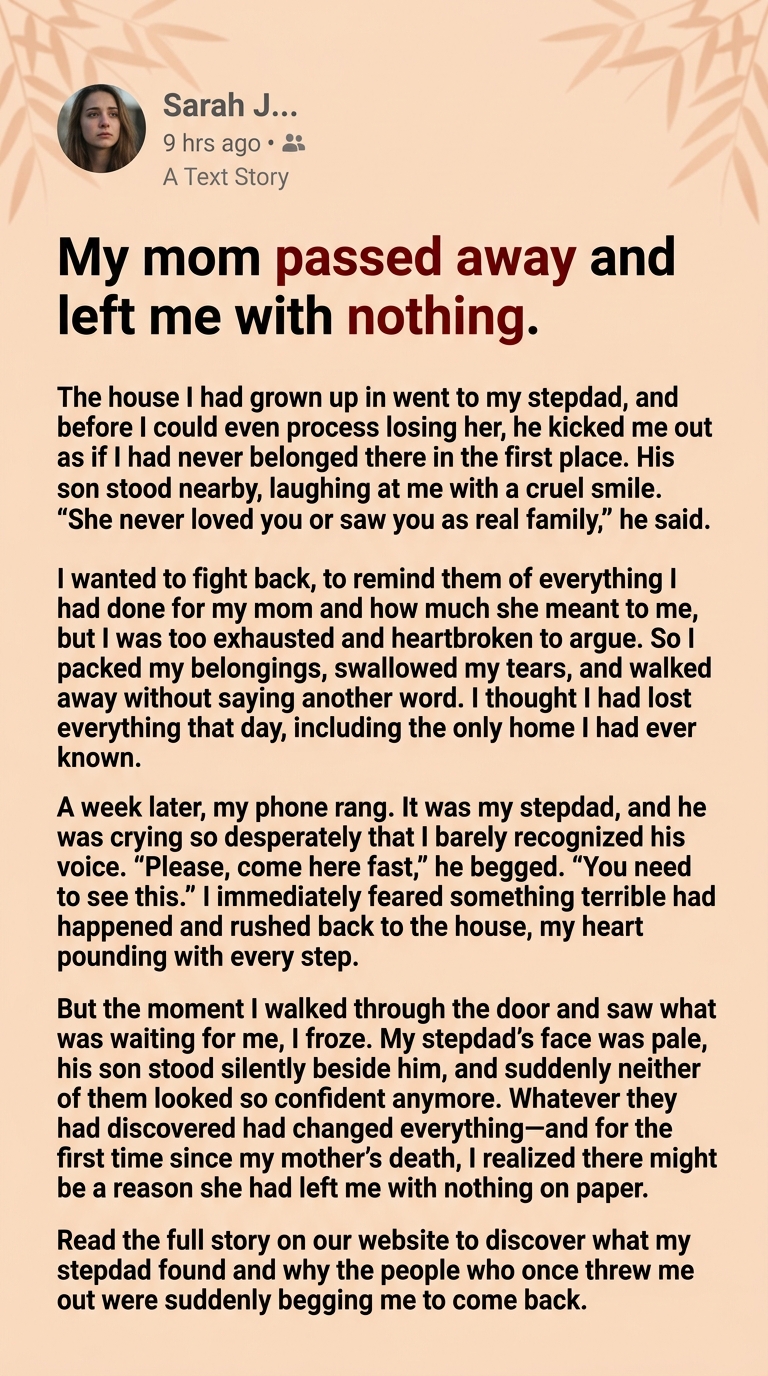
My Stepdad Kicked Me Out After My Mom Died—A Week Later, He Called Me Crying, Begging Me to Come Back
When my mother died, I thought the worst pain I would ever experience was saying goodbye to her.
I was wrong.
The worst pain came three days after her funeral, when my stepfather, Richard, stood in the living room of the house where I had grown up and told me I no longer belonged there.
My mother had been married to Richard for twelve years. During that time, I had tried my best to accept him as part of our family, even when his son, Brandon, made it clear that he never considered me his brother.
Richard had always treated Brandon differently. Brandon could do no wrong, while everything I did seemed to irritate him. Still, I endured it because my mother loved Richard, and I wanted her to be happy.
Then cancer took her.
In the weeks before she died, I barely left her side. I helped her eat, drove her to appointments, sat beside her bed when the pain kept her awake, and held her hand whenever she became frightened.
Sometimes, in the quiet hours of the night, she would look at me with tears in her eyes.
“You’ve always been my good boy,” she whispered once. “Never forget how much I love you.”
I promised her I wouldn’t.
I had no idea those would become the words I would cling to when everyone else seemed determined to make me feel unwanted.
After the funeral, I assumed Richard and I would at least try to support each other through our grief.
Instead, he called me into the living room and placed a stack of papers on the coffee table.
“The house is mine now,” he announced.
I stared at him.
“What do you mean?”
“Your mother left the property to me. The paperwork is clear.”
I knew my mother had changed some of her estate documents after she married Richard, but I had never asked her about the details. I had been too busy worrying about her health to imagine that I might one day need to defend my place in her life.
“So where am I supposed to go?” I asked.
Richard shrugged.
“You’re an adult. You’ll figure something out.”
Brandon leaned against the doorway, watching with an amused expression.
“Looks like you’re finally moving out,” he said. “Guess Mom never loved you or saw you as real family.”
I felt as though someone had struck me in the chest.
He had called my mother Mom for years, but he had never been there for her the way I had during her final months. He had visited occasionally, complained about how depressing the house felt, and disappeared whenever she needed help.
Yet he stood there laughing while I was being thrown out of the only home I had ever known.
I wanted to scream. I wanted to tell Richard how many nights I had slept beside my mother’s bed, how many times I had helped her through terrible pain, and how many things I had sacrificed to make sure she never felt alone.
But I was exhausted.
My mother was gone, and I couldn’t bear the thought of begging the people standing in front of me to acknowledge that I had loved her.
So I packed my clothes, gathered a few photographs, and took the small wooden jewelry box she had given me when I turned eighteen.
Before leaving, I stood in her bedroom for one last moment.
Her favorite blue cardigan was still draped over the chair. A half-finished book lay on her bedside table. The faint scent of her lavender lotion lingered in the air.
I pressed the cardigan against my face and cried.
Then I closed the door and walked away.
For the next week, I stayed in a cheap rented room and tried to figure out how to rebuild my life. I worked extra shifts, avoided talking about the funeral, and told everyone who asked that I was fine.
I wasn’t fine.
I was angry, grieving, and deeply ashamed that the people who had shared my mother’s home could treat me as if I had never mattered to her.
Still, I refused to call Richard.
I would rather struggle on my own than ask him for anything.
Then, exactly seven days after he had thrown me out, my phone rang.
Richard’s name appeared on the screen.
I almost ignored it.
When I finally answered, I heard a sound I had never expected to hear from him.
He was crying.
Not quietly. Not the kind of tears someone tries to hide.
He was sobbing so hard that his words came out broken.
“Please,” he said. “You have to come back. Please come here as fast as you can.”
My stomach tightened.
“What happened? Is Brandon okay?”
“Just come. You need to see this.”
“Richard, you’re frightening me. Tell me what’s going on.”
He drew a shaky breath.
“It’s about your mother.”
I grabbed my keys and rushed out.
The entire drive, my mind raced through terrible possibilities. Had someone discovered a problem with her medical records? Had Richard found something at the hospital? Was there something about her final days that I didn’t know?
When I reached the house, the front door was already open.
Richard stood in the hallway, pale and visibly shaken.
Brandon was beside him, but the smug expression I remembered had disappeared. He looked as though he hadn’t slept in days.
Neither man said anything as I stepped inside.
Then I saw the dining table.
It was covered with documents, old photographs, bank statements, and a small wooden box I recognized immediately.
It had belonged to my mother.
“What is all this?” I asked.
Richard looked at me, and his eyes filled with tears again.
“Your mother left something behind,” he said. “Something we didn’t know about.”
I approached the table.
On top of the documents lay a sealed envelope with my name written across it in my mother’s handwriting.
My knees nearly gave way.
I hadn’t seen her handwriting since the day she became too weak to hold a pen.
I picked up the envelope and carefully opened it.
Inside was a letter.
My dearest Daniel,
If you’re reading this, then I am no longer there to explain what I have done.
I know you may be hurt or confused. Please read everything before you decide what to believe.
There is something I never told you because I wanted you to grow up believing that love was enough to make a family. I was afraid that the truth would make you feel as though you had to choose between the people you loved.
But now I need you to know that you were never forgotten, and you were never less important to me than anyone else.
I stopped reading.
My hands trembled so badly that the paper rustled.
“What does this mean?” I asked.
Richard lowered his head.
“Keep reading.”
The next page explained that my mother had discovered, several years earlier, that a substantial amount of money she had saved before her marriage was at risk of becoming entangled in financial arrangements Richard had made.
She had consulted an attorney and an independent financial adviser. Together, they had helped her separate certain assets and prepare documents explaining what she wanted to happen after her death.
One of those documents concerned a trust established for my benefit.
The trust had been funded with money my mother had inherited from her own parents, along with savings she had accumulated before marrying Richard. It was managed separately from the house and had its own legal records.
I read the figures twice.
The account held considerably more money than I had ever imagined my mother possessed.
But the letter made one thing clear: the money was not the real reason she had left it to me.
Daniel, I know that Richard has sometimes struggled to understand our relationship. I hoped that time would help him see that loving you does not take anything away from him or Brandon.
I also know that you have spent years trying to keep everyone happy, even when it meant hiding your own hurt.
I don’t want you to spend the rest of your life proving that you deserve to belong.
The trust is meant to give you choices. It is not a reward for loving me, because your love was never something you needed to earn.
Please use it to build a life in which you feel safe, respected, and free.
I lowered the letter.
For a long moment, I couldn’t speak.
My mother had known I might be left with nothing from the house. She had known that the people around her might misunderstand her intentions.
And she had quietly made arrangements to ensure that my future would not depend entirely on them.
But there was more.
Beneath the letter was a document from her attorney, dated several months before her death. It confirmed the existence of the trust and named me as its beneficiary.
Another document showed that the house itself had been addressed separately in her estate plan.
Richard had inherited the house under the terms of the will, subject to the usual legal obligations. But the house had never represented the entirety of my mother’s estate.
He had assumed that because he received the property, he had received everything.
He had been wrong.
“What happened?” I asked, looking at him.
Richard rubbed his face with both hands.
“Brandon found the box while we were cleaning your mother’s desk. We thought it contained old insurance papers. Then we found the trust documents and the letter from her attorney.”
Brandon stared at the floor.
“And you called me because…” I began.
“Because I realized what I’d done,” Richard said.
His voice cracked.
“I threw you out without even asking whether you had somewhere to go. I told myself I was doing what your mother would have wanted, but I hadn’t even read the documents she left behind.”
I looked at him in disbelief.
“Yesterday, you told me I wasn’t your responsibility.”
“I know.”
“You let Brandon laugh at me while I packed my things.”
Richard closed his eyes.
“I know.”
“And now that you’ve discovered Mom left me money, you want me back?”
The room went silent.
Richard’s face crumpled.
“No,” he said quietly. “At least, I hope that’s not why I’m asking. I know how it looks. I know I don’t deserve to ask you for anything.”
“Then why did you call?”
He took a long breath.
“Because your mother left another letter. One addressed to me.”
He picked up a folded page from the table and handed it to me.
The handwriting was hers.
I read it slowly.
Richard,
If you are reading this, please remember that my son was part of my life long before you entered it.
You promised me that you would treat him as family. I believed you when you said that you understood what it meant to love someone who had already lost so much.
I am not asking you to give him everything. I am asking you never to make him feel that his place in this family depends on what he can offer you.
If the day comes when I am no longer here, I hope you will help him through his grief rather than add to it.
Please don’t let my death become the reason he loses his home, his security, and the people he has loved.
If you cannot give him the love he deserves, at least give him the dignity of making his own choices.
I trusted you with the people I loved most. I hope you will remember that trust when I am gone.
I finished reading and placed the letter on the table.
Richard was crying openly now.
“I didn’t understand,” he whispered. “I was so focused on the house and the paperwork that I never stopped to think about what your mother had actually wanted.”
I looked at Brandon.
He had been silent the entire time.
Finally, he spoke.
“I didn’t know about the trust either.”
I didn’t answer.
He swallowed.
“What I said to you that day was cruel. I wanted you gone because I thought the house should belong to Dad and me. I didn’t care what happened to you.”
It was the first honest thing I had ever heard him say.
“I can’t take it back,” he continued. “But I’m sorry.”
I wanted to feel satisfied. I wanted their apologies to undo the humiliation of being thrown out while I was still grieving.
They couldn’t.
The memory of carrying my bags down the driveway would stay with me for a long time.
And I had to ask myself a difficult question: if my mother had left me nothing in a trust, would either of them have called me back?
I suspected I already knew the answer.
Richard seemed to understand what I was thinking.
“You don’t have to come back,” he said. “I shouldn’t have asked as if you owed me that. The attorney has explained that the trust is yours, and we’re arranging a proper meeting to go through the documents. You can decide what you want to do.”
For the first time, he wasn’t telling me what would happen.
He was leaving the decision to me.
That mattered more than I expected.
Over the next several weeks, I met with my mother’s attorney and an independent adviser. They reviewed the trust, explained my rights, and confirmed the arrangements for administering the estate.
The money would not make my grief disappear, but it gave me the stability I needed to find a permanent place to live and think about my future without constant fear.
I rented a small apartment with big windows and enough room for a desk and a bookshelf. I bought a secondhand couch and placed my mother’s photograph on the mantel.
For the first time in weeks, I could sleep without wondering where I would be the following month.
Richard sent me messages occasionally. Some were apologies. Others were simple updates about the house.
I didn’t rush to forgive him.
Eventually, I agreed to meet him for coffee.
He looked older than I remembered, and he spent most of the meeting staring at his hands.
“I thought the house was the most important thing your mother left behind,” he admitted. “I didn’t understand that the way I treated you would be something you remembered long after the paperwork was settled.”
I listened without interrupting.
“I can’t ask you to trust me again just because I feel guilty,” he continued. “I know that. I just want you to know that I understand why you left, and why you might never want to come back.”
I told him I appreciated the apology, but that rebuilding any relationship would take time.
Brandon apologized separately. I accepted that he was sorry, but I made it clear that I wouldn’t pretend his words had never happened.
We weren’t suddenly a happy family. There were too many years of resentment and too much pain to erase with one conversation.
But I no longer felt trapped by the need to win their approval.
Months later, I returned to the house to collect a few things my mother had left in the attic.
I stood in the hallway where Richard had once told me to leave, remembering how small and powerless I had felt.
Then I looked at the photograph of my mother on the wall.
I finally understood the most important part of her letter.
She hadn’t left me the trust because she wanted me to defeat Richard or Brandon. She had left it because she knew that love and security were not always the same thing, and she wanted me to have both.
She couldn’t guarantee that everyone would treat me fairly after she was gone.
But she could make sure I had the freedom to walk away when they didn’t.
I carried the last box to my car and paused at the front door.
Richard stood several feet behind me.
“Your mother loved you very much,” he said.
“I know.”
“And I should have remembered that.”
I nodded, then stepped outside.
For months, I had believed that my mother had left me with nothing.
Now I understood that she had left me something no one could take away: the means to build a life of my own, the truth about her intentions, and the knowledge that I had never needed to earn her love.
The house had gone to Richard.
The apologies had come too late to erase what happened.
But my future belonged to me.
And for the first time since my mother’s death, that was enough.

