My mother was the person who made every place feel like home.
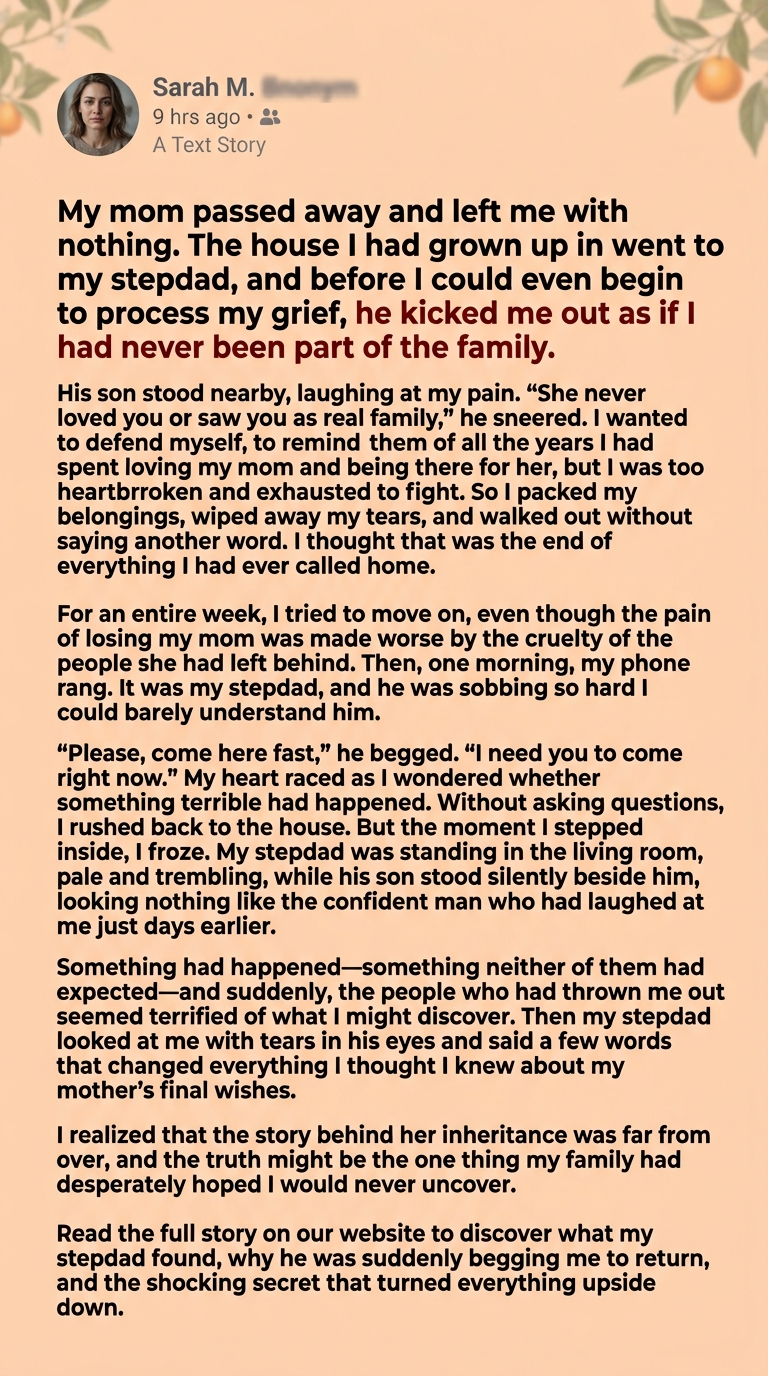
When she passed away, I thought the hardest part would be learning to live in a world without her. I never imagined that, before I had even finished grieving, I would lose the house where I had grown up and discover how little my stepfather thought of me.
After the funeral, my stepfather, Richard, called me into the living room.
His son, Daniel, was sitting on the couch, scrolling through his phone as though nothing important had happened.
Richard placed a folder on the table.
“This house belongs to me now,” he said. “You need to make arrangements to leave.”
I stared at him, unable to understand what I was hearing.
“Leave? Dad, Mom just died. Where am I supposed to go?”
He looked away.
“You’re old enough to take care of yourself. I have my own family to think about.”
His words hurt, but what Daniel said next hurt even more.
He leaned back and laughed.
“Did you honestly think she loved you as much as she loved us? You were never really part of this family.”
For a moment, I couldn’t speak.
I remembered the nights I had stayed awake beside my mother when she was sick. I remembered taking her to appointments, preparing meals when she was too tired to stand, and sitting beside her when she was frightened about the future.
I remembered her holding my hand and telling me how grateful she was that I was there.
And now, the two people standing in front of me were acting as if those years had never happened.
I wanted to defend myself. I wanted to tell Daniel that love wasn’t measured by blood, and I wanted to remind Richard that my mother had trusted me with more than he realized.
But grief had drained every ounce of strength from me.
So I packed my clothes, gathered a few photographs of my mother, and placed her favorite blue scarf in my suitcase.
Before leaving, I looked around my childhood home one last time.
The kitchen still smelled faintly of the tea she used to make. Her reading glasses were on the small table beside the window. A flower she had planted months earlier was still blooming outside.
Everything looked the same.
Except I no longer belonged there.
I walked out without another word.
For the next seven days, I stayed in a small rented room and tried to put my life back together. I found temporary work, answered messages from concerned friends, and forced myself to eat even when I had no appetite.
At night, I cried quietly into my pillow.
I wasn’t only mourning my mother anymore. I was mourning the family I had believed I still had.
I kept wondering whether Richard had always felt this way about me. Had he secretly resented my presence for years? Had Daniel’s cruel words simply revealed what they had both been thinking?
I had no answers.
Then, early one morning, my phone rang.
Richard’s name appeared on the screen.
I almost ignored it.
But something about the repeated calls made me uneasy, so I answered.
“Hello?”
For several seconds, all I heard was crying.
Then Richard spoke.
“Please,” he said, his voice shaking. “You need to come home.”
I sat upright.
“What happened?”
“I can’t explain it over the phone. Just come. Please.”
I hesitated.
A week earlier, he had watched me leave with nowhere to go. He hadn’t called to ask whether I was safe or whether I had somewhere to sleep.
Why was he suddenly begging me to return?
“Is Daniel all right?” I asked.
“He’s here. Just come back. There’s something you need to see.”
I grabbed my jacket and left immediately.
The journey felt longer than usual. Every possible explanation ran through my mind. Had someone been injured? Had Richard discovered something about my mother’s illness? Had he finally realized what he had done?
When I arrived, the front door was unlocked.
I stepped inside.
Richard stood in the living room, pale and trembling. His eyes were red, and several documents lay scattered across the coffee table.
Daniel stood beside the fireplace, his arms hanging loosely at his sides.
He wasn’t laughing now.
Neither of them spoke when I entered.
I looked from one face to the other.
“What happened?”
Richard swallowed hard.
“We found something in your mother’s study.”
My heart began to pound.
“What kind of something?”
He pointed toward the table.
“Your mother left a letter. It was sealed inside a small envelope with your name on it. We didn’t know it was there.”
I approached the table slowly.
The envelope was old, cream-colored, and unmistakably addressed in my mother’s handwriting.
My name was written across the front.
Beneath it were five simple words.
For my child, when needed.
My fingers trembled as I opened it.
Inside was a handwritten letter and a card bearing the contact details of a lawyer.
I began to read.
My dearest child,
If you are reading this, it means I can no longer sit beside you and explain everything myself.
There is something I want you to understand. You have never needed to earn your place in my heart. You were my child in every way that mattered, and nothing that happens after I am gone can change that.
I stopped reading.
Tears blurred the page.
My mother had known I might need those words someday.
I continued.
I know that questions may arise about the house and the things I leave behind. I have made arrangements with my lawyer to ensure that my wishes are properly explained and that the documents relating to my estate can be reviewed.
Please do not make decisions out of fear or allow anyone to convince you that your place in this family depended on what you inherited.
I want you to have peace. I want you to be treated fairly. And above all, I want you to remember that you were loved.
All my love,
Mom.
I pressed the letter against my chest.
For the first time since her death, I felt as though she had reached across the silence to hold me.
But the letter didn’t explain why Richard was so frightened.
I looked at the lawyer’s card.
“Have you spoken to this person?”
Richard nodded.
“Yesterday. We found the envelope while clearing out the study. I called the lawyer because I wanted to know whether the letter meant anything.”
“And?”
His face tightened.
“The lawyer asked us to bring in the documents relating to the house and your mother’s estate. He said there were matters we needed to clarify before making any further decisions.”
Daniel finally spoke.
“Dad thought the house was automatically his because his name was on the paperwork.”
Richard shot him a warning look.
I turned toward them.
“What does that mean?”
Richard rubbed his face with both hands.
“Your mother and I had discussed the house years ago. I believed that everything would pass to me when she died. I didn’t think there was anything else to consider.”
“But you told me I had to leave.”
He lowered his eyes.
“Yes.”
“You watched me pack my things.”
“I know.”
“You didn’t even ask where I was going.”
He began to cry again.
“I know. I was wrong.”
For a moment, I felt a flash of anger so intense that I could barely look at him.
An apology couldn’t undo the humiliation of being forced out of my home while I was grieving. It couldn’t erase the nights I had spent alone wondering whether my mother had ever truly wanted me there.
But I still needed to know what the lawyer had discovered.
“What exactly did he tell you?”
Richard took a deep breath.
“He said the documents had to be reviewed before anyone could claim the house belonged entirely to them. He also said your mother’s written instructions might be important to understanding her intentions.”
Daniel stared at the floor.
Then Richard revealed the part that had frightened them both.
“The lawyer asked whether you had been given a copy of the estate documents. When I told him no, he said you needed to be contacted immediately.”
I looked at the letter again.
My mother hadn’t promised me a fortune. She hadn’t written that I would automatically receive the house. She had done something more important: she had made sure that her wishes would not be forgotten and that I would have the opportunity to understand my rights.
And Richard had made a terrible mistake by assuming that he could decide everything without me.
“Why did you call me crying?” I asked quietly.
He looked at me with shame.
“Because I finally understood that I had treated you as though you didn’t matter. And because the lawyer made it clear that I couldn’t simply ignore your mother’s wishes or keep you in the dark.”
Daniel shifted uncomfortably.
“Look,” he said, “I was angry. I shouldn’t have said those things to you.”
I turned toward him.
“You laughed when I was being thrown out of my own home.”
His expression changed.
“I know.”
“No. I don’t think you do. I wasn’t asking for your money. I wasn’t demanding the house. I had just lost my mother, and you made me feel as if I had never been loved by her.”
He had no answer.
For once, there was no clever remark or cruel laugh to fill the silence.
I gathered the letter and the lawyer’s card.
“I’ll speak to the lawyer myself,” I said. “I want everything explained properly. I want to know what Mom arranged, what the documents say, and what my rights are.”
Richard nodded immediately.
“Of course.”
“And whether I have any inheritance or not, I won’t let anyone tell me that my mother’s love was something I had to prove.”
I turned toward the door.
“Wait,” Richard said.
I stopped.
“Are you ever going to forgive me?”
I looked at the man who had once sat beside my mother at family dinners, who had attended her birthday celebrations, and who had promised to care for the family she loved.
“I don’t know,” I answered honestly. “An apology is a beginning, not a solution. You’ll have to show me that you mean it.”
Then I left.
This time, I didn’t leave because someone had forced me out.
I left because I had chosen to protect myself.
The following week, I met with my mother’s lawyer. He reviewed the relevant documents with me, explained the legal process, and helped me understand what could and could not be established about the estate.
There were still questions to resolve, and I refused to accept anyone’s promises without proper documentation.
The process took time, but I finally had something I had been missing since the day my mother died: the confidence to ask questions and the courage to stand up for myself.
I also began to understand that my mother’s greatest gift wasn’t necessarily a house or a financial inheritance.
It was the knowledge that I had been loved, even when the people around me behaved as though I wasn’t worth protecting.
Richard sent several messages over the following weeks. At first, his apologies were awkward and defensive. Eventually, he stopped making excuses and began acknowledging the harm he had caused.
Daniel also apologized, although I made it clear that rebuilding trust would take more than a few words.
I didn’t immediately move back into the house. I needed time to grieve, to rebuild my independence, and to decide what kind of relationship I wanted with them.
Months later, I returned to the garden where my mother had planted her favorite flowers.
I stood quietly beside them, remembering the woman who had taught me that family was supposed to be a place of safety, not a weapon used to make someone feel unwanted.
I finally understood something I wished I had known the day I walked away.
Losing a home does not mean losing your worth. And being treated as though you don’t belong does not mean you were never loved.
My stepfather had called me back because he was afraid of what he had discovered. But what I discovered was even more important.
I could honor my mother’s memory without allowing the people she left behind to decide my value.
And for the first time since her funeral, I began to feel at home again—not because of a house, an inheritance, or anyone else’s approval, but because I was finally standing up for myself.
The End.
I Thought My Mother Had Left Me Nothing—Until We Found the Letter She Had Hidden