The Full Story
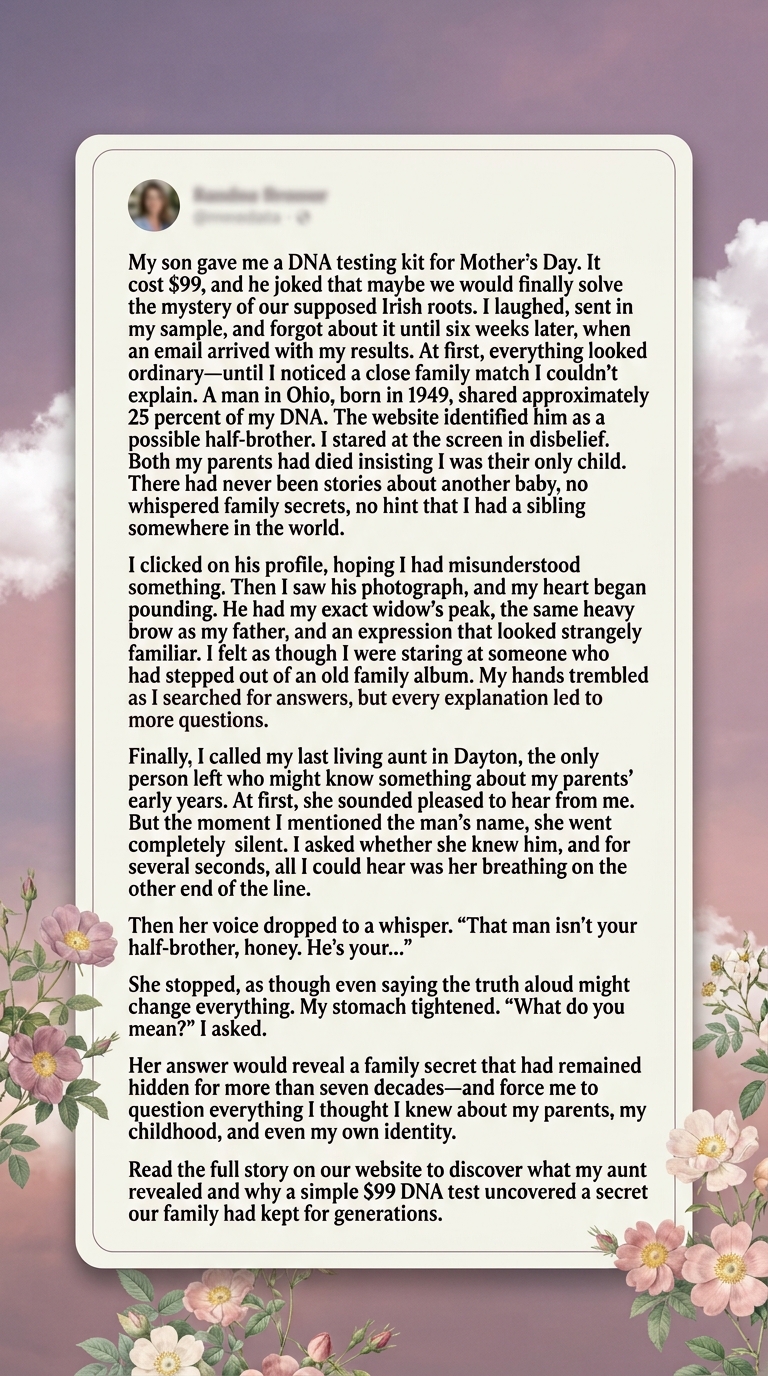
When my son gave me a DNA testing kit for Mother’s Day, I thought it was a harmless little joke.
“Maybe we’ll finally prove we’re Irish,” he said, grinning as I turned the $99 box over in my hands.
My father had always claimed that his family descended from Irish immigrants. He told stories about a great-grandfather who supposedly crossed the Atlantic with nothing but a suitcase and a stubborn streak. My mother had repeated those stories so often that I had never thought to question them.
So I laughed, swabbed my cheek, mailed the sample, and forgot about it.
Six weeks later, an email arrived with my results.
At first, everything seemed ordinary. There were percentages, colorful maps, and distant relatives with names I didn’t recognize. Then I noticed a match listed as a close family member.
A man born in Ohio in 1949.
The website estimated that we shared approximately 25 percent of our DNA, suggesting he could be my half-brother.
I stared at the screen.
Both my parents were dead. My father had passed away when I was in my forties, and my mother had followed him several years later. They had always insisted I was their only child. There had never been a mention of another baby, a previous marriage, or a son who had been given away.
I clicked on the man’s profile.
His name was Thomas Whitaker.
The photograph made my stomach tighten. He had a widow’s peak like mine, a heavy brow that reminded me of my father, and a slight crease beside his mouth that I had seen in my own reflection for decades.
It felt like looking at a photograph of a relative who had somehow been cut out of our family album.
I searched his name online. I found a short professional biography, a few photographs, and a retirement announcement from an engineering company in Ohio. Nothing explained why we shared so much DNA.
Finally, I called my last living aunt, Margaret, who lived in Dayton.
She was my mother’s younger sister, and at eighty-seven, she was the only person left who had known my parents when they were young.
She sounded delighted to hear from me.
We talked about the weather, my son’s new job, and the garden she was trying to keep alive. Then I mentioned the DNA test and read her Thomas’s name.
She went silent.
At first, I thought the connection had dropped.
“Aunt Margaret?”
I heard her take a shaky breath.
“Where did you get that name?”
“From a DNA website. It says he’s probably my half-brother. Do you know him?”
Another long silence followed.
Then she whispered, “That man isn’t your half-brother, honey.”
My fingers tightened around the phone.
“He’s your cousin.”
I blinked.
“My cousin? How could we share that much DNA?”
She let out a breath that sounded as though she had been holding it for seventy years.
“Because he’s your father’s brother’s son. Your uncle’s boy.”
I sat down hard on the edge of my bed.
“My father had a brother?”
“Yes,” she whispered. “His name was Michael. And your parents spent their whole lives making sure you never heard about him.”
For a moment, I couldn’t speak.
My father had told me countless stories about his childhood. He had described his school, his first job, the house where he grew up, and the summers he spent fishing with his father.
But there had never been a Michael.
“Why?” I finally asked. “Why would they hide an entire person from me?”
Aunt Margaret began to cry.
“Because of what happened in 1949.”
She explained that my father had grown up in a strict, working-class family in Ohio. His older brother, Michael, was considered the rebellious one. He played music, wanted to travel, and refused to follow the path their father had planned for him.
My father, by contrast, had been the dependable son. He worked hard, kept his promises, and wanted everyone to believe that his family was respectable.
In the spring of 1949, Michael married a young woman named Eleanor. They were barely adults, and when Eleanor became pregnant, the family reacted with a mixture of excitement and anxiety.
The baby was Thomas.
But before Thomas was born, Michael and his father had a terrible argument over money. Michael wanted to move to another state to pursue a job opportunity. His father accused him of abandoning his responsibilities, and my father sided with their parents.
The argument grew so bitter that Michael left the family home.
A few months later, Michael and Eleanor separated. Their marriage had been strained by financial problems and disagreements about where to live. Eleanor returned to her own family, taking baby Thomas with her.
My father considered his brother’s departure a disgrace.
“He said Michael had betrayed everyone,” Aunt Margaret told me. “He refused to speak his name. Your grandfather agreed. They told people Michael had gone away and wanted nothing more to do with the family.”
“But he was still alive,” I said.
“Yes. He was alive, and he tried to come back.”
Aunt Margaret explained that Michael had written several letters to his parents over the following years. He wanted to reconcile. He sent photographs of Thomas as a toddler and asked whether he might bring his son to visit.
My grandparents never answered.
My father knew about the letters. According to my aunt, he believed that reopening the relationship would bring back an old family conflict and damage the image of stability he had worked so hard to maintain.
He chose silence.
Eventually, Michael stopped writing.
I sat with the phone pressed to my ear, trying to absorb what I was hearing.
“So my father had a nephew all this time?”
“Yes.”
“And nobody told me?”
“Your father didn’t want to talk about Michael. Your mother thought it was better not to upset him. I was young, and I was told to stay out of it. By the time I was old enough to understand how wrong it was, the silence had become a family habit.”
I felt angry, but beneath the anger was something else: grief for a person I had never known and for a relationship that had been denied to both of us.
“Did my father ever see him again?”
Aunt Margaret hesitated.
“Yes,” she said. “Once.”
She explained that in the late 1970s, Michael had returned to Ohio to settle an estate after their father died. He tried to arrange a meeting with my father. They met briefly at a diner, but the conversation ended in another argument.
My father left without saying goodbye.
Michael never tried to visit again.
“He wasn’t perfect,” Aunt Margaret added. “He was stubborn, and he made mistakes. But he wanted his family. He wanted his brother to know his son. Your father couldn’t forgive him for leaving, even though he never gave him a real chance to explain himself.”
I looked again at Thomas’s photograph on my computer screen.
“Does Thomas know any of this?”
“I don’t know, sweetheart. Michael eventually moved away. He died years ago. I heard that Thomas grew up with his mother’s family, and I never knew whether he was told the full story.”
After we ended the call, I sat at my desk for nearly an hour.
My father’s silence had always seemed like a collection of harmless omissions. He didn’t talk about certain relatives. He disliked family reunions. He changed the subject whenever someone mentioned his childhood.
I had assumed he was simply private.
Now I understood that silence could be a decision, and that a decision repeated for decades could become an inheritance.
I returned to the DNA website and sent Thomas a short message.
“Hello, Thomas. My name is Susan Bennett. Our DNA results suggest we are close relatives. I believe your father may have been my father’s brother. If you’re comfortable discussing it, I’d love to learn more about our family connection.”
I didn’t expect an immediate reply.
But the next morning, my inbox contained a message from him.
“Dear Susan, I’ve been wondering about this match. My mother always told me that my father had a brother who refused to acknowledge us. I never knew his name for certain, and I never imagined I would find a relative this way. I’d be glad to talk.”
I read the message twice.
Then I called him.
His voice was warm and slightly gravelly. He told me that he was seventy-six, retired, and living outside Columbus, Ohio. He had two adult daughters and three grandchildren. His wife had died several years earlier, and he now spent much of his time volunteering at a local history museum.
He also had a small box of family photographs and documents that his mother had kept.
“I always thought there was a part of my father’s story I wasn’t getting,” he said. “My mother didn’t speak badly of him, but she never wanted to discuss why they separated. She said it was complicated.”
I told him what Aunt Margaret had revealed.
For a long moment, he said nothing.
Then he asked, “Did your father ever mention me?”
I swallowed.
“No. Not once.”
He sighed.
“I guess that answers a question I’ve had my whole life.”
We spoke for nearly two hours. He told me about his childhood, his mother, and the few things he remembered hearing about his father. I told him about my parents, the family stories I had grown up with, and how strange it felt to discover an uncle and cousin in my seventies.
We didn’t try to make the past sound better than it was.
Thomas acknowledged that his father had been absent and that his mother had raised him through difficult years. I acknowledged that my father had been a loving parent in many ways, but that he had also made a choice that hurt people who had never been given the opportunity to speak for themselves.
Neither of us had to excuse the past to begin learning about it.
A week later, Thomas mailed me copies of the photographs and letters his mother had saved.
One photograph showed a young man standing beside a river, smiling at the camera. He had dark hair, a strong brow, and the same widow’s peak I saw in the mirror every morning.
On the back, in faded handwriting, were the words:
“Michael, summer of 1948.”
I stared at the photograph until my eyes blurred.
For the first time, I could see the face of the uncle my father had erased from our family history.
There were also letters. Some were brief, written in a hurry. Others were longer and more emotional. In one, Michael asked his father to let him bring Thomas to visit.
“I don’t want my son to grow up believing he has no family on my side,” he had written. “Whatever happened between us, he deserves to know where he comes from.”
My grandfather had never replied.
I showed the letters to my son, who had given me the DNA kit in the first place.
He read them quietly, then looked at me.
“I thought we were just finding out whether we were Irish,” he said.
I laughed through my tears.
“So did I.”
A few months later, Thomas and I arranged to meet in Ohio. I was nervous as I walked into the restaurant where we had agreed to have lunch. I had spoken to him many times by then, but seeing him in person felt different.
He stood when he saw me.
For a moment, we simply looked at each other.
Then he smiled.
“You really do have the same eyebrows,” he said.
I laughed, and the tension broke.
We spent the afternoon comparing family photographs and trading stories. We discovered that we both liked old movies, strong coffee, and the kind of history that people rarely included in official records. He showed me pictures of his daughters and grandchildren. I showed him photographs of my son and my parents.
We weren’t instantly transformed into lifelong companions. We were two older people learning how to make room for a relationship that should have had decades to grow.
But it was a beginning.
Before we parted, Thomas handed me a copy of one of his father’s letters.
“I thought you should have this,” he said. “It’s part of your family, too.”
I thanked him and placed it carefully in my bag.
On the drive home, I thought about my father. I remembered his kindness when I was sick, his pride when I graduated, and the way he used to whistle while repairing things around the house. Those memories were real.
So was the secret.
For a while, I wondered whether discovering the truth meant I had to judge my entire childhood differently. Eventually, I realized I didn’t have to choose between loving my father and acknowledging the harm he had done.
People can be loving in one part of their lives and deeply wrong in another. Understanding that doesn’t excuse their choices. It simply allows us to see them honestly.
I also understood why my aunt had remained silent for so long. Families sometimes mistake silence for peace. They believe that avoiding a painful subject protects everyone, when in reality it can leave questions unanswered for generations.
The $99 test had not simply revealed a genetic connection. It had uncovered a story that my family had spent decades refusing to tell.
And it gave Thomas and me the chance to decide what happened next.
Today, we keep in touch. We share photographs, exchange birthday messages, and occasionally meet when our schedules allow. My son jokes that his Mother’s Day gift gave him a cousin, an uncle, and a family history lesson all at once.
I still have the photograph of Michael on my desk.
Sometimes I look at it and wonder what our family might have been like if my father had answered those letters. I wonder what it would have meant to grow up knowing Thomas, to share holidays, to hear stories about an uncle who loved music and dreamed of traveling.
I’ll never know.
But I do know this: the truth did not arrive to destroy the memories I treasured. It arrived to make room for the ones I had never been allowed to have.
My parents insisted I was an only child. They were wrong in a way I could never have imagined.
I had an uncle whose name was forbidden, a cousin who grew up wondering why his father’s family had disappeared, and a history that waited seventy years for someone to ask the right question.
All it took was a small box, a DNA sample, and the willingness to listen when an old secret finally began to speak.
And the most surprising part wasn’t that I had found another relative.
It was that, after all those years, there was still time to know him.