The Full Story
For forty-five years, I believed my biological parents were strangers whose names I might never know.
I had been adopted at birth through a closed adoption. My adoptive parents loved me, gave me a stable home, and never made me feel unwanted. As I grew older, I became curious about where I came from, but curiosity never felt urgent enough to disrupt the life I had built.
I married the woman I loved, raised two wonderful children, and spent seventeen happy years building a family of my own.
I thought my story was settled.
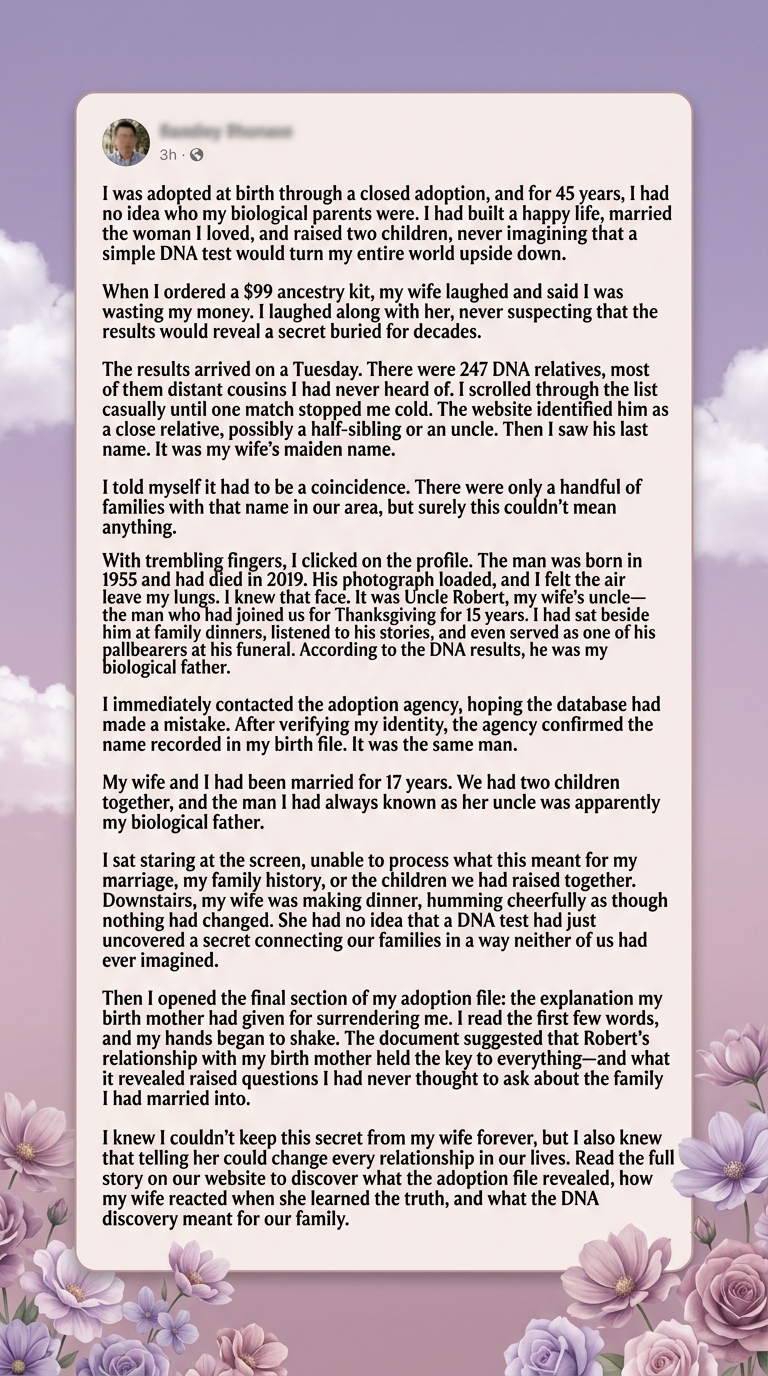
Then I ordered a $99 DNA ancestry kit.
My wife, Claire, laughed when she saw the box on our kitchen counter.
“You’re spending a hundred dollars to find out whether you’re Irish?” she teased.
“Maybe I’ll discover I’m descended from royalty,” I replied.
She rolled her eyes and went back to making dinner.
Neither of us could have imagined that a small plastic tube would uncover a secret that had been sitting at our family table for fifteen years.
The results arrived on a Tuesday morning.
I opened the website on my laptop and scrolled through the list of 247 DNA relatives. Most were distant cousins with unfamiliar names. I clicked on a few profiles, studied the family trees, and was about to close the page when one match caught my attention.
The website described him as a close relative, possibly a half-sibling or an uncle.
His surname was Whitaker.
Claire’s maiden name.
I stared at the screen, trying to convince myself it was a coincidence. The Whitaker family was large, and several branches had lived in the same region for generations.
Still, I clicked on the profile.
A photograph appeared.
My stomach dropped.
The man was Robert Whitaker, Claire’s uncle. He had died in 2019, but I knew his face as well as I knew my own reflection. He had attended our Thanksgiving dinners for fifteen years, sat beside me during family celebrations, and told the same stories about his childhood every time someone brought out the dessert.
I had even been one of the pallbearers at his funeral.
According to the DNA results, Robert was almost certainly my biological father.
I read the page again. Then I checked the estimated relationship, the shared DNA amount, and the family information.
Nothing changed.
I closed the laptop and walked downstairs.
Claire was chopping vegetables, humming along to the radio.
“How was your day?” she asked.
I opened my mouth, but no words came out.
She looked up.
“What’s wrong?”
“Nothing,” I lied. “Just a headache.”
I went back upstairs and called the adoption agency.
After verifying my identity, the representative explained that my original records had been sealed under the rules in effect when I was born. Because of updated regulations, the agency could provide certain nonidentifying details and confirm information through its authorized process.
I explained the DNA match.
There was a pause while she checked my file.
Then she said, “The name recorded in your original birth documentation is Robert Whitaker.”
I gripped the edge of my desk.
“Are you certain?”
“Yes. The record identifies him as your biological father.”
I thanked her, ended the call, and sat motionless for several minutes.
Robert.
The man who had carved the turkey at our Thanksgiving table.
The man who had congratulated me when Claire and I announced our engagement.
The man whose funeral I had attended six years earlier.
My biological father had been part of my family for almost half my adult life, and neither of us had known.
Or at least, I believed neither of us had known.
That was when I opened the final section of the adoption file.
It contained a letter written by my birth mother, dated shortly after my birth. Most of the document concerned practical matters, but near the end, she had written a few sentences explaining why she had chosen adoption.
I read them once.
Then again.
“My relationship with Robert was brief, and I believed he would never acknowledge the child. His family would not have accepted what happened, and I was afraid of what the truth would do to everyone involved. I chose adoption because I believed it would give my son a chance at a life untouched by our circumstances.”
I stopped reading.
The document didn’t say whether Robert knew she was pregnant. It didn’t explain the precise nature of their relationship, and it didn’t tell me whether anyone else in the Whitaker family had known about me.
But it made one thing painfully clear.
My birth had been connected to a family secret that someone had deliberately buried.
And now I had to tell my wife.
That evening, I waited until the children had gone upstairs and the dishes were finished.
Claire sat beside me on the sofa, her feet tucked beneath her. She noticed the sealed envelope in my hands.
“You’ve been acting strange all day,” she said. “What’s going on?”
I placed the DNA report on the coffee table.
“I found a close relative.”
She leaned forward.
“Who?”
I turned the laptop toward her.
When she saw Robert’s photograph, her expression changed from curiosity to confusion.
“That’s Uncle Robert. Why is he on your results?”
“The test says we’re close biological relatives.”
She frowned.
“What does that mean?”
I swallowed.
“The agency confirmed it. Robert was my biological father.”
Claire stared at me.
Then she laughed once, a short, disbelieving sound.
“That’s impossible.”
“I wish it were.”
She picked up the report, reading every line as though a mistake might reveal itself if she looked hard enough.
“No,” she whispered. “There has to be some kind of error.”
“I thought so, too. I contacted the agency. They confirmed his name from my birth file.”
She lowered the paper.
“But he was my uncle.”
“I know.”
“He held our children when they were babies. He came to our wedding. He was at our house for Christmas.”
Her voice began to shake.
“I know,” I repeated.
She stood and walked to the window. For a long time, she said nothing.
Then she turned toward me.
“Did he know?”
“I don’t know.”
“Did my parents know?”
“I don’t know that either.”
She covered her mouth with one hand.
I had prepared myself for anger, disbelief, and questions. I had not prepared myself for the look on my wife’s face as she tried to reconcile the man she had loved all her life with a family history she had never understood.
Finally, she sat down again.
“Show me the letter.”
I handed her the adoption file.
She read my birth mother’s words slowly. When she reached the final paragraph, she closed her eyes.
“His family would not have accepted what happened,” she whispered. “What does that mean?”
“I don’t know.”
“Was she afraid of him? Was he married? Was there something else going on?”
“I don’t know, Claire. I’m trying to find out.”
She looked at the photograph of Robert again.
For the first time since I had known her, I saw her uncle as someone she was no longer sure she understood.
Then she asked the question I had been dreading.
“Does this change what we are?”
I reached for her hand.
“No. It changes what we know about our past. It doesn’t change the life we’ve built together.”
She squeezed my fingers, but tears slipped down her cheeks.
“I need time,” she said.
“I understand.”
That night, we slept in the same bed but barely spoke. I lay awake listening to the quiet rhythm of her breathing, wondering how a single discovery could make familiar memories feel so different.
I thought about the Thanksgiving dinners, the jokes Robert had told, and the photographs of our children sitting on his lap. I wondered whether I had unknowingly inherited his expressions, his mannerisms, or his laugh.
I also wondered whether the family had hidden something from me—or whether Robert himself had carried the secret to his grave.
The next morning, Claire called her mother, Margaret.
I sat nearby while she explained the DNA results and asked whether Margaret knew anything about Robert’s relationship with my birth mother.
Margaret didn’t answer immediately.
Then she said, “You need to come over. Both of you.”
We drove to her house that afternoon.
Margaret was waiting at the kitchen table with a small wooden box. She looked older than she had the week before, though I knew that was impossible. Sometimes a difficult truth changes the way you see a person’s face.
“I should have told you years ago,” she said.
Claire sat opposite her.
“Told us what?”
Margaret opened the box and removed several old photographs and a folded letter.
She explained that Robert had been twenty-three when he met a young woman named Ellen at a community theater where he volunteered. Ellen was intelligent, independent, and working toward a nursing qualification. Their relationship lasted several months, but Robert’s family disapproved of her.
At the time, Robert was expected to marry someone from a family his parents considered suitable. He had always been treated as the promising son, the one who would uphold the family name.
Ellen later discovered she was pregnant.
According to Margaret, Robert was frightened. He and Ellen argued about what to do, and their relationship ended before I was born.
“Did he know about the pregnancy?” I asked.
Margaret hesitated.
“He knew she believed she was pregnant. But I don’t know whether he ever saw you or knew when you were born.”
“Why didn’t anyone tell me?”
“Because Ellen disappeared from our lives, and Robert refused to discuss her. Your grandfather was furious. He said the matter had been settled and that we were never to bring it up again.”
Claire stared at her mother.
“You knew there might be a child?”
Margaret nodded, tears gathering in her eyes.
“I knew there had been a pregnancy. I didn’t know whether the baby survived, whether there had been an adoption, or where the child went. Robert never told me.”
“Did you suspect it was him?” Claire asked.
“Not specifically. We had no reason to connect the two of you. When you brought him home for dinner years later, he was simply the man you were marrying. Robert treated him kindly. I never imagined he was looking at his own son.”
I felt a strange ache in my chest.
Robert had sat across from me at dinner, asked about my work, and joked about my terrible attempts at gardening. He had known me as Claire’s husband, not as the child he had once feared he might have fathered.
Or perhaps he had suspected something.
There was no way to know.
Margaret unfolded the letter.
It had been written by Robert to his older sister decades earlier. The paper was yellowed, and several lines had been crossed out.
One sentence stood out.
“I made a decision when I was young that I have spent my life trying not to think about. I hope the child has a good life, wherever he is. I don’t know whether I deserve to meet him, but I wish I had been brave enough to find out.”
I read the sentence several times.
It didn’t prove that Robert had known my identity or understood what had happened to me. But it showed that the possibility of a child had haunted him.
Claire began to cry.
“He never told me,” she said. “Not once.”
Margaret reached across the table.
“He was ashamed. In our family, people believed that keeping quiet was the same as protecting everyone. We thought we were preserving the family’s reputation. We didn’t understand how much damage that silence could do.”
I looked down at the letter.
For forty-five years, I had imagined my biological father as a blank space on a document. Now he had a face, a voice I remembered, and a history full of decisions I could never ask him to explain.
I was angry that he hadn’t searched for me. I was sad that he had died without knowing who I had become. I was also aware that I couldn’t fairly decide what he had known or what he could have done without understanding more of the story.
The truth was complicated.
But it was finally a truth we could discuss.
Over the following weeks, Claire and I worked through our feelings together. We spoke to a family counselor who helped us separate the shock of the discovery from the relationship we had built over seventeen years.
We also contacted the adoption agency again to ask whether additional records could be released. Some information remained confidential, but we were able to confirm my birth mother’s identity and learn that she had later built a life in another state.
I wrote her a letter.
I told her that I had a happy life, that I had married a wonderful woman, and that we had two children. I didn’t demand explanations or accuse her of abandoning me. I simply asked whether she would be willing to tell me more about the circumstances surrounding my birth.
Several weeks passed before a reply arrived.
Her name was Ellen, and she was eighty years old.
She wrote that she had thought about me every year of her life. She had been young, frightened, and financially unstable when she became pregnant. Robert had not offered her a clear commitment, and the pressure from his family had made her feel that there was no future for them together.
She had chosen adoption after speaking with a counselor and meeting the couple who would become my adoptive parents.
She wanted me to know that the decision had not been made because she believed I was unwanted.
“I believed you deserved a stable home and a life without the bitterness that had surrounded our relationship,” she wrote. “I have wondered whether I made the right choice every day, but I have always hoped you were loved.”
I cried when I read those words.
I had been loved.
My adoptive parents had given me a wonderful childhood. Ellen had made a decision under circumstances I could never fully reconstruct. Robert had carried regrets that he had never learned how to express.
None of those facts erased the pain or answered every question.
But they helped me understand that my life had not begun with a simple story of rejection. It had begun with people making complicated choices, some out of fear, some out of love, and some out of shame.
Eventually, Ellen and I arranged a video call.
She looked at me for a long time before speaking.
“You have his eyes,” she said softly.
I smiled sadly.
“So I’ve been told.”
She told me about the theater where she and Robert had met, the songs they had listened to, and the plans they had made before their relationship fell apart. She didn’t portray him as a villain or herself as a victim. She spoke honestly about the ways they had both been young and unprepared for what happened.
I asked whether she regretted placing me for adoption.
She shook her head.
“I regret the pain that surrounded it. I regret that you had to discover so much of your history by yourself. But I don’t regret wanting you to have a safe, loving home.”
I thanked her for telling me the truth.
After the call, Claire and I sat together on the sofa.
“It’s strange,” she said. “I feel like I’ve lost the uncle I thought I knew, even though he’s been gone for years.”
“I understand.”
“I’m angry that he never told anyone. But I also feel sad for him.”
I nodded.
We both did.
Over time, we stopped treating the DNA result as something that had to destroy our understanding of the family. Instead, we allowed it to become one more part of our history—an uncomfortable, important part that deserved to be acknowledged.
We told our children when we felt ready. They had questions, especially about how Robert could have been my biological father and still have been part of their mother’s family. We explained that family relationships can be complicated and that the discovery did not change who had raised them, who loved them, or the life we had shared.
They were surprised, but they were thoughtful. They asked to see the photographs and read the letter. One of them noticed that Robert and I had the same habit of raising one eyebrow when we were skeptical.
We laughed at that.
It was the first time the discovery had made us smile rather than ache.
Today, I still think about Robert whenever I look at the old family photographs. I remember him as the uncle who brought terrible jokes to Thanksgiving and always asked whether anyone wanted more potatoes. I also remember that he was a man who had once faced a life-changing decision and apparently spent years wishing he had handled it differently.
I cannot ask him what he knew, why he stayed silent, or whether he would have wanted a relationship with me.
Those questions will remain unanswered.
But I have learned that discovering the truth about where you come from doesn’t have to erase the life you built along the way.
Claire is still my wife. Our children are still our children. The love we have shared for seventeen years is not made less real by the revelation of a hidden biological connection.
What changed was our understanding of the past.
For decades, our family had mistaken silence for protection. They believed that if they never spoke about the pregnancy, the broken relationship, or the child who had been placed for adoption, the consequences would disappear.
They didn’t.
The secret simply waited until a $99 DNA kit gave it a way to speak.
I still keep a copy of Robert’s letter in my desk. Not as an excuse for what he did or as proof that he was a good or bad man, but as a reminder that people can carry regrets they never learn how to resolve.
I can’t rewrite the choices made before I was born.
I can, however, choose what I do with the truth now.
And that is what I intend to do: live the life I was fortunate enough to have, honor the people who loved me, and make sure the next generation of our family understands that painful truths are better faced with compassion and honesty than buried in silence.