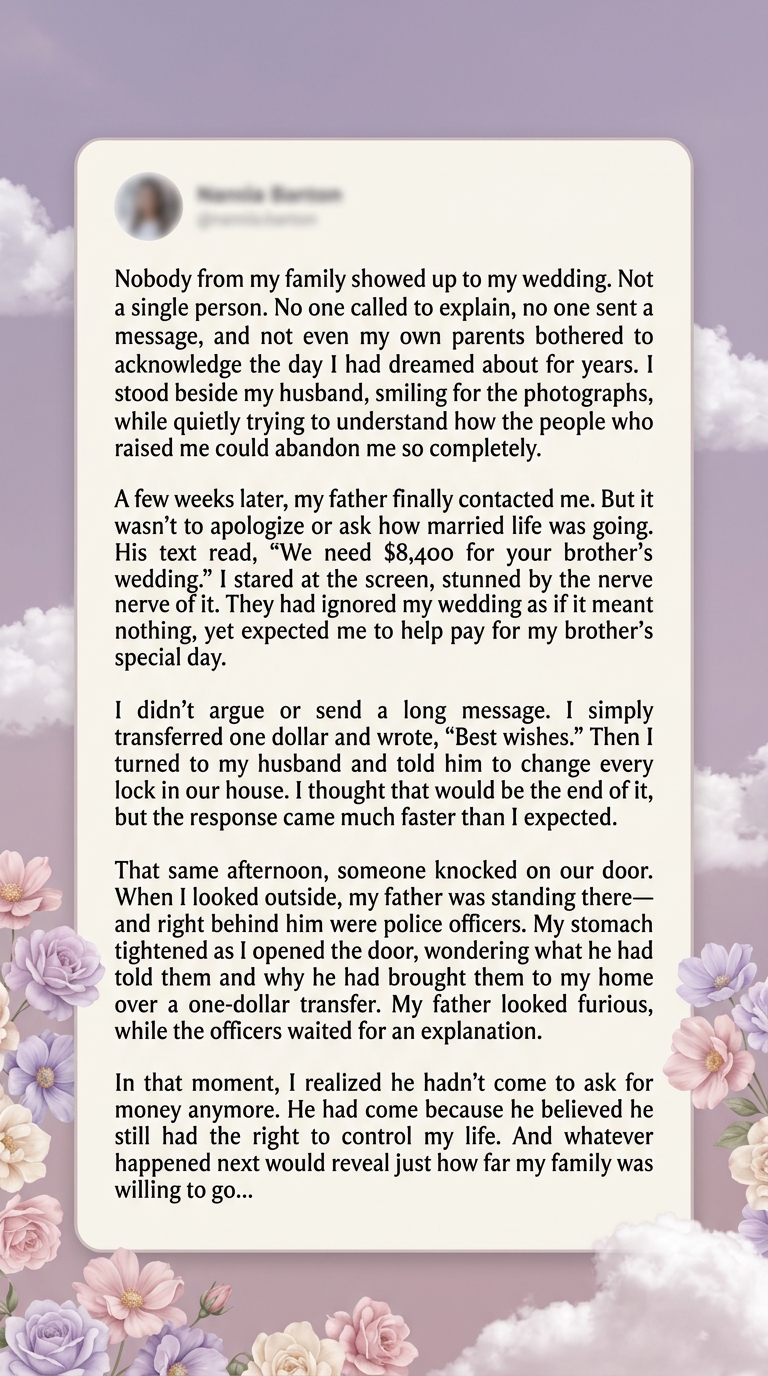
Nobody from my family showed up to my wedding.
Not my parents. Not my brother. Not even my aunt, who had once promised she would be the first person on the dance floor.
I stood beside my husband, Daniel, in a little garden venue outside town, smiling for photographs while an empty row of chairs reminded me that the people who were supposed to love me most had chosen not to come.
My mother had read the invitation. My father had confirmed the date months earlier. My brother, Tyler, had even joked that he expected a “pretty expensive meal” at the reception.
But on the morning of my wedding, every one of them went silent.
No call. No message. No explanation.
Daniel held my hand beneath the table during dinner.
“You don’t have to pretend you’re okay,” he whispered.
I looked at the beautiful flowers, the guests who had traveled to celebrate with us, and the empty chairs at the front.
“I just don’t understand how they could do this.”
He squeezed my fingers.
“I’m here. And the people who came are here because they want to be.”
I tried to believe him.
For the next few weeks, I focused on building our new life. Daniel and I had bought a small house two years earlier. I had saved for the down payment before we were married, and the deed was in my name alone. It wasn’t a mansion, but it was ours in every way that mattered.
My family had never been especially kind about it.
My parents always seemed to believe that whatever I earned belonged to the family, especially when Tyler needed something.
When I bought the house, my father called it “a nice place for everyone to gather.”
When I paid off my car, my mother said I should be grateful I didn’t have children yet, because then I’d understand how expensive life could be.
And when I got engaged, Tyler said, “Don’t forget, I’m the one who’s going to need help with the big wedding.”
I thought he was joking.
I should have known better.
Three weeks after my wedding, my phone buzzed while I was making coffee.
It was my father.
We need $8,400 for your brother’s wedding.
I read the message twice.
There was no greeting. No apology for missing my wedding. No question about how Daniel and I were doing.
Just a demand.
I set the phone on the counter and stared at it.
Daniel walked into the kitchen.
“What’s wrong?”
I handed him the phone.
He read the message, then looked at me.
“They didn’t come to our wedding, and now they’re asking you to pay for Tyler’s?”
I nodded.
For years, I had tried to earn my family’s approval by being dependable. I paid for birthday dinners, helped with bills, and covered emergencies that somehow always seemed to involve Tyler.
I had convinced myself that if I gave enough, they would eventually treat me like I mattered.
But standing in my kitchen, I finally understood something.
They didn’t miss my wedding because they forgot.
They missed it because they didn’t believe it mattered.
I opened my banking app.
Daniel watched me carefully.
“Are you going to send them the money?”
“No.”
I transferred one dollar to my father.
Then I wrote:
Best wishes.
I put the phone down.
Daniel let out a quiet breath.
“That’s probably going to make him angry.”
“I know.”
I looked around our house—the home I had worked for, the home where I had finally begun to feel safe.
“Let’s change the locks.”
Daniel nodded.
We called a locksmith that morning. He replaced the front and back door locks, and we made sure the garage entry was secure as well.
My father still had an old key from when we first bought the house. I had never thought much about it before.
Now I wanted every entrance to belong only to the people who lived there.
The locksmith had barely finished when someone knocked.
I looked through the front window.
My father stood on the porch.
Two police officers were beside him.
My stomach tightened.
Daniel stepped in front of me.
“Stay here,” he said.
But I followed him to the door.
My father looked furious.
“There she is,” he said to the officers. “That’s my daughter.”
One officer raised a hand gently.
“Ma’am, could we speak with you for a moment?”
I opened the door but kept the security chain in place.
“What’s going on?”
My father pointed toward the house.
“She changed the locks and won’t let me in.”
I stared at him.
“You don’t live here.”
“I helped you buy this place.”
“No, you didn’t.”
His face reddened.
“I gave you money when you needed it.”
“You gave me a few hundred dollars for furniture. I thanked you. That doesn’t make this your house.”
The officers exchanged a glance.
One of them asked, “Do you own this property together?”
“No,” I said. “The deed is in my name. My husband and I live here.”
My father interrupted.
“She sent me a dollar with a message. Then she changed the locks. I think she’s trying to provoke me.”
The officer looked at him.
“Sir, what exactly are you reporting?”
My father hesitated.
“She won’t help with her brother’s wedding. We need the money, and she’s being disrespectful.”
For a moment, I thought I had misheard him.
The officer’s expression remained professional, but his voice became firmer.
“Not giving someone money is not a police matter.”
My father shook his head.
“She owes us. We raised her.”
I felt something inside me settle.
Not anger.
Not fear.
Clarity.
“I appreciate that you raised me,” I said. “But I don’t owe you $8,400 because you chose to miss my wedding.”
My father looked at me as though I had slapped him.
“You’re making a scene over one dollar.”
“No,” I replied. “I’m making a boundary over years of being treated like my life doesn’t matter.”
The second officer asked whether my father had a key or any legal ownership.
I explained that he had once been given a spare key for emergencies, but we had changed the locks because I no longer wanted him entering without permission.
The officers asked to see proof of ownership. Daniel brought out the property documents, and I showed them the deed.
After reviewing everything, the first officer turned to my father.
“Sir, this is her home. You have no right to enter without her permission. If you have a financial dispute, you need to address it through the proper civil process. But based on what you’ve told us, this is not a police matter.”
My father stared at him.
“So you’re just going to let her do this?”
“She’s allowed to decide who enters her home.”
The officers asked him to leave the property.
He walked down the porch steps, still muttering.
Before he reached his car, he turned back.
“You’ll regret treating your family this way.”
I looked him in the eye.
“I already regret how long I let you treat me that way.”
Then I closed the door.
For several minutes, Daniel and I stood silently in the entryway.
My hands were shaking.
He wrapped his arms around me.
“You did it,” he whispered.
I leaned against him.
“I thought I would feel guilty.”
“Do you?”
I looked at the new lock on the door.
“No. I feel relieved.”
That evening, my mother called.
I almost let it go to voicemail, but I answered.
“What did you do to your father?” she demanded.
I closed my eyes.
“He brought police officers to my house because I wouldn’t pay for Tyler’s wedding.”
“He was embarrassed.”
“Mom, you didn’t come to my wedding.”
Silence.
Then she said, “Your brother’s wedding is more complicated. We needed everyone to help.”
“Everyone?”
“You know what I mean.”
I took a slow breath.
“I invited you to the most important day of my life. You ignored it. Then Dad demanded $8,400 from me. I sent him one dollar, and he brought the police to my door.”
My mother sighed.
“You’ve always been so sensitive.”
That sentence hurt more than I expected.
Not because it was new.
Because it was familiar.
I had heard it every time I asked to be treated fairly.
“I’m not discussing this anymore,” I said. “I love you, but I won’t pay for Tyler’s wedding, and I won’t allow Dad to enter my home without permission.”
She hung up.
For a while, the family group chat was filled with messages about how selfish I had become.
Tyler sent me a private message.
You really couldn’t help me out? It’s my wedding.
I replied:
I hope your wedding is beautiful. But I won’t pay for it.
He wrote back:
Don’t expect me to be there when you need something.
I stared at the message.
Then I deleted the conversation.
I didn’t block everyone immediately. I simply stopped answering demands and stopped explaining myself to people who had already decided I was wrong.
A month later, Tyler’s wedding took place.
I saw photographs online. My parents were there. My aunt was there. Everyone looked happy.
I felt a brief ache when I saw the family portrait.
Then Daniel came into the room with two mugs of tea.
“Are you okay?”
I nodded.
“I’m sad,” I said. “But I’m not surprised anymore.”
He sat beside me.
“You can be sad and still know you made the right choice.”
That night, I took my wedding photograph from the shelf.
The empty chairs were visible in the background.
For the first time, I didn’t crop them out.
They were part of my story.
Not the part that defined my marriage, but the part that taught me what I needed to know about my family.
I had spent years believing love meant being available whenever someone demanded something from me.
Now I understood that love could be generous without being forced.
It could be kind without surrendering every boundary.
And it could mean closing a door—not to punish someone, but to protect the life waiting on the other side.
My family had missed my wedding.
They had missed the chance to celebrate the woman I had become.
But they hadn’t taken my future.
Daniel and I built our home around honesty, respect, and the simple promise that neither of us would ever have to earn a place in the family by paying for it.
The new locks worked perfectly.
And for the first time in my life, I knew exactly who had a key.