The day I found my daughter sleeping in a homeless shelter, I finally understood what it meant to be the kind of father who could lose his child while she was still alive.
Eight months earlier, I had thrown eighteen-year-old Kayla out of my house because she came home drunk.
It was two in the morning.
I heard the front door open, followed by the uneven sound of her shoes against the hallway floor. When I stepped out of my bedroom, she was standing near the stairs, soaked from the rain, with her backpack hanging from one shoulder.
I smelled alcohol immediately.
“What have you been drinking?”
She looked at the floor.
“Dad, please. I need to talk to you.”
I reached for her backpack. Inside, I found a half-empty bottle of vodka.
My anger took over.
“You’re eighteen years old, and you’re coming home like this?”
She started crying.
“I know. I know I messed up.”
“Then why did you do it?”
She opened her mouth, then closed it again.
I remember how frightened she looked.
But I didn’t see fear.
I saw disrespect.
“Not under my roof,” I said.
“Dad, please. Just listen to me.”
“No.”
“Please, I need you.”
I pointed toward the front door.
“Get out.”
She stared at me as if she couldn’t believe I meant it.
“Where am I supposed to go?”
“You should have thought about that before you came home drunk.”
She stepped onto the porch.
The rain was coming down hard, and her thin sweatshirt was already soaked through.
She turned back one last time.
“Dad, I’m trying to tell you something.”
I shut the door.
Then I changed the locks.
My wife, Laura, stood at the top of the stairs, watching me.
“What did you just do?”
“I taught her that there are consequences.”
Laura came downstairs.
“She was crying, Mark. She was scared.”
“She made a choice.”
“And you made one, too.”
I refused to listen.
The next morning, Laura called Kayla’s phone repeatedly. It went straight to voicemail.
She asked me to go look for our daughter.
I told her Kayla was an adult and needed to figure things out.
Three days later, Laura packed a suitcase.
“You don’t understand what you’ve done,” she said.
I stood in the doorway, arms crossed.
“She’ll come back when she’s ready to apologize.”
Laura looked at me with tears in her eyes.
“I’m not leaving because Kayla made a mistake. I’m leaving because you made her believe she had no home.”
Then she walked out.
My fourteen-year-old son, Ethan, watched from the hallway.
I told him his mother needed time.
I told him Kayla needed to grow up.
I told myself a lot of things.
For eight months, I heard nothing from my daughter.
No calls.
No messages.
No birthday card.
At first, I checked my phone every evening.
Then I stopped.
I convinced myself that silence meant she was learning independence.
My mother called me once and said I had been cruel.
I told her she didn’t understand how difficult it was to raise teenagers.
She replied, “I understand how difficult it is to be a parent. That’s why you don’t stop being one when your child makes a mistake.”
I hung up.
I was good at hanging up on people.
Then, one afternoon, Ethan came home from school looking pale.
“Dad?”
I was sitting at the kitchen table.
“What’s wrong?”
He held out his phone.
“I found Kayla.”
I took it.
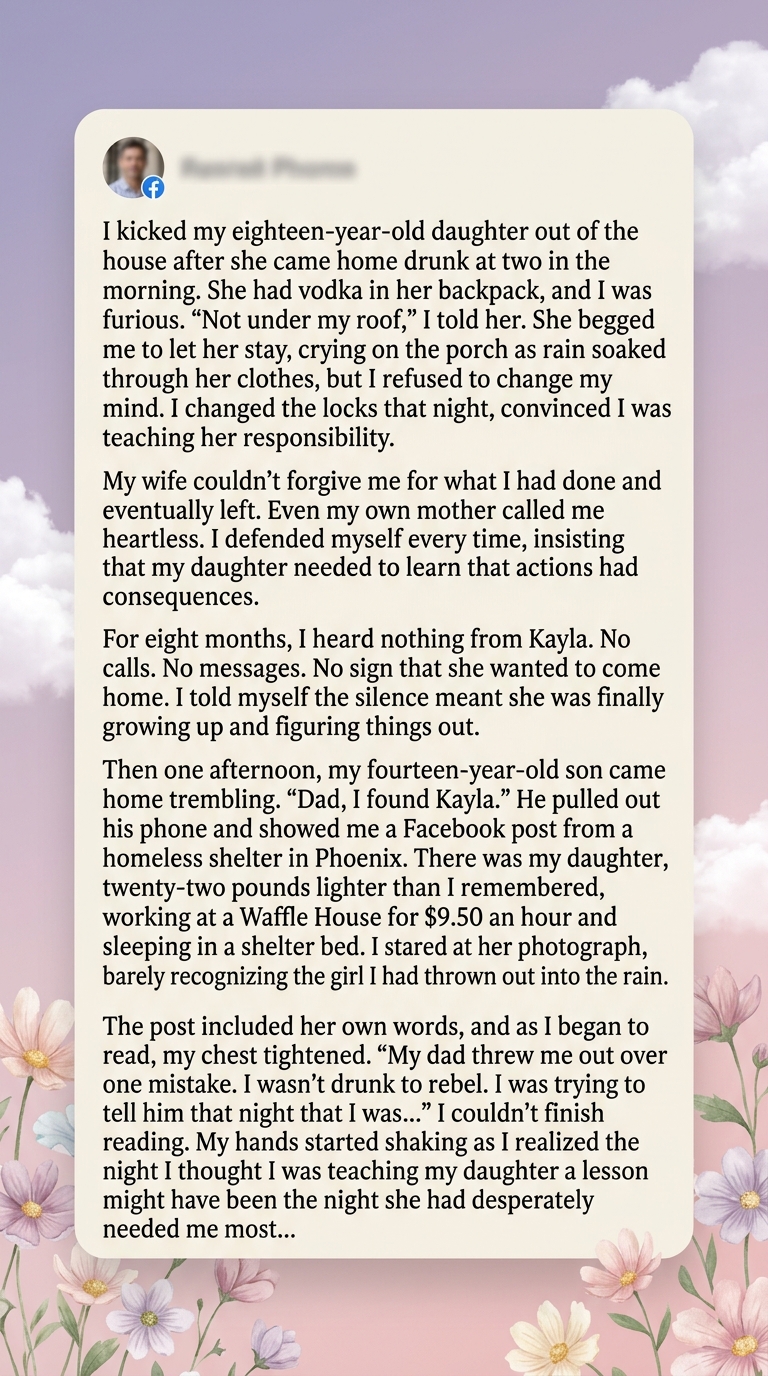
The screen showed a Facebook post from a homeless shelter in Phoenix. The shelter had shared a photograph of several young adults who were working toward stable housing.
Kayla was standing near the center.
She looked thinner than I remembered. Her cheeks were hollow, and her hair was pulled back into a messy ponytail.
The caption said she was working at a Waffle House for $9.50 an hour and staying at the shelter while saving money for an apartment.
I stared at the photograph.
“Where did you find this?”
“Someone shared it. I recognized her.”
I scrolled down.
The post included a short statement written by Kayla.
Eight months ago, my dad threw me out after I came home drunk. I know drinking was wrong, and I wish I could take that night back. But I wasn’t drunk to rebel. I was trying to tell him that night that I was afraid of someone.
My chest tightened.
I kept reading.
My boyfriend had been threatening me. He was older, and he knew how to make me feel small. He had been taking my money and telling me that if I left him, he would come after me. That night, I drank because I was scared and didn’t know how to ask for help.
I wanted to tell my dad that my boyfriend had followed me home. I wanted him to protect me.
But my dad saw the bottle and never heard the rest.
I lowered the phone.
My hands were shaking.
Ethan stood beside me.
“Dad, is that true?”
I couldn’t answer.
I remembered Kayla on the porch.
Please, I need you.
I’m trying to tell you something.
I had heard her words.
I had simply decided they didn’t matter.
I scrolled farther.
Kayla had written that after I changed the locks, she spent the first night in a bus station. A woman working there noticed her crying and helped her find a youth shelter.
She had tried to call me twice.
I hadn’t answered because I didn’t recognize the number.
She had worked temporary jobs, slept in different places, and eventually found the shelter in Phoenix. She had been there for months, trying to save enough money to rent a room.
The post ended with a sentence that nearly broke me.
I still love my family. I just don’t know if I can ever trust my dad to love me when I need him most.
I put the phone down.
Ethan was crying.
“Can we go get her?”
I looked at my son.
“Yes.”
For the first time in eight months, I didn’t have an excuse.
I called the shelter using the contact information on the post. A staff member answered and confirmed that Kayla was there, but she couldn’t share private details without Kayla’s permission.
I told her who I was.
There was a pause.
“Mr. Bennett,” she said carefully, “Kayla knows you may contact us. She has asked that we not give out her location or personal information without her consent.”
I swallowed.
“Can you tell her I want to talk?”
“I can pass along the message.”
I waited.
The staff member called back later that evening.
“She is willing to speak with you tomorrow. She does not want you to come to the shelter without an appointment.”
I agreed.
The next morning, I drove to Phoenix with Ethan.
I had imagined that seeing Kayla again would bring immediate relief.
Instead, the closer we got, the more ashamed I felt.
I kept thinking about the porch.
The rain.
The bottle.
The lock clicking into place.
When we arrived, a shelter counselor met us in a small conference room.
She explained that Kayla had been working, attending counseling, and making plans to move into a shared apartment. She had also received help getting a protective order against her former boyfriend.
“She has made a lot of progress,” the counselor said. “But she’s still rebuilding. Please don’t expect her to make your feelings the priority today.”
I nodded.
“I understand.”
A few minutes later, the door opened.
Kayla stepped inside.
For a moment, I couldn’t move.
She looked older.
Not just because she had lost weight or because her hair was shorter.
She looked like someone who had learned to survive without expecting anyone to catch her when she fell.
Ethan stood up.
“Kayla.”
She smiled faintly and hugged him.
Then she looked at me.
“Hi, Dad.”
I wanted to hug her.
I wanted to tell her everything would be okay.
But I knew I had no right to decide what she needed.
So I stayed where I was.
“Hi, sweetheart.”
She sat across from me.
The silence was painful.
Finally, I said, “I read your post.”
She looked down.
“I figured you might.”
“I didn’t know.”
She lifted her eyes.
“You didn’t ask.”
The words landed exactly where they belonged.
I nodded.
“You’re right.”
I took a breath.
“I was angry about the drinking. I still believe it was dangerous, and I wish you hadn’t done it. But I should never have thrown you out. I should never have changed the locks. You were my daughter, and you were asking me for help.”
Her eyes filled with tears.
“I was scared, Dad.”
“I know.”
“No. You know now. That night, you didn’t want to know.”
I lowered my head.
“You’re right.”
For years, I had believed that being a strong father meant making rules and enforcing them.
I had confused authority with protection.
Kayla wiped her eyes.
“I don’t know if I can come home.”
I felt the old instinct rise inside me—the urge to tell her she was being unreasonable, that I had apologized, that she should give me another chance.
I swallowed it.
“You don’t have to decide today.”
She looked surprised.
“I don’t?”
“No. I want you to be safe. I want you to have a place to live. I want you to finish building your life. If you don’t want to live with me, I’ll respect that.”
Her shoulders relaxed slightly.
I continued.
“I’d like to help with your apartment deposit if you want. No conditions. No demand that you forgive me. And if you ever want to talk, I’ll answer.”
She studied my face.
“Even if I’m upset?”
“Especially then.”
She began to cry.
I moved my hand across the table, but stopped before touching hers.
“Can I?”
She nodded.
I took her hand.
For the first time since that night, I felt my daughter allowing me to be close.
It wasn’t forgiveness.
It was a beginning.
Over the next few months, I kept my promises.
I helped Kayla review apartment listings. I paid the deposit directly to the property manager after she agreed to accept the help. I didn’t ask her to move back home.
I visited when she invited me.
Sometimes we talked for an hour.
Sometimes we sat quietly and ate breakfast.
She told me about the shelter, about working long shifts, and about the fear she still felt when someone raised their voice.
I listened.
When she told me something difficult, I didn’t defend myself.
When she needed space, I gave it to her.
Laura eventually agreed to meet me for coffee.
She told me she had known Kayla was struggling but hadn’t understood how dangerous the situation had become.
“I should have pushed harder,” she said.
I shook my head.
“We both missed things. But I was the one who shut the door.”
Laura didn’t promise to come back.
She said she needed time.
I accepted that.
Ethan began visiting Kayla on weekends. They went to movies, shared meals, and slowly rebuilt the sibling relationship that had been interrupted by my decision.
One Sunday, Kayla invited us to her apartment.
It was small, with secondhand furniture and a kitchen table she had found at a thrift store.
She had a plant on the windowsill and a photograph of Ethan beside her bed.
I stood in the doorway, looking around.
“You did all this?”
She smiled.
“Mostly with a lot of overtime.”
I felt proud.
Then I felt ashamed that I had once mistaken her need for help as a lack of responsibility.
She had been responsible enough to survive.
But she shouldn’t have had to survive alone.
Before we left, Kayla walked me to the door.
“Dad?”
I turned.
“I don’t know when I’ll be able to forgive you completely.”
I nodded.
“You don’t owe me a timeline.”
She looked down at her hands.
“But I want to try.”
My eyes filled.
“I’d be grateful for that.”
She hugged me.
It was a short hug, and she let go first.
I didn’t ask her to stay longer.
I didn’t tell her everything was fixed.
I simply said, “I love you.”
She answered quietly.
“I love you, too.”
On the drive home, Ethan sat beside me.
“Are you happy?”
I thought about it.
“I’m grateful.”
He nodded.
“That’s probably better.”
He was right.
I had spent eight months telling myself that my daughter needed to learn a lesson.
The lesson I needed to learn was much harder.
A child can make a dangerous mistake and still deserve a safe place to come home.
A parent can set boundaries without abandoning the person who needs them.
And when someone you love says, “Please, I need you,” the first thing you should do is listen.
I couldn’t undo the night I changed the locks.
But I could spend the rest of my life making sure Kayla never had to wonder whether she was still my daughter.
She had never stopped being my daughter.
I had simply forgotten what that meant.