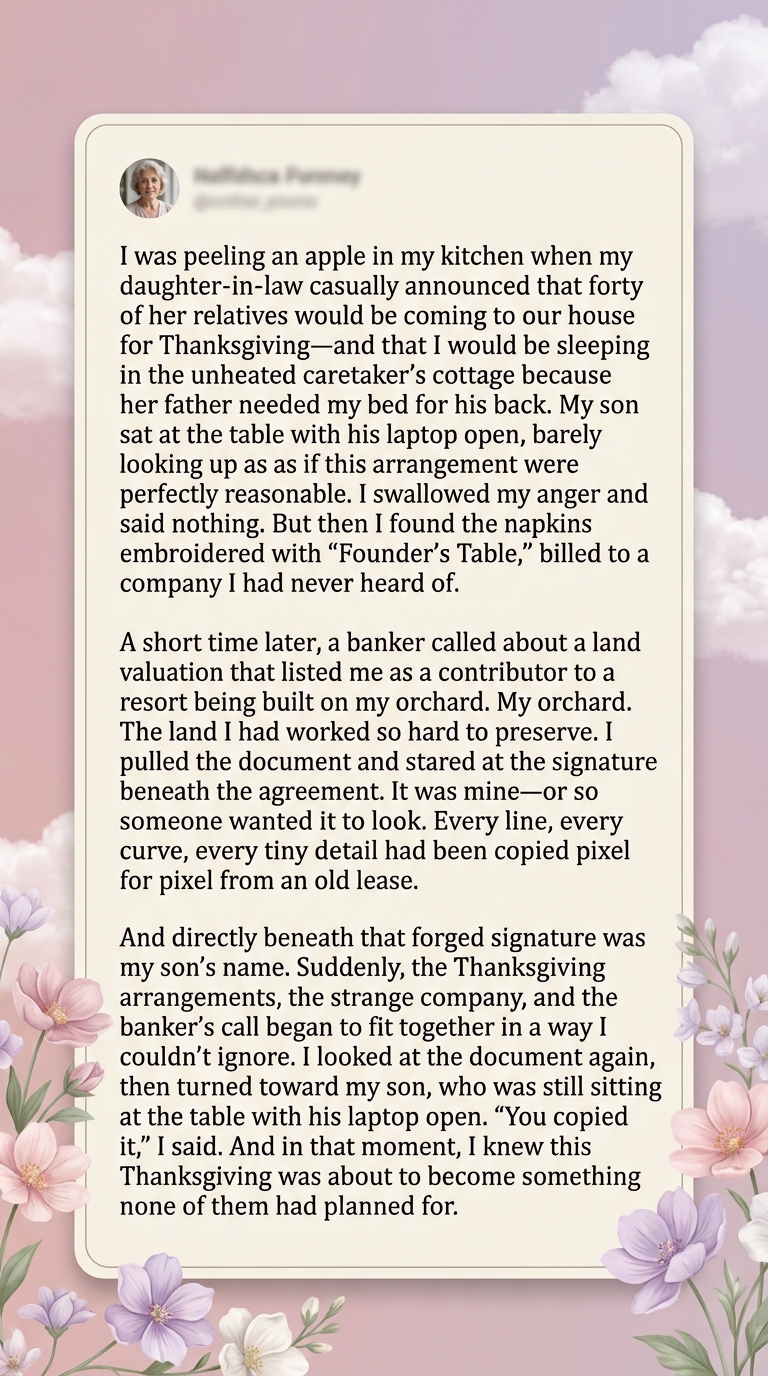
I was peeling an apple in my kitchen when my daughter-in-law casually announced that forty of her relatives would be coming to our house for Thanksgiving—and that I would be sleeping in the unheated caretaker’s cottage because her father needed my bed for his back.
“It’s only for a few nights, Evelyn,” Claire said, scrolling through her phone. “The cottage has a roof. You can use the electric blanket.”
My son, Andrew, sat at the table with his laptop open, barely looking up.
“Mom, it’ll be fine,” he said. “We just need to make everyone comfortable.”
I stared at the apple in my hand.
This was my house. My orchard. The land my late husband and I had spent thirty-eight years tending, planting, and protecting.
And somehow, I had become the inconvenience.
I swallowed my anger and said nothing.
At seventy-one, I had learned that silence could be useful. Sometimes it gave people enough room to reveal what they were really doing.
That afternoon, I found the napkins.
They were folded inside a cardboard box on the pantry shelf, embroidered in gold thread with the words Founder’s Table. I had never ordered them.
The invoice was tucked beneath the packing paper.
The company name was unfamiliar: Founder’s Table Hospitality Group.
The order included forty napkins, forty matching place cards, and a printed seating plan for Thanksgiving dinner.
At the bottom was a note:
Private investor preview. Orchard property to be presented as future resort site.
I read it twice.
Then I called the number on the invoice.
A woman answered.
“Founder’s Table Hospitality.”
“I’m Evelyn Hart. I found an invoice addressed to my property. Can you tell me what this order is for?”
There was a pause.
“Mrs. Hart, I believe your son is coordinating the Thanksgiving investor dinner.”
“Investor dinner?”
“Yes. The guests are being shown the proposed resort property. We understood that you had agreed to contribute the orchard.”
My fingers tightened around the phone.
“I have not agreed to contribute anything.”
The woman sounded startled.
“I’m sorry. I was told the paperwork had been completed.”
“What paperwork?”
She said she would have someone call me back.
I hung up and stood in the kitchen, looking out the window at the orchard.
The trees were bare now, their branches dark against the November sky. My husband, Thomas, had planted the first row when we were newly married. He used to say that land was not something you owned forever.
“You borrow it from the future,” he would tell me.
After he died, I kept the orchard alive because I couldn’t bear the thought of it becoming another forgotten piece of property.
I had refused developers for years.
Now my own son was apparently offering it to them.
The phone rang again.
This time, it was a banker.
“Mrs. Hart, I’m calling about the land valuation associated with the proposed resort development.”
I sat down.
“What valuation?”
The banker explained that a development company had submitted documents listing me as a contributing landowner. The orchard was being included in a proposed resort project, and the company needed confirmation of the property’s ownership and estimated value.
“I’m not contributing my land,” I said.
The banker paused.
“That’s concerning. We have an agreement bearing your signature.”
I asked him to send me a copy.
When the email arrived, I opened the attachment.
The document listed the orchard, the acreage, and a proposed development structure. It described my land as a contribution toward the resort in exchange for an interest in the project.
At the bottom was my name.
My signature.
I stared at it.
It looked exactly like mine.
Every line. Every curve. Even the tiny mark I made when my pen lifted at the end.
But I had never signed that agreement.
I searched my files for the old lease I had signed years earlier when a neighboring farmer rented a small section of the orchard.
There it was.
The signature on the resort agreement had been copied from that lease.
Pixel for pixel.
I felt sick.
Then I noticed the second signature.
Andrew Hart.
My son.
I looked toward the dining room.
He was still sitting at the table, his laptop open, tapping away as though nothing had happened.
I walked in holding the document.
“You copied it,” I said.
Andrew looked up.
“What?”
“My signature.”
His face changed.
Claire appeared in the doorway.
“Evelyn, what’s going on?”
I placed the document on the table.
“Someone used my signature to offer my orchard to a resort company.”
Andrew closed his laptop.
“Mom, I can explain.”
“Then explain.”
He rubbed his face.
“The project isn’t what you think.”
“Then why does it say I’m contributing my land?”
“It’s a preliminary agreement.”
“Preliminary to what? Selling my property without my permission?”
Claire stepped forward.
“We were trying to make this a family opportunity.”
I looked at her.
“By putting me in the caretaker’s cottage while you entertain investors in my home?”
She crossed her arms.
“That was just a practical arrangement.”
“Nothing about this is practical. It’s dishonest.”
Andrew stood.
“Mom, the resort would be good for the area. It would bring jobs. Restaurants. A hotel. We could preserve part of the orchard and make money from the rest.”
“Then why didn’t you ask me?”
He looked away.
“Because you always say no.”
I felt the words settle between us.
“So you decided my answer didn’t matter.”
Claire’s voice sharpened.
“Evelyn, you’re seventy-one. You can’t keep managing this place forever. We were trying to make sure your future was secure.”
I stared at her.
“My future was secure before you forged my name.”
Andrew flinched.
“Mom, please.”
I looked at him.
“Did you copy my signature?”
He didn’t answer.
That was enough.
I picked up the document and walked out of the room.
For the first time in my life, I was afraid of my own son.
I spent the night in my bedroom, locking the door.
The next morning, I called my attorney, Margaret Lewis.
She had handled my husband’s estate and knew every detail of the orchard’s ownership.
When I explained what had happened, she asked me to send the documents immediately.
“Do not sign anything,” she said. “Do not agree to any transfer. And do not let anyone pressure you into a meeting with the developers.”
I followed her instructions.
She reviewed the paperwork and confirmed that the agreement had not been properly authorized. The orchard remained in my name, and the development company could not treat it as a valid contribution simply because someone had submitted a document with my signature.
But she warned me that the forged paperwork needed to be addressed formally.
“We’ll notify the company and the bank,” she said. “We’ll also preserve the original documents and request a review of how they were submitted.”
I asked her whether Andrew could have done this without realizing the consequences.
Margaret was quiet.
“He signed beneath your name. Whether he understood every consequence is something we’ll need to determine. But he knew he was acting without your permission.”
I closed my eyes.
I had raised Andrew alone after Thomas died when he was twenty-four. I had paid for his college, helped him buy his first house, and stood beside him through a difficult divorce.
I had never imagined he would use my trust against me.
That afternoon, Margaret sent formal notices to the banker and the development company.
The Thanksgiving dinner was canceled.
The company withdrew the property from its preliminary proposal while the documents were investigated.
And I changed the locks.
Andrew came to my door that evening.
“Mom, can we talk?”
I opened it but didn’t invite him inside.
He looked exhausted.
“I know I made a mistake.”
I folded my arms.
“A mistake is forgetting to pay a bill. You used my signature to offer my land.”
“I didn’t think it would go this far.”
“You knew enough to sign your name beneath mine.”
He looked down.
Claire stood behind him.
“We didn’t mean to hurt you,” she said.
I looked at her.
“Then why did you treat me like a guest in my own home?”
She had no answer.
Andrew took a breath.
“The resort company offered us a consulting position. They said if we could secure the property, we’d be part of the project.”
I stared at him.
“So this was about money.”
“It was about building something.”
“Something you wanted to build with my land.”
He nodded.
“I thought you would eventually agree.”
I shook my head.
“You didn’t want my agreement. You wanted my signature.”
Andrew’s eyes filled with tears.
“I’m sorry.”
I believed he was sorry.
But remorse did not undo what he had done.
“I love you,” I said. “But I cannot trust you with my property, my finances, or my decisions right now.”
He nodded slowly.
“I understand.”
“You will not enter the orchard without my permission. You will not contact the company on my behalf. And you will not ask me to sign anything.”
Claire opened her mouth, but Andrew touched her arm.
“We’ll go,” he said.
They left.
I closed the door and leaned against it.
For the first time since Thomas died, the house felt empty in a way that frightened me.
But it also felt like mine again.
The following weeks were difficult.
The company cooperated with the document review and confirmed that the agreement had been submitted by Andrew. The bank removed the orchard from the proposed valuation pending the investigation.
I worked with Margaret to secure the property records and establish clearer protections around any future transaction.
Andrew later admitted that he had scanned my old lease and used the image to create the signature on the agreement. He had believed the company would present the proposal to me after the Thanksgiving dinner, when I would supposedly be surrounded by family and more willing to agree.
That explanation hurt more than the forgery itself.
He had planned to use the holiday to pressure me.
The company ended its discussions with him, and he lost the consulting opportunity he had expected.
I did not celebrate.
I simply wanted the truth to be clear.
By December, the orchard was quiet again.
I spent my mornings pruning the apple trees and my afternoons sorting through Thomas’s old gardening books.
One day, I found a note tucked inside his favorite book.
It read:
The best thing we can leave our children is not land or money. It is the knowledge that they can stand on their own feet.
I sat beneath the kitchen window and cried.
Thomas would have been heartbroken by what Andrew had done.
But he would also have told me not to let grief make every decision for me.
So I waited.
In January, Andrew came alone.
He stood on the porch holding a small paper bag.
“I brought you apples,” he said.
I looked at him.
“From where?”
“The grocery store.”
I almost smiled.
“My orchard has plenty.”
“I know.”
He placed the bag on the porch.
“I don’t expect you to forgive me today.”
I nodded.
“Good.”
He swallowed.
“I’ve started counseling. I need to understand why I thought I could do something like that and still call myself a good son.”
I didn’t answer immediately.
Then I said, “That is a good place to start.”
He looked toward the orchard.
“Will you ever let me help again?”
“Maybe.”
His face fell slightly.
“But not with the property,” I continued. “Not until trust has been rebuilt, and not without clear boundaries.”
He nodded.
“I understand.”
I opened the door a little wider.
“You can come in for coffee.”
It wasn’t forgiveness.
It wasn’t a promise that everything would return to the way it had been.
It was simply a beginning.
The next Thanksgiving, I hosted a smaller dinner.
There were twelve people, not forty.
My sister came from Ohio. Two neighbors brought pies. Andrew arrived with a dish he had cooked himself.
Claire did not come.
I had not invited her.
The dining room table was crowded with familiar faces, and the orchard outside was covered in a thin layer of frost.
Before dinner, Andrew stood beside his chair.
“I want to say something,” he began.
Everyone grew quiet.
“I hurt my mother last year. I tried to make decisions about her property without her permission, and I betrayed her trust. She didn’t owe me forgiveness, and she still doesn’t. I’m grateful she’s willing to let me be here today.”
He looked at me.
“I love you, Mom.”
I reached for his hand.
“I love you too.”
We sat down.
The meal was simple. There were no investors, no seating charts, and no one sleeping in the caretaker’s cottage.
After dinner, Andrew helped me clear the plates.
When we finished, he looked out the window.
“The orchard is beautiful.”
I stood beside him.
“It took a lot of work to keep it that way.”
He nodded.
“I know.”
I hoped he did.
Because the orchard was more than land.
It was the life Thomas and I had built together. It was the home where I had raised my son. It was the place I had chosen to preserve long after everyone else thought it would be easier to sell.
And it was mine to decide what happened to.
That Thanksgiving, I learned something I wish I had understood sooner.
Family can love you and still hurt you.
Forgiveness can begin without surrendering your boundaries.
And a home is not truly a home if the person who owns it has to ask permission to sleep in her own bed.
I never sold the orchard.
I never signed the resort agreement.
And I never again mistook silence for consent.