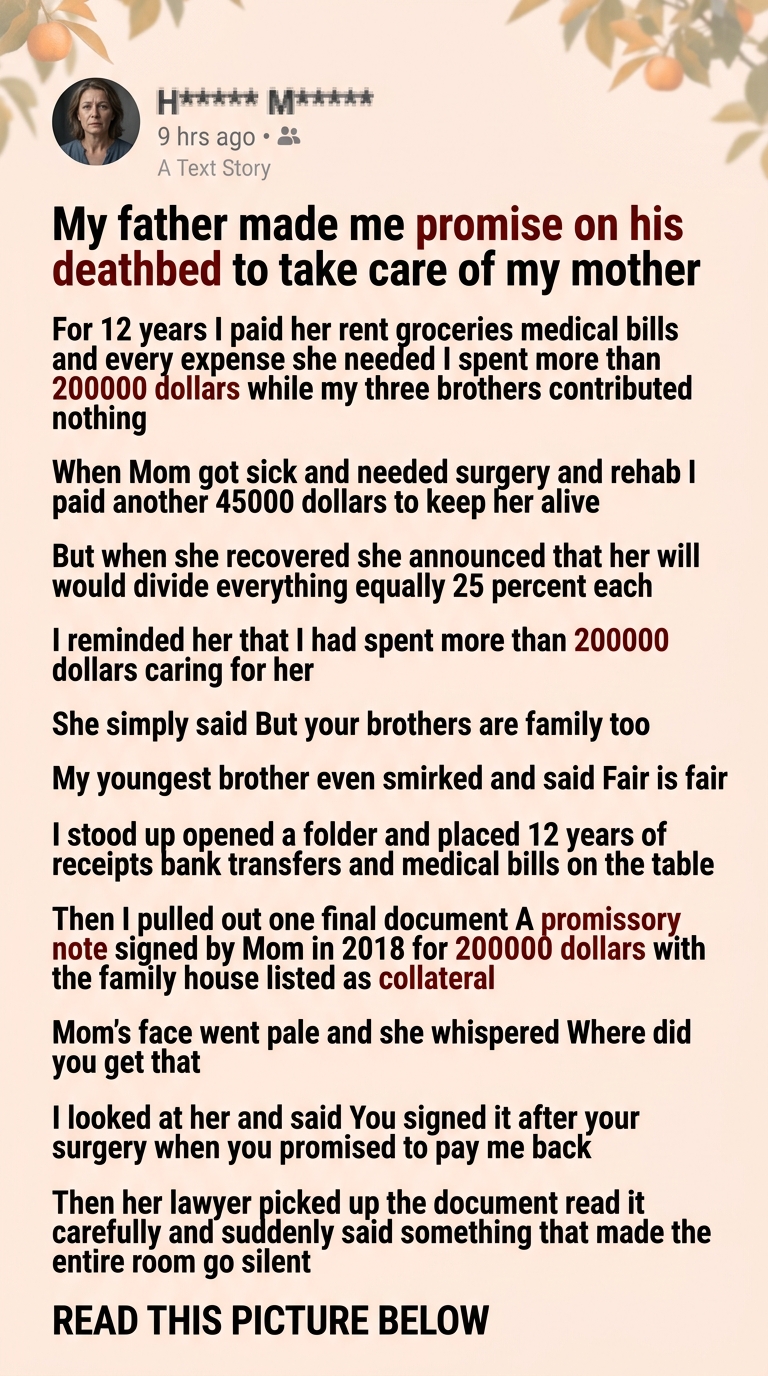
I Spent $245,000 Caring for My Mother for 12 Years—Then She Decided to Split Everything Equally
My father made me promise something on his deathbed that would change my life for the next twelve years.
“Take care of your mother,” he whispered, gripping my hand weakly. “Make sure she never has to struggle.”
I promised him without hesitation. At the time, I believed I was simply doing what any loving son would do.
I had no idea how much that promise would cost me—or how deeply it would divide our family.
After my father passed away, my three brothers gradually disappeared from our mother’s life. They always had excuses. One was too busy with work. Another claimed he had debts of his own. The youngest insisted that he couldn’t afford to help.
Meanwhile, I became the person Mom depended on for everything.
I paid her rent, bought her groceries, covered her utility bills, and took her to medical appointments. When she needed new medication, I paid for it. When unexpected expenses came up, I handled them without asking questions.
Month after month, year after year, the bills kept coming.
Over twelve years, I spent more than $200,000 supporting her.
My brothers rarely called to ask whether she had enough money. They almost never visited unless there was a holiday or a family gathering.
Whenever I brought up the possibility of sharing the responsibility, Mom would remind me of my promise to Dad.
“He trusted you the most,” she would say. “You’re the one he knew would take care of me.”
Those words always made me feel guilty for even asking.
So I continued paying.
Then, three years ago, Mom’s health took a frightening turn. Doctors discovered that she needed major surgery, followed by an extended period of rehabilitation.
The expenses were enormous.
I spent another $45,000 covering her surgery, medication, rehabilitation, and recovery. I rearranged my work schedule, spent countless nights worrying about her condition, and used savings I had planned to put toward my own future.
My brothers were informed about everything.
One sent a brief message saying he hoped she would get better. Another promised to visit but never showed up. The youngest didn’t contribute a single dollar.
Still, I told myself that keeping Mom healthy was what mattered most.
Thankfully, she recovered.
For the first time in years, I felt that perhaps our family could finally return to normal. I imagined Mom enjoying her remaining years in peace, and I hoped my brothers might finally recognize how much responsibility I had carried.
Then came the family meeting that changed everything.
Mom invited all four of us to her house. She said she had something important to discuss regarding her will.
We gathered around the dining table. My brothers sat comfortably in their chairs, making small talk while Mom arranged several documents in front of her.
Finally, she looked at us and announced, “I’ve decided that everything I leave behind will be divided equally among my four children.”
I stared at her, thinking I must have misunderstood.
“Everything?” I asked.
She nodded.
“Twenty-five percent for each of you. I want to make sure nobody feels left out.”
I took a slow breath.
“Mom, I’ve spent more than $200,000 taking care of you over the last twelve years. I paid another $45,000 for your surgery and rehabilitation. Are you saying none of that will be considered?”
Her expression hardened.
“You chose to help me. I never forced you.”
The words hit harder than I expected.
I had missed vacations, postponed plans, and watched my savings disappear because I believed I was honoring my father’s final wish. Now my mother spoke as though those sacrifices meant nothing.
“But you told me you needed help,” I replied quietly. “And you promised that I wouldn’t be left carrying everything alone.”
She shook her head.
“Your brothers are family too. They deserve the same inheritance.”
My youngest brother leaned back in his chair and smirked.
“Fair is fair,” he said. “We all have an equal right to what’s left.”
I looked at him.
For twelve years, he had contributed almost nothing. Yet he was now speaking as though he had stood beside me through every hospital visit, every overdue bill, and every sleepless night.
Something inside me finally settled.
I stopped arguing.
Instead, I reached down, opened the folder I had brought with me, and placed it on the table.
Inside were twelve years of bank transfers, rent payments, grocery receipts, utility bills, medical invoices, and records of the money I had sent to Mom.
I had kept nearly everything.
“Before we discuss fairness,” I said, “I think everyone should see what actually happened.”
My brothers began flipping through the papers. Their confident expressions gradually faded as they saw the dates and totals.
Then I reached into the folder again.
This time, I pulled out a single document and placed it directly in front of Mom.
It was a promissory note dated 2018.
The document bore her signature and acknowledged a debt of $200,000. It also listed the family house as collateral, subject to the terms written in the agreement.
Mom stared at it.
The color drained from her face.
“Where did you get that?” she whispered.
I met her eyes.
“You signed it after your surgery in 2018, when you promised to repay me. You said you wanted everything documented so there would never be an argument between us.”
She shook her head as if she couldn’t believe what she was seeing.
“I thought you had lost that paper.”
“I kept it safe.”
My youngest brother suddenly stopped smiling.
He reached for the document, but Mom pulled it closer to herself.
“That’s a family matter,” she said, her voice trembling. “We don’t need to involve lawyers.”
Before I could answer, the family lawyer, who had been sitting quietly at the end of the table, extended his hand.
“May I examine it?”
I passed him the document.
He read the first page carefully, then turned it over and examined the signatures and the section describing the collateral. He asked whether I had the original and whether there were any additional agreements.
I handed him the remaining papers.
The room fell silent as he reviewed them.
Finally, he looked up.
“I need to be very clear about something,” he said. “An equal inheritance and an existing debt are two different legal issues. We cannot assume that one cancels out the other.”
Mom swallowed nervously.
“What does that mean?”
The lawyer placed the promissory note on the table.
“It means we must establish whether this agreement is authentic, enforceable, and still valid under the applicable law. We also need to examine the terms concerning the house. If the debt is legally enforceable, it may have to be addressed before the estate is distributed, depending on the circumstances.”
My youngest brother pushed his chair back.
“But she promised us equal shares!”
The lawyer turned toward him.
“A promise to divide an estate equally does not automatically erase a valid debt. Those are separate questions.”
For the first time that afternoon, nobody had anything to say.
Mom looked at me with tears gathering in her eyes.
“You would really do this to your own mother?”
I felt a familiar ache in my chest. Despite everything, she was still the woman who had raised me.
But I could no longer pretend that love meant accepting every unfair burden without question.
“I didn’t create this debt, Mom,” I replied. “We both signed an agreement. I spent years helping you because I loved you, and I paid the money we agreed you would repay because I trusted you.”
I paused before continuing.
“I’m not asking you to love me more than my brothers. I’m asking you not to pretend that my sacrifices never happened.”
My middle brother stared at the table. The youngest crossed his arms, but he didn’t smirk again.
Mom wiped her eyes.
“I never thought it would come to this.”
“Neither did I,” I told her. “I thought we could settle this honestly without having to prove anything.”
The lawyer gathered the documents and explained that he would need to review the original agreement, verify its legal status, and determine what options were available. He cautioned everyone against making assumptions about the outcome before that review was complete.
The meeting ended without a new will, without an agreement among the siblings, and without the easy smiles that had filled the room when we first arrived.
Over the following weeks, the lawyer examined the records and advised us on the next steps. The promissory note became the center of the discussion, not because it guaranteed that I would receive the house, but because it raised a serious question that could no longer be ignored: what did Mom legally owe, and how should that obligation be handled before her estate was divided?
My brothers finally began asking about the years of expenses they had never bothered to understand.
I didn’t demand that they repay every dollar I had spent. I knew some of that money had been given freely, and I wasn’t interested in turning every act of kindness into a bill.
But I also refused to let anyone rewrite twelve years of my life as though I had done nothing.
Eventually, I learned a difficult lesson.
Keeping a promise to a parent does not mean surrendering your right to fairness. Helping someone you love should not require pretending that your own needs and sacrifices don’t matter.
I still loved my mother. I still wanted her to be safe and comfortable.
But from that day forward, I stopped confusing love with silence.
My father had asked me to take care of Mom. He had never asked me to let the rest of the family take advantage of me.
And as for the inheritance, the final outcome would depend on the actual agreement, the evidence, and the law—not on who argued the loudest at the dining table.
For the first time in twelve years, I was prepared to let the truth speak for itself.
Because fairness isn’t always about giving everyone the same thing. Sometimes, it’s about acknowledging who carried the burden when nobody else was willing to help.