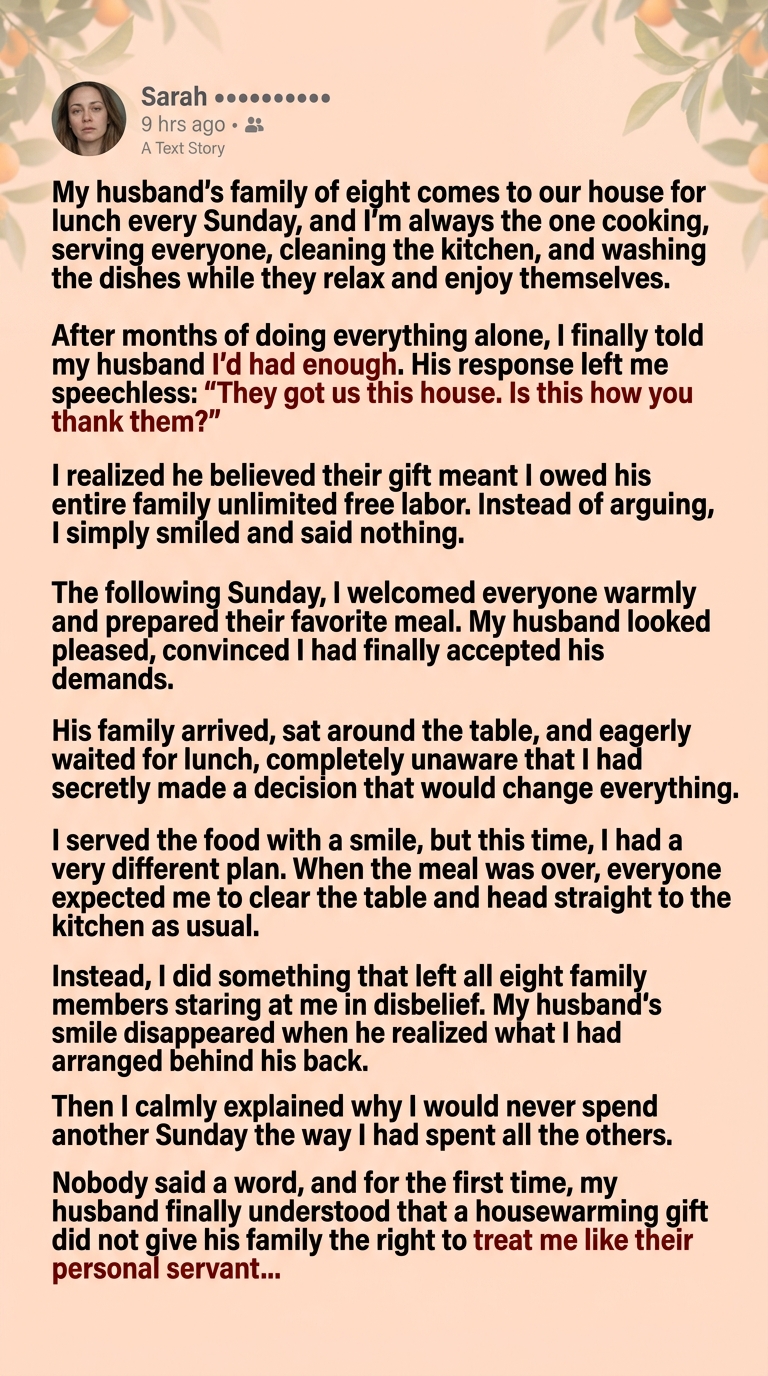
Every Sunday, my husband’s family of eight came to our house for lunch.
At first, I didn’t mind. Family gatherings were supposed to be joyful, and I genuinely wanted to build a good relationship with his relatives. They had helped us financially when we bought our house, and I appreciated their generosity.
So I cooked their favorite dishes, set the table, served everyone, and made sure nobody needed anything.
After lunch, while they relaxed in the living room, I cleared the plates, scrubbed the pots, wiped the counters, and washed every dish.
My husband rarely entered the kitchen.
“Everything was delicious,” someone would say before leaving. “We’ll see you next Sunday!”
And every Sunday, they returned.
Weeks became months. The gatherings that once felt special slowly became another full day of unpaid work. I had no time to rest, read a book, visit friends, or even enjoy the meal I had spent hours preparing.
One evening, after another exhausting Sunday, I finally spoke to my husband.
“I love having your family over,” I told him. “But I can’t keep doing all the cooking and cleaning by myself. We need to share the work, or we need to change how we host lunch.”
He barely looked up from his phone.
“They got us this house,” he replied. “Is this how you thank them?”
For a moment, I couldn’t believe what I had heard.
I understood that his family had helped us. I was grateful for that gift. But I had never agreed to repay it with endless Sundays of cooking, serving, and cleaning.
“Do you really think their gift means I have to do everything for them?” I asked.
He sighed as if I were being unreasonable.
“They’re my family. It’s only one day a week.”
One day a week.
He said it as though the hours of shopping, chopping, cooking, serving, and cleaning simply disappeared.
I wanted to argue, but I realized that another argument would probably change nothing. He had already decided that my time mattered less than his family’s expectations.
So I smiled and said nothing.
The following Sunday, I woke up early and prepared the meal they loved most. I roasted the chicken, made the potatoes, prepared the vegetables, and arranged everything beautifully on the table.
My husband watched me with a satisfied expression.
“See?” he said. “I knew you’d understand.”
I smiled again.
He had no idea what I had arranged.
At noon, his family arrived, laughing and chatting as usual. They complimented the food, filled their plates, and settled into their familiar seats.
I served everyone warmly. I asked about their week, listened to their stories, and made sure everyone had enough to eat.
For the first time in months, I wasn’t angry.
I had made my decision, and I was ready to follow through.
After lunch, the family leaned back in their chairs. Someone praised the dessert. Another relative started discussing what we should eat the following Sunday.
My husband stood up, stretched, and walked toward the living room.
Then he glanced at the table.
I hadn’t moved a single plate.
Instead, I placed a folder beside the serving dishes and calmly announced, “Before everyone leaves, I have something I’d like us to discuss.”
The room grew quiet.
My husband turned around. “What is this?”
I opened the folder.
Inside were three things: a simple breakdown of the time I spent preparing each Sunday meal, a list of the household expenses I had been covering, and a printed menu from a local catering company.
“I’ve been thinking about the house your family helped us buy,” I began. “I’m grateful for that help, and I always will be. But I need everyone to understand something.”
I looked around the table.
“A gift is a gift. It isn’t a lifetime contract that makes one person responsible for everyone else’s comfort.”
Nobody interrupted me.
“For months, I’ve spent my Sundays shopping, cooking, serving, and cleaning. I’ve done it because I wanted everyone to feel welcome. But somewhere along the way, my kindness became an expectation.”
My husband’s smile disappeared.
I continued, “Starting next Sunday, we have three choices. We can take turns hosting. We can make lunch a potluck, with everyone bringing a dish and helping clean up. Or we can order food and split the cost.”
I paused.
“What I won’t do anymore is spend my entire Sunday working while everyone else enjoys a family gathering.”
One of his sisters slowly nodded.
“Honestly,” she admitted, “I thought you enjoyed cooking for everyone. I didn’t realize you were doing all of this alone.”
His mother looked at the table, then at me.
“Why didn’t you say something sooner?”
“I tried,” I answered gently. “I spoke to my husband. He told me that because you helped us get this house, I owed everyone this.”
All eyes turned toward him.
My husband looked uncomfortable. “I didn’t mean it like that.”
“Then what did you mean?” I asked. “Because that’s exactly how it sounded.”
For once, he had no immediate answer.
His older brother finally spoke.
“We helped you buy the house because we wanted you both to have a good home. We didn’t do it so she would have to wait on us every Sunday.”
His mother nodded in agreement.
“If we had known this was happening, we would have helped.”
I felt something loosen inside my chest. I hadn’t expected everyone to agree with me, but hearing them say those words mattered.
Then I did something else my husband hadn’t anticipated.
I picked up my own plate, placed it beside the sink, and sat down on the sofa with a cup of tea.
“I’ve finished my part of today’s gathering,” I said. “The kitchen is available for anyone who wants to help.”
The silence lasted only a few seconds.
Then his sister stood up and began collecting plates. His brother carried the serving dishes into the kitchen. Two other relatives started stacking the remaining plates, while his mother asked where I kept the dish soap.
Within minutes, the entire family was working together.
My husband remained beside the dining table, staring at the scene.
Finally, he approached me.
“You could have told me you were going to do this,” he whispered.
“I did tell you I needed help,” I replied. “You just didn’t take me seriously.”
He sat beside me, looking at the floor.
For the first time, he seemed to understand that the problem wasn’t lunch. It was the assumption that my time and effort belonged to everyone else.
When his family left that afternoon, his mother hugged me at the door.
“Next Sunday, I’ll bring the dessert,” she promised. “And someone else can do the dishes.”
I laughed. “That sounds fair.”
Later that evening, my husband came into the kitchen while I was putting away the last few clean plates.
“I’m sorry,” he said quietly. “I treated their gift as if it gave me the right to decide how you should spend your time. It didn’t. And I shouldn’t have expected you to do everything.”
I didn’t immediately tell him everything was fine.
Instead, I told him what I needed going forward: shared responsibilities, decisions made together, and no more using family generosity as a reason to dismiss my feelings.
He agreed.
The following Sunday, his family arrived with homemade dishes, and everyone helped prepare the table. After lunch, my husband washed the plates while his brother dried them. His mother and sister packed the leftovers.
I sat at the table and enjoyed a second cup of coffee.
Nobody complained. Nobody treated me differently. In fact, the gathering felt warmer than it had in months because everyone was finally participating.
From then on, Sunday lunch became something we shared instead of something I endured.
The house was still a gift I appreciated. His family was still welcome. And I was still happy to cook when I wanted to.
But one thing had changed permanently: gratitude no longer meant sacrificing my peace to keep everyone else comfortable.
My husband learned that a home is built on more than money, and a family gathering should never depend on one person’s exhaustion.
A gift can create gratitude, but it should never erase someone’s right to set boundaries.
And the Sunday I stopped doing everything alone wasn’t the day I turned my back on my husband’s family.
It was the day we finally learned how to treat each other like family.