The Truth I Was Never Told
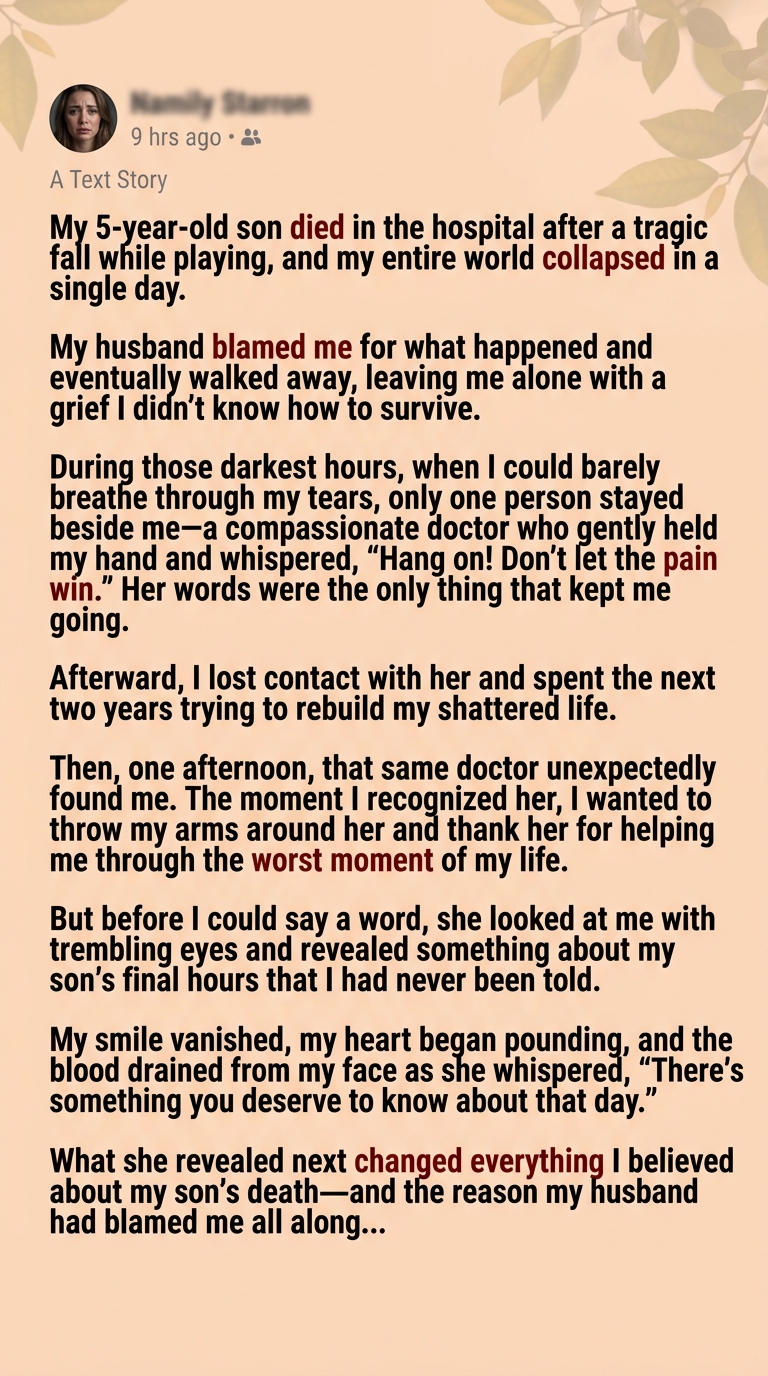
The day I lost my five-year-old son, Daniel, was the day my world stopped making sense.
That morning, he had run through the living room wearing his favorite superhero cape, laughing as he chased a toy car across the floor. He had begged me to watch him perform one last superhero landing before breakfast.
I remember laughing and telling him to be careful.
Those were the last ordinary moments I would ever have with my little boy.
Later that afternoon, while he was playing, Daniel suffered a terrible fall. Everything happened so quickly that I could barely understand what I was seeing. One moment, he was my energetic little boy. The next, I was rushing beside a hospital stretcher, begging the medical team to save him.
“Please,” I sobbed. “He’s only five. Please don’t let my baby die.”
The doctors worked desperately to save him. I stood outside the treatment room with shaking hands, praying to a God I had barely spoken to in years.
When the doctor finally approached me, I knew from her expression that my life was about to change forever.
She gently explained that Daniel had died despite their efforts.
I don’t remember falling to the floor, but I remember the sound of my own screaming. It was a sound I had never heard from myself before, and I hoped I would never hear it again.
My husband, Mark, stood nearby in stunned silence.
At first, I thought we would hold each other and somehow survive the unimaginable together. We had lost our child. Surely, that was the one pain that would bring us closer.
Instead, Mark turned toward me with tears in his eyes and anger in his voice.
“Why weren’t you watching him?”
I tried to explain what had happened, but he shook his head.
“You were supposed to keep him safe.”
His words cut deeper than anything else that day.
I was already drowning in guilt, replaying every moment and wondering whether I could have done something differently. Now the person who should have held me was telling me that I was responsible.
That evening, while I sat beside Daniel’s hospital bed, a doctor named Dr. Evelyn Carter came into the room.
She was in her early forties, with tired eyes and a gentle voice. She had been part of the team that treated my son.
She didn’t offer empty promises or tell me that everything happened for a reason. She simply pulled a chair beside me and sat quietly.
After a while, I whispered, “I don’t know how I’m supposed to go home without him.”
She reached for my hand.
“Hang on,” she said softly. “Don’t let the pain win. You don’t have to figure out how to live the rest of your life tonight. Just get through the next minute.”
For the first time since hearing the news, I felt that someone understood how impossible the world had become.
Dr. Carter stayed until a nurse needed her elsewhere. Before she left, she told me that I could ask the hospital for support whenever I needed it.
I never forgot her kindness.
But in the days that followed, my marriage fell apart. Mark became increasingly distant. Every conversation returned to the accident, and every argument ended with him suggesting that I should have prevented it.
Months later, he left.
He said he couldn’t look at me without remembering the worst day of our lives.
He didn’t seem to understand that I couldn’t escape that day either.
I was left alone in the house where Daniel had played, surrounded by toys I couldn’t bear to move. His little shoes remained beside the door. His drawings stayed on the refrigerator. Sometimes, I would hear a child’s laughter outside and turn around before remembering that my son would never run into my arms again.
For a long time, I barely functioned.
Eventually, with the help of a grief counselor and a few people who refused to let me disappear into my sorrow, I began to rebuild my life. I returned to work. I packed Daniel’s clothes into a memory box. I learned to visit the park without leaving in tears every time I saw a little boy his age.
The pain never vanished. I simply learned how to carry it.
Two years passed.
Then, one rainy afternoon, I stopped at a small café after work. As I waited for my coffee, I heard someone say my name.
I turned.
A woman stood a few steps away, holding an umbrella. Her hair was shorter, but I recognized her eyes immediately.
“Dr. Carter?”
She smiled, though the expression seemed strained.
“I’ve been hoping I’d run into you.”
For a moment, I couldn’t speak. Then I stood and hugged her.
“I never got to thank you,” I whispered. “You were there when I thought I couldn’t survive another minute. I have never forgotten what you said to me.”
She hugged me back, but when she pulled away, I noticed her hands were trembling.
“There is something I need to talk to you about,” she said.
My smile faded.
We sat at a table near the window. For several seconds, she stared at her untouched coffee.
“It’s about Daniel,” she finally said. “And what happened at the hospital that day.”
My heart began to pound.
“Was there something else? Did someone make a mistake?”
She took a slow breath.
“I want to be careful with my words. I don’t want to give you an answer that the medical records cannot support. But there is information from that day that you may never have been told.”
She explained that, while reviewing Daniel’s case during a later hospital quality review, she had noticed that some of the details surrounding his arrival and treatment had not been clearly communicated to our family.
The team had documented the severity of his injuries and the attempts to save him. But there had also been confusion about the timeline—when the fall was discovered, when emergency help was called, and what information had been available to the people caring for him.
I stared at her.
“What does that mean?”
“It means,” she answered carefully, “that I cannot tell you that a different action would have saved Daniel. I cannot promise you that anyone could have changed the outcome. But I also don’t believe you should spend the rest of your life accepting blame when the facts do not establish that you caused his death.”
Tears filled my eyes.
For two years, I had lived beneath my husband’s accusation. I had treated his words as if they were a medical finding, a final judgment delivered by someone who knew the truth.
But Mark had never been able to explain exactly what I had done wrong. He had only repeated that I should have prevented the accident.
Dr. Carter continued.
“Your husband spoke with members of the team that evening. He was overwhelmed and angry. He asked whether anything could have been done differently. Some of the answers he received were uncertain because the team was still reviewing the timeline. Later, I learned that he had interpreted that uncertainty as proof that you had failed Daniel.”
I felt as if the room had tilted.
“So he blamed me because he couldn’t bear not knowing why it happened?”
“I can’t know everything that was in his heart,” she said. “Grief can make people search desperately for someone or something to blame. But uncertainty is not proof of guilt.”
I covered my mouth and began to cry.
For two years, I had believed that my husband possessed some terrible truth about me. I thought he knew I had failed our son in a way I could never repair.
Now, for the first time, I could see another possibility.
Perhaps Mark had been unable to face the fact that terrible things could happen without a simple explanation. Perhaps blaming me had felt easier than living with a question neither of us could answer.
But Dr. Carter wasn’t finished.
“There is one more thing,” she said. “I wanted you to have the opportunity to request a formal review of the records and receive an explanation directly from the hospital. I shouldn’t make conclusions on your behalf. You deserve the documented facts, explained clearly.”
She gave me the contact information for the hospital’s patient relations office and offered to help me understand the medical terminology if I chose to pursue the review.
I thanked her through my tears.
That night, I sat at home with Daniel’s memory box beside me. For the first time in two years, I didn’t ask myself what I should have done differently.
Instead, I asked what I actually knew.
I requested the records and met with the appropriate hospital representatives. They walked me through the documented timeline, the treatment provided, and the limits of what could be determined afterward. Some questions remained unanswered. No one could honestly tell me that a different outcome had been possible.
But the review did not establish that I had caused Daniel’s death.
That distinction changed my life.
I had spent two years punishing myself for an accusation that had never been proven.
A few weeks later, Mark called. He had heard that I had contacted the hospital.
“What are you trying to prove?” he asked.
“I’m trying to understand what happened to our son,” I answered. “And I’m done accepting blame simply because you needed someone to blame.”
He was silent for a long time.
Finally, he admitted that he had spent those two years replaying the accident too. He had wondered whether he should have been there, whether he should have noticed something, whether he could have done more.
He had turned those questions into anger because anger was easier for him to express than helplessness.
“I’m sorry,” he whispered. “I should never have made you carry all of that.”
His apology did not erase the years of loneliness. It did not restore our marriage or bring Daniel back. I told him that I hoped he would seek help for his grief, but I couldn’t promise that we would become close again.
Forgiveness, I was learning, did not mean pretending the hurt had never happened.
Months later, I returned to the park where Daniel used to play. I brought a small photograph of him, the one in which he was grinning with a missing front tooth and his superhero cape hanging crookedly around his shoulders.
I sat on a bench and watched the children run across the grass.
For the first time, their laughter didn’t feel like an accusation against my sadness. It sounded like life continuing, even after mine had broken.
I thought about Dr. Carter’s words.
“Hang on. Don’t let the pain win.”
I finally understood what she had meant. She hadn’t promised that I would stop missing my son. She had reminded me that grief didn’t have to become a life sentence of self-punishment.
Daniel’s death would always be part of my story. So would the love I had for him, the people who helped me survive, and the courage it took to question the blame I had carried for so long.
I placed the photograph back in my bag and whispered, “I love you, my little superhero. I always will.”
Then I stood up and walked home.
I still didn’t have every answer about that terrible day. But I no longer needed to believe that I was guilty simply because I was heartbroken.
And that was the truth that finally allowed me to begin living again.