When my father was dying, he took my hand and made me promise him something.
“Look after your mother,” he whispered. “Make sure she never has to face life alone.”
I was the oldest of four children. My three younger brothers, Andrew, Brian, and Michael, stood around the hospital bed, but Dad looked directly at me.
“I will,” I promised.
I meant every word.
After Dad died, Mom struggled to manage the bills on her own. Her pension covered some expenses, but not enough to maintain the life she had known with him.
So I stepped in.
I paid her rent when she moved into a smaller apartment. I covered groceries, utilities, medical appointments, and unexpected repairs. Whenever she called because she couldn’t afford something, I found a way to help.
My brothers always had reasons they couldn’t contribute.
Andrew was raising children and paying off his house.
Brian was building his career and said he needed to focus on his future.
Michael was always between jobs or dealing with another financial problem.
I listened to their explanations and kept helping Mom.
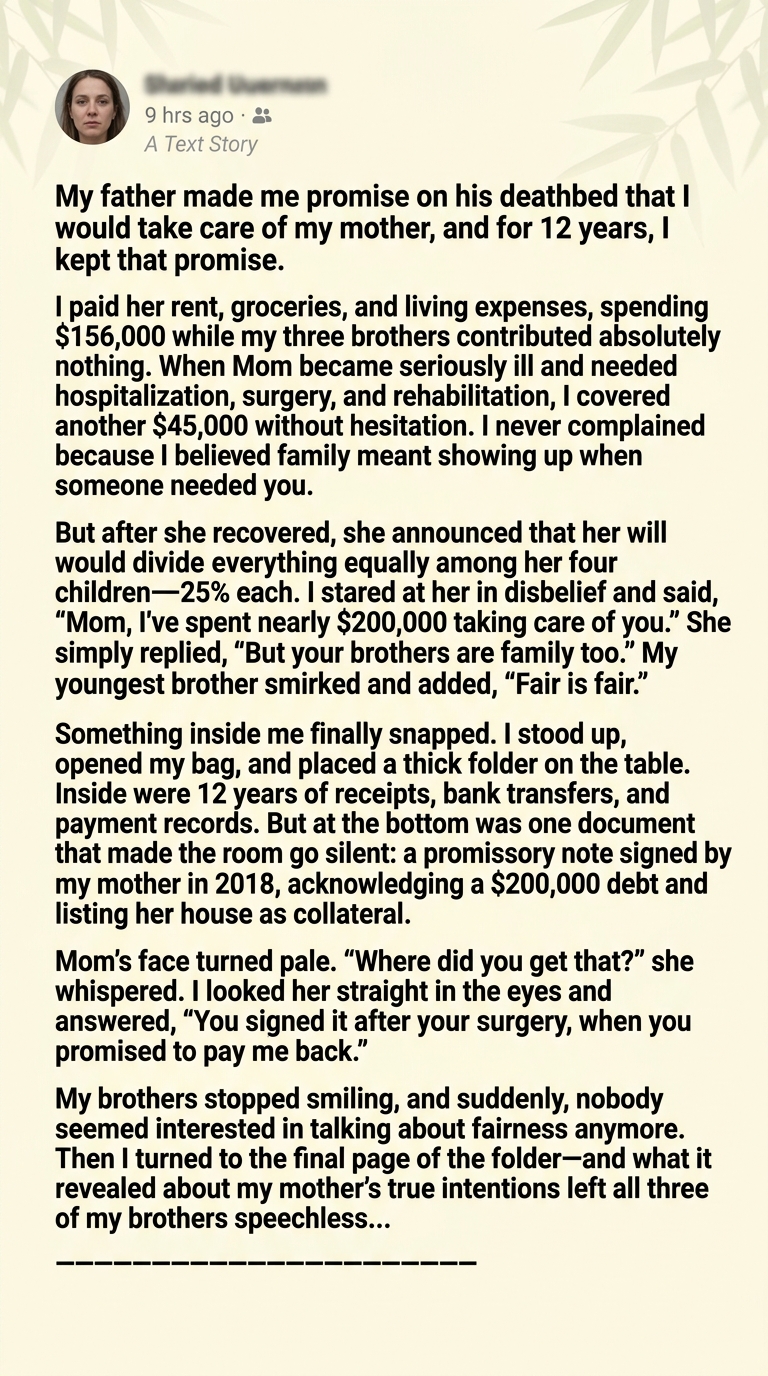
For twelve years, I paid approximately $156,000 toward her living expenses.
I never demanded repayment. I never asked my brothers to reimburse me. I simply believed that family meant showing up when someone needed you.
Then, when Mom became seriously ill, everything grew more difficult.
She needed hospitalization, surgery, and months of rehabilitation. I took time away from work to coordinate appointments, speak with doctors, and make sure she had what she needed when she returned home.
I covered another $45,000 in medical and related expenses.
By then, the total had reached approximately $201,000.
I was exhausted, but I didn’t regret helping her.
I thought I was doing what Dad had asked of me.
After Mom recovered, we gathered at her house for Sunday dinner.
She seemed stronger and happier than she had in months. My brothers were there, too, and for once, nobody had an excuse to leave early.
After dinner, Mom announced that she had updated her will.
“I’ve decided everything should be divided equally among my four children,” she said. “Twenty-five percent each.”
I stared at her.
“Everything?”
She nodded.
“Your father wanted us to treat you all equally.”
I could hardly believe what I was hearing.
“Mom, I’ve spent nearly $200,000 taking care of you over twelve years. I’ve covered your living expenses and paid your medical bills. My brothers haven’t contributed anything.”
Andrew shifted in his chair.
Brian looked down at his plate.
Michael smirked.
“Fair is fair,” he said. “We’re all her children.”
Something inside me finally broke.
I had never expected Mom to reward me with a fortune. I hadn’t helped her because I wanted a bigger inheritance.
But hearing my brothers talk about fairness after years of leaving everything to me felt unbearable.
I stood up, walked to my bag, and took out a thick folder.
“I thought we should discuss fairness,” I said.
Inside were twelve years of bank statements, receipts, payment confirmations, medical invoices, and records of the money I had given Mom.
I placed the folder on the table.
My brothers stopped talking.
Then I removed the final document.
It was a promissory note signed by Mom in 2018, acknowledging a debt of $200,000 and referring to her house as collateral.
Her face turned pale.
“Where did you get that?” she whispered.
“You signed it after your surgery,” I replied. “You told me you wanted to repay what I had spent caring for you. You asked me to prepare the paperwork, and you signed it.”
Mom stared at the document.
For several seconds, nobody spoke.
Then Andrew reached for the note.
“Does this mean she owes you the money before the inheritance is divided?”
“I don’t know exactly how it will be handled,” I said. “That’s why I’ve kept the records and had the documents reviewed.”
I wasn’t interested in making threats or pretending that a piece of paper automatically settled every legal question. The note needed to be examined alongside the payment records, the circumstances in which it was signed, and the applicable law.
But it was evidence that the money might not have been intended as a gift.
Mom looked at me with tears in her eyes.
“I thought you had forgotten about that agreement.”
“I didn’t forget,” I replied. “I simply never thought I would need to remind you.”
Then I turned to the final page of the folder.
It was a letter Mom had written and signed shortly after she recovered from surgery.
She had asked me to keep it with the financial records.
I had never opened it because she had told me it was meant for the day we needed to discuss her estate.
Now, with all three of my brothers watching, I unfolded it.
The letter began:
To my four children,
I know I have not always handled our family finances fairly. For many years, I relied on my oldest child to help me survive financially, and I allowed my other children to believe that this help came without sacrifice.
That was my mistake.
My brothers exchanged uncomfortable glances.
The letter continued.
When I became seriously ill, I was frightened. I did not know whether I would recover, and I worried about leaving debts behind. My oldest child paid expenses that I could not cover. I signed a promissory note because I wanted to acknowledge that money as a debt rather than pretend it had never happened.
I have since been tempted to divide my estate equally because I wanted to avoid conflict among my children. But equal shares do not automatically settle the debt I acknowledged.
I paused.
Mom had written one more paragraph.
Before my estate is distributed, I want the promissory note and the supporting records reviewed by an independent attorney. Any valid debt should be addressed according to the law and the terms of the agreement. The remaining estate can then be distributed according to my valid will.
The room fell silent.
My brothers had expected an argument about who loved Mom more.
Instead, they were looking at a document that raised a question none of them had considered: whether Mom’s estate had an obligation that needed to be addressed before anyone received an inheritance.
Michael’s smirk disappeared.
“So you’re going to take the house?” he asked.
“No,” I replied. “I’m going to find out what the agreement actually means.”
Mom began to cry.
“I didn’t want to hurt any of you.”
I sat down beside her.
“I don’t want to hurt you, either. But I can’t pretend those twelve years cost me nothing.”
For the first time, she acknowledged what I had sacrificed.
She apologized for allowing my brothers to assume I could handle everything indefinitely. She admitted that she had avoided difficult conversations because she feared they would divide the family.
That evening, we agreed not to make any immediate decisions about the will or the house.
Instead, Mom hired an independent estate attorney, and I obtained my own legal advice.
The attorneys reviewed the promissory note, the payment records, and the circumstances surrounding the agreement. They also examined whether the house had actually been pledged as valid collateral and whether any additional formalities were required.
The process took months.
Some expenses were clearly documented as loans. Others had been described in messages as gifts or ordinary family support. The lawyers explained that the difference mattered, and not every payment could automatically be treated as part of the debt.
The promissory note itself also required legal review before anyone could determine exactly what it entitled me to recover.
My brothers initially resisted the process.
They accused me of trying to take their inheritance.
I reminded them that I was not asking to be given money simply because I was the oldest or because I believed I had been the better child.
I was asking for a documented agreement to be treated seriously.
Eventually, Mom acknowledged the debt that the attorneys determined was supported by the agreement and records. The family reached a written settlement addressing the valid obligation, the status of the house, and the remaining estate.
The house was not automatically taken from Mom, and the inheritance was not decided by an argument around the dinner table. Everything was handled through the appropriate legal process.
Once the financial obligations were resolved, Mom’s remaining estate was distributed according to her valid will.
The result was not exactly what I had expected when I first opened the folder.
But it was fairer than pretending that twelve years of support had never happened.
My brothers also had to confront their own choices.
Andrew admitted that he had assumed I wanted to handle everything because I rarely complained.
Brian acknowledged that he had avoided contributing because he feared Mom would ask him for more than he could comfortably afford.
Michael apologized for his remark about fairness.
I accepted their apologies, but I didn’t promise that everything would return to normal immediately.
Trust is not restored simply because people finally admit what they have done.
Mom and I also had difficult conversations.
I told her that I loved her, but I needed to stop being the person who automatically solved every problem. If she needed help in the future, we would discuss what was reasonable and how the responsibility could be shared.
She agreed.
Over time, our relationship became less dependent on emergencies and unspoken expectations.
I continued visiting her, but I no longer paid every bill without question or sacrificed my own financial security to prevent someone else from feeling uncomfortable.
One afternoon, several months after the settlement, Mom and I sat together in her garden.
She took my hand.
“Your father asked you to take care of me,” she said. “But he never asked you to give up your own life.”
I looked at her.
“I know that now.”
She began to cry.
“I should have understood that sooner.”
I hugged her.
I hadn’t helped my mother because I expected an inheritance. I had helped her because I loved her, because I remembered Dad’s final request, and because I wanted her to feel safe.
But I finally understood that love did not require me to remain silent about every sacrifice.
Nor did fairness mean that everyone had to receive the same thing without considering the obligations that came first.
My brothers and I did not become perfectly close overnight. We still disagreed, and there were moments when the old resentment returned.
But we stopped pretending that my contributions had never happened.
And I stopped believing that being a good daughter meant carrying every burden alone.
Years earlier, I had promised my father that I would take care of Mom.
I had kept that promise.
What I finally learned was that keeping it did not mean surrendering my own future.
I had spent twelve years making sure my mother never stood alone. In the end, I learned that honoring my father’s promise also meant standing up for myself.