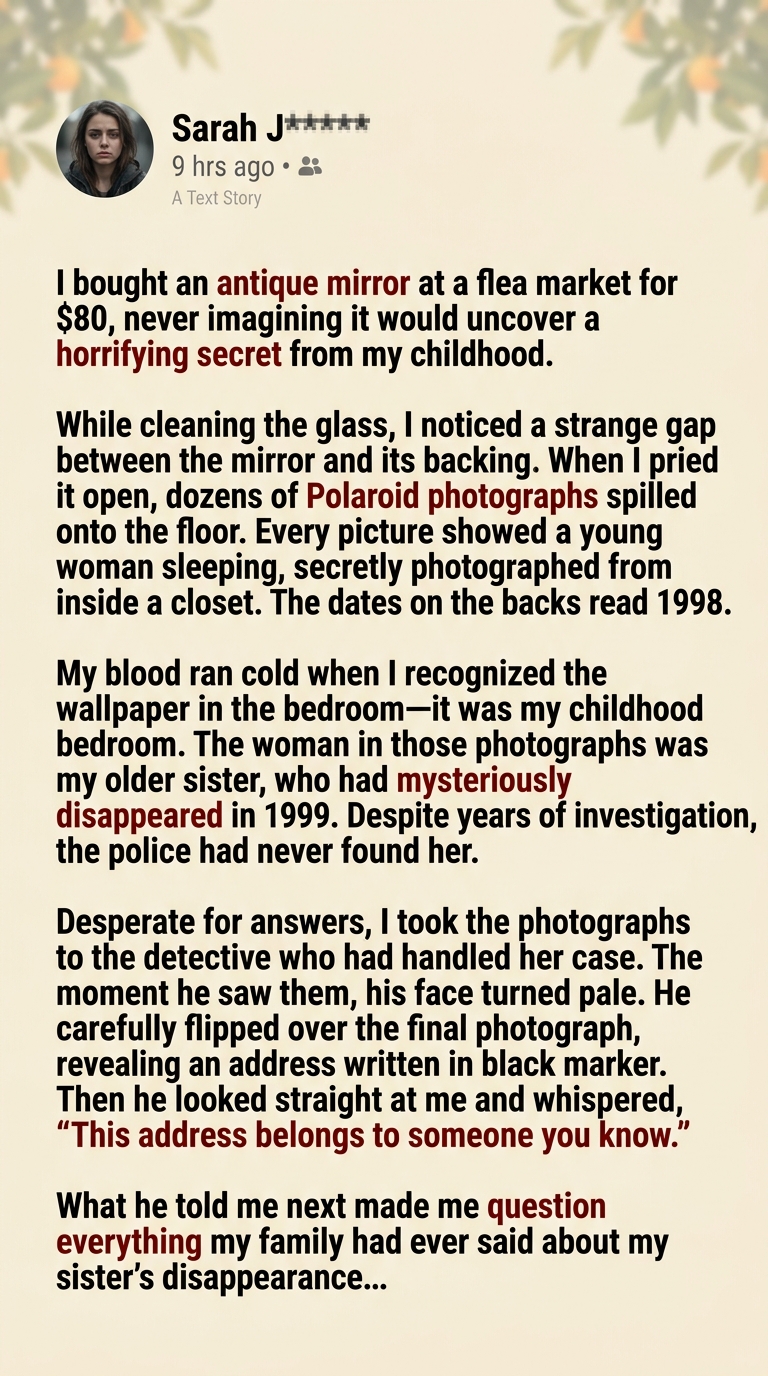
The mirror cost me eighty dollars.
It was an antique with a dark wooden frame, tarnished brass corners, and a thin crack near the bottom. I found it at a flea market on a rainy Saturday, tucked between a broken grandfather clock and a stack of dusty picture frames.
The seller told me it had come from an estate sale.
I bought it because something about it felt strangely familiar.
I had no idea that, within a week, I would be holding evidence connected to the disappearance of my older sister, Rachel.
Rachel vanished in 1999.
She was nineteen years old. I was twelve.
The last time I saw her, she stood in our kitchen wearing her favorite blue sweater, arguing playfully with our mother about whether she could borrow the family car. She laughed when I teased her about being late, then promised to bring me something from town.
She never came home.
At first, my parents believed she had stayed with a friend. By midnight, they were calling everyone she knew. By the following morning, the police were involved.
Search teams checked nearby roads and wooded areas. Detectives interviewed her friends, classmates, and relatives. Our family appeared on local television, pleading for information.
But nobody found Rachel.
As the years passed, the investigation grew quiet. My parents moved away from our childhood home, and our family learned to live around the hole her disappearance had left behind.
My father insisted that Rachel had probably run away. My mother refused to discuss the subject for more than a few minutes.
I never fully believed either of them.
Rachel had been planning her future. She wanted to study photography, travel, and eventually move to a city where nobody knew her as the daughter of our small-town family.
She had dreams, but she had never given me a reason to believe she would disappear without saying goodbye.
For twenty-seven years, I wondered what had happened to her.
Then I bought the mirror.
On Sunday afternoon, I laid it across a blanket and began cleaning the wooden frame. While wiping the back, I noticed a narrow gap between the glass and its backing.
The backing seemed newer than the rest of the frame.
Curious, I loosened the small metal fasteners and carefully lifted one corner.
Something shifted inside.
I tilted the mirror slightly, and a stack of photographs slid onto the blanket.
They were Polaroids, yellowed with age. Some had curled edges, and others were stuck together.
At first, I assumed they were ordinary family photographs left behind by the previous owner.
Then I looked at the top picture.
A young woman was asleep in a bed.
The photograph had been taken from an unusual angle, as though the person holding the camera had been concealed behind a partly opened closet door.
I picked up another.
The same woman. The same bed.
Then another.
My fingers began to shake.
In one picture, the woman had turned slightly toward the wall. In another, her face was visible.
I knew that face.
It was Rachel.
I dropped the photograph.
For a moment, I couldn’t hear the rain against the windows or the traffic outside. All I could hear was my own heartbeat.
I picked up the pictures one by one.
There were more than thirty.
Every image showed Rachel sleeping, apparently photographed without her knowledge.
The dates written on the backs ranged from October to December 1998.
I turned toward the window and tried to steady my breathing.
Then I noticed the wallpaper.
Pale green with tiny white flowers.
I remembered it perfectly. My parents had chosen it when Rachel and I shared a bedroom during our childhood. I could still picture the little wooden bookshelf beside the closet and the faint scratch near the window where I had once dragged a toy across the wall.
These photographs had been taken in our house.
I sat on the floor, surrounded by the images, and tried to understand what I was seeing.
Who had taken them?
Why had they been hidden inside a mirror?
And how had the mirror ended up at a flea market decades later?
I called the police.
The detective who had handled Rachel’s disappearance, Daniel Mercer, had retired years earlier. The department helped me contact him, and when I explained what I had found, he asked me to bring the photographs to him.
His voice changed when I mentioned the dates and the room.
“I want to see those pictures,” he said. “Please don’t alter them or write anything on them.”
The following morning, I met him in a small office near the police department.
Mercer was older than I remembered, with silver hair and tired eyes. He had kept copies of several records from Rachel’s case, and a cardboard archive box sat on the table beside him.
I placed the photographs in front of him.
He put on gloves and examined them carefully.
At first, he said nothing.
Then he reached the final photograph.
He turned it over.
An address had been written across the back in thick black marker.
Mercer’s face went pale.
I leaned forward.
“What is it?”
He read the address again, then looked directly at me.
“This address belongs to someone you know.”
My stomach tightened.
“Who?”
He slid the photograph toward me.
It was the address of the house where my father’s younger brother, Uncle Peter, had lived in 1998.
Peter had been a familiar figure in our childhood. He came to family dinners, brought us birthday presents, and sometimes helped my father with repairs around the house.
After Rachel disappeared, he had joined the search efforts. He had handed out flyers and comforted my mother. Whenever someone suggested that a relative might know more than they were saying, Peter was the first to insist that the family had nothing to hide.
I stared at the address.
“Are you saying he took these photographs?”
“No,” Mercer replied. “I’m saying the address gives us a lead. We need to establish who wrote it, who took the pictures, and how they relate to Rachel’s disappearance.”
He explained that the original investigation had focused on Rachel’s friends, a former boyfriend, and the possibility that she had left town voluntarily.
The photographs had never been part of the evidence.
If they were authentic, they could change the direction of the investigation.
I asked him whether Peter had ever been considered a suspect.
Mercer reviewed the records.
“Your uncle was interviewed as part of the original investigation,” he said. “There wasn’t enough evidence at the time to pursue him further.”
I felt a chill.
“Then why was this address hidden with the pictures?”
“I don’t know yet.”
He told me that he would contact the appropriate investigators and arrange for the photographs to be documented and examined. He also advised me not to confront Peter or discuss the evidence publicly while the investigation was being reviewed.
I promised I wouldn’t.
But when I left his office, I knew my understanding of my childhood had changed forever.
That evening, I called my mother.
She answered cheerfully, asking whether I had eaten dinner. I almost couldn’t bring myself to speak.
“Mom, I found something connected to Rachel.”
The silence on the other end lasted several seconds.
“What did you find?”
I explained about the mirror and the photographs. When I mentioned the address, her breathing became uneven.
“Peter’s address?” she whispered.
“Yes. Why?”
She began to cry.
I drove to her house the following morning.
She was waiting at the kitchen table with an old envelope. Inside were photocopies of two letters and a page from a calendar.
My mother explained that, in the weeks before Rachel disappeared, she had noticed Peter visiting our house more frequently. Sometimes he arrived when my parents were away. Whenever she asked Rachel about it, Rachel became quiet and changed the subject.
My mother had once confronted my father.
He told her not to interfere.
He said Peter was helping Rachel with a personal problem and that discussing it would only make things worse.
A few days after Rachel disappeared, Peter told the family that he had seen her near the bus station.
My father repeated the story to the police.
But my mother had never seen proof that Rachel had boarded a bus.
“Why didn’t you tell Detective Mercer?” I asked.
My mother pressed a tissue to her face.
“Your father said I would destroy the family if I accused Peter without evidence. He insisted Rachel had chosen to leave. I wanted to believe him because the alternative frightened me.”
I looked at the letters.
They showed that Peter had contacted Rachel repeatedly in the weeks before she vanished. They did not prove what had happened, but their dates overlapped with the photographs.
The calendar page contained a handwritten note about a meeting at Peter’s house.
It was dated just days before Rachel disappeared.
I photographed the documents and contacted Mercer before making any copies for myself.
He arranged to receive the originals through the appropriate investigative process.
For the first time in decades, the case had several connected pieces of evidence that investigators could examine together.
A few weeks later, Mercer called me.
The department had located an old storage unit registered under Peter’s name. It contained boxes of family belongings, letters, and personal items that had belonged to Rachel.
Among them was her blue sweater.
The one she had worn in our kitchen the day I last saw her.
I sat down when Mercer told me.
“Does this mean you know what happened to her?”
“Not yet,” he said. “It means we have evidence that needs to be investigated. I don’t want to give you an answer before we can support it.”
I appreciated his honesty, even though it left me with the same ache I had carried for most of my life.
The investigators interviewed Peter again.
He initially denied knowing anything about the photographs. When shown the address on the final picture, he claimed someone else must have written it.
Later, he admitted that he had taken the pictures but insisted they were part of a family matter. He denied harming Rachel and said he knew nothing about her disappearance.
His explanation raised more questions than it answered.
Why had he photographed his niece while she slept?
Why had he hidden the photographs?
And why were Rachel’s belongings in his storage unit?
Investigators continued examining the evidence and looking for independent confirmation of the timeline. They also revisited old witness statements that had received little attention during the original search.
A former neighbor remembered seeing Peter’s car near our house late at night on several occasions. Another recalled hearing a heated argument shortly before Rachel disappeared.
Those memories did not prove who was responsible for Rachel’s disappearance, but they provided new leads.
As the investigation continued, I struggled with a painful realization: my family had spent decades protecting a version of events that nobody had ever fully established.
My father had died years earlier. I would never be able to ask him why he had discouraged my mother from speaking up or why he had repeated Peter’s story without proof.
I could be angry about that.
I could grieve the years we had lost.
But I couldn’t make him answer.
Instead, I focused on what could still be done.
I provided investigators with everything I remembered about Rachel’s final months. I described the house, the room, the closet, and the people who had visited us. I also told them about the little things I had dismissed as a child because I hadn’t understood their significance.
The investigation did not produce an immediate resolution. There were still gaps in the evidence, conflicting recollections, and questions that required careful examination.
But the case was no longer resting entirely on the assumption that Rachel had run away.
Someone had finally found a reason to look again.
Months later, I returned to the flea market where I had purchased the mirror.
I had no intention of buying anything. I simply wanted to stand in the place where the mystery had begun.
The seller’s stall was empty that day.
Rain tapped against the metal roof, just as it had when I first saw the mirror.
I thought about Rachel as she had been before her disappearance: the girl who sang terribly while making breakfast, borrowed my sweaters without asking, and promised to teach me to drive when I grew older.
For years, I had been afraid that remembering her would mean remembering only the day she vanished.
Now I was trying to remember the rest of her life, too.
I kept a photograph of us together from before 1999. It showed us sitting on the front steps, squinting into the afternoon sunlight.
I placed it in a new frame at home.
The antique mirror remained in a box until investigators finished examining it.
I had bought it for eighty dollars, believing it was simply an old object with an interesting frame.
Instead, it had revealed a secret that had remained hidden for nearly three decades.
It had not told me where Rachel was.
It had not proved who was responsible for her disappearance.
And it had not repaired the years of silence that had separated our family from the truth.
But it had done something I once thought impossible.
It had given us a reason to ask the questions we should have asked long ago.
I used to think closure meant discovering exactly what had happened and finally putting the past away.
Now I understood that truth sometimes arrives in pieces. Sometimes it comes with more questions than answers. And sometimes the first step toward finding someone is admitting that the story you’ve been told may be incomplete.
I still hoped that one day I would learn what happened to my sister.
Until then, I would not let the silence speak for her.
The mirror had been hidden away for years.
But the truth, however painful, deserved to be brought into the light.